Glance
pp. 46-47 · Read in the full issue
One Backward Glance
Some Memories From Eighteen Months in Wartime N. Caledonia
By D. Weaver
REMOTE and unreal beneath the plane’s wing stretched away New Caledonia’s rugged and ravine-slashed mountains. Within minutes, the mud-coloured, C-54 army transport plane was thundering over the coastline and from two miles up I took my last glimpse of the French colony which I had known for 18 months On the green sea atolls and sand cays, like jewels, sparkled and gleamed in the new sunlight of early day.
Stripped for war-time service, the grim austerity of the interior of the plane was neither comfortable nor comforting. The metal seats lining each side of the fuselage did not encourage relaxation, and the “Mae West” life-jacket and bulky parachute felt hot and cumbersome as they hung like dead-weights from my shoulders and bulged around my rear and my middle.
The baritone quartet of the engines crowded each individual in the plane into solitary confinement with his thoughts; speech was impossible. I eased my shoulders into the webbing back-rest, pulled the coarse, Army blanket around me as protection against the chill of the high altitude, and was conscious of a peculiar emptiness in my stomach and a tightness in my throat. sunning slowly away in a mist behind the plane, New Caledonia was disappearing out of sight. The chances were that I would never travel in that direction a fra in T found mvself rememberins New again, i louna mysen rememoenng rview mam IWAS remembering Anse Vata ...
Four miles out from Noumea there was a half-moon bay. a bay as I remember always amythest in colour, where long lazy combers hissed across the sun-drenched sands in a pattern of lacv foam There dawns came on crimson feet "out of the east and danced across the sky. There was nothing to compare with the dawn over Anse Vata
Bay, unless perhaps it was the moonlight, with all the mysterious silver witchery of beams stealing through the palm fronds. i It was easy to remember, too, the days we had ventured out in small sail boats to run down to Magenta Bay, idling in and out of coral coves, exploring the hundred islands that dot the miles of bay, and, from the sunburnt decks, watching the shadows play at hide and seek across the majestic slopes of Mont Dor. And at last reluctantly setting our homeward course by Ameedee Lighthouse.
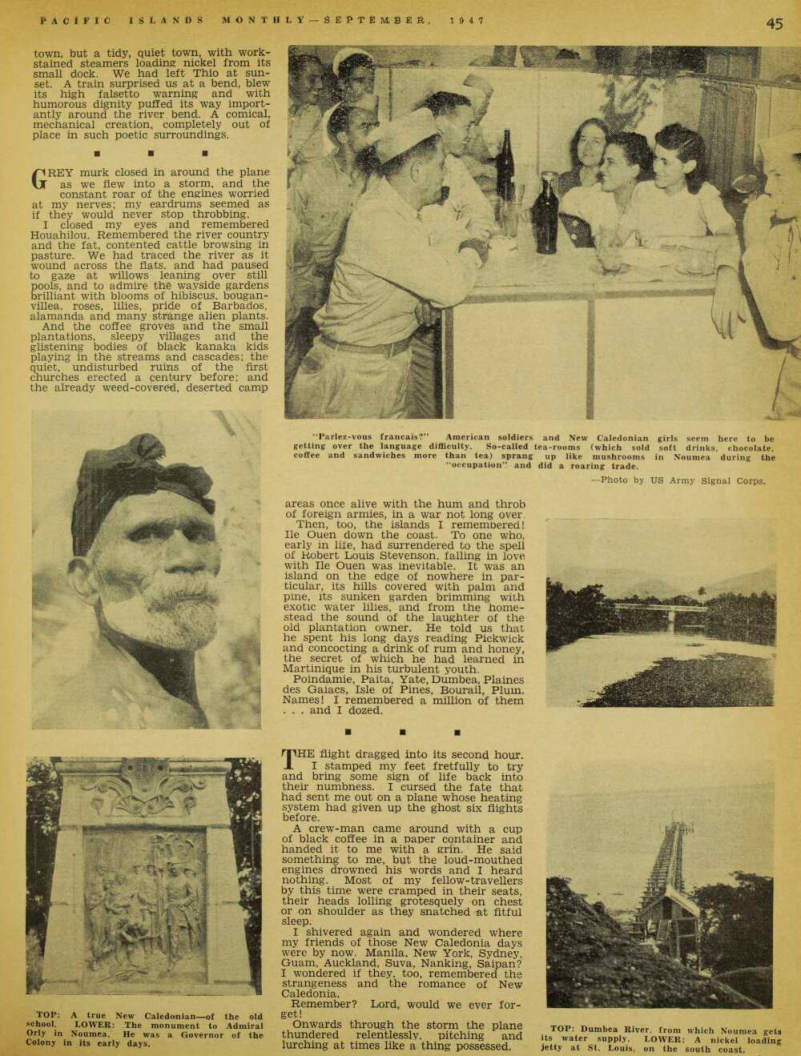
T WAS remembering Noumea—gaudy, J. colourful and indescribably filthy, busy with the comings and goings of a polyglot collection of races: Kanaka housewives in their inelegant “Mother Hubbards”: Javanese and Tonkinese women with their delicate grace and dark eyes, more picturesquely dressed in richly embroidered jackets and black satin pantaloons; French women, displaying, even in this backwater, that quality of chicness that has ever been the envy of women of other nationalities: Oriental men squatting on the curbs by the cobbled roadsides, forever smoking and throwing dice; small forsaken parks with their statues to forgotten heroes—soldiers from the French garrison, in pillbox hats or berets, like characters out of a novel by P. C. Wren. Weatherbeaten and dilapidated shops turning drab faces to even drabber streets where gutters ran with sUme refuse; the so i emn old-world dignity of the Cathedral, the fascinating little cafes that served delicious dishes; the innumerable bars.
But the grimness of Noumea was forgotten when I remembered Coconut Square in December. December is the time of the year when the Flamboyant trees frock themselves in scarlet gowns.
The hundreds of trees crowded in the centre of this small city, intertwine their branches in an almost unbroken canopy and when the branches are heavy witn
bloom the bright, rich colour seeps into the cobbled pathways, touching the polluted water slushing in the gutters with magic until they, too, run crimson as they reflect back the glow of a million petals, Gulls flying overhead catch the faint rose tinge in the downy feathers of their underwings, and children in the streets catch the colour in their smiling faces.
Coconut Square in December! j REMEMBER the crossroad crucifix, the m i SS i o n of San Luis, the tiny village churches, the little country towns with the village schoolhouse and the war memorials, the tall green spires of pines, the painted mountains and the fresh, clear streams.
I recalled the beauty of the mountain passes on the road to Thio. where you zigged and zagged for hours into the re mote peaks and looked back to see a world of mountain crest and untouched forest, or sun-filled valleys, Someone would point to a slash down a cliff face and say: “That is the richest nickel deposit in the world,” and you be lieve them in the same good-hearted way you believed that the guillotine on He Nou was the very one which had lopped off the unhappy head of Marie Antoinette.
From the centre of the mountain ranges I had looked clear across the island and had seen the ocean to the east and the ocean to the west. On these mountain roads the bush pushed to the edge of the ragged track, and here and there a yellow battalion of tall grasses advanced down a hillside and the jungle scrub retreated before it back to its rocky domain in the deep ravines, Above the rattle and the banging of the vehicle that whirled you madly down the tortuous mountain road, you caught the music of moving water, and then over a cliff side, a glimpse of a tiny streamlet bouncing on its way, moving irresistably to the sea.
And so to Thio we had gone, a small
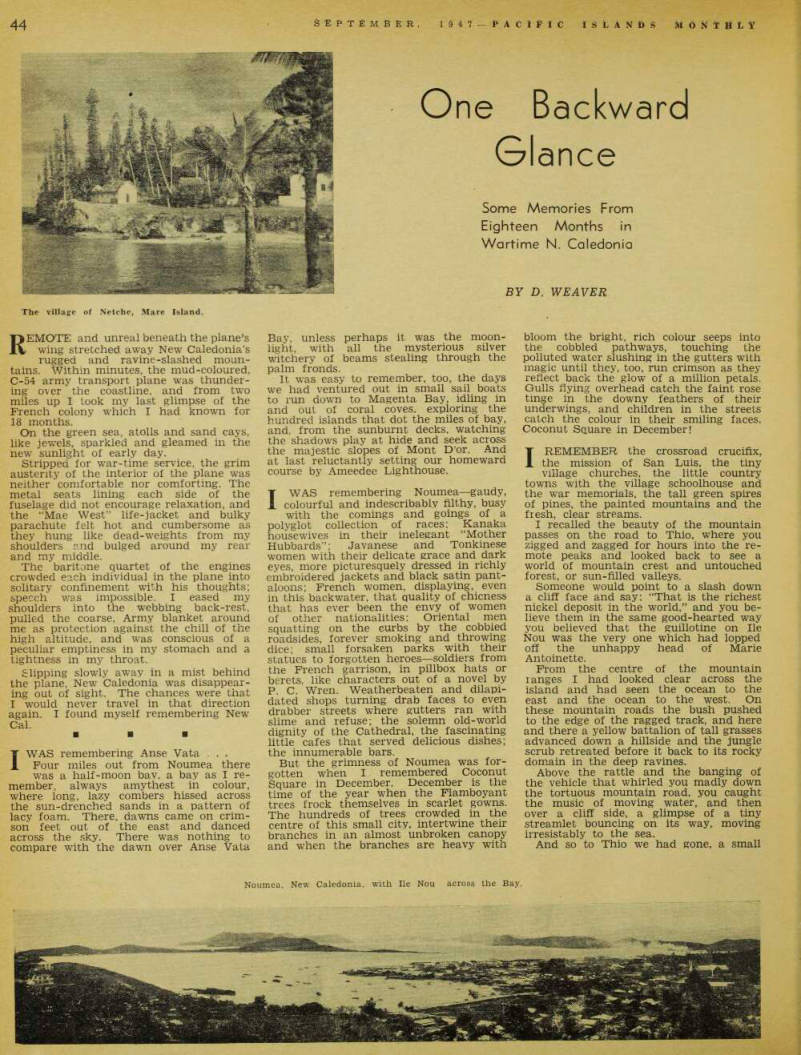
The village of Netche, Mare Island.
Noumea, New Caledonia, with He Nou across the Bay.
town, but a tidy, quiet town, with work stained steamers loading nickel from its small dock. We had left Thio at sun set. A train surprised us at a bend, blew its high falsetto warning and with humorous dignity puffed its way import antly around the river bend. A comical, mechanical creation, completely out of place in such poetic surroundings, ■ ■ ■ GREY murk closed in around the plane as we flew into a storm, and the constant roar of the engines worried at my nerves; my eardrums seemed as if they would never stop throbbing.
I closed my eyes and remembered Houahilou. Remembered the river country and the fat, contented cattle browsing in pasture. We had traced the river as it wound across the flats, and had paused to gaze at willows leaning over still pools, and to admire the wayside gardens brilliant with blooms of hibiscus, bougan villea, roses, lilies, pride of Barbados, alamanda and many strange alien plants.
And the coffee groves and the small plantations, sleepy villages and the glistening bodies of black kanaka kids playing in the streams and cascades: the quiet, undisturbed ruins of the first churches erected a century before: and the already weed-covered, deserted camp
areas once alive with the hum and throb of foreign armies, in a war not long over Then, too, the islands I remembered!
He Ouen down the coast. To one who, early in life, had surrendered to the spell of Robert Louis Stevenson, falling in love with He Ouen was inevitable. It was an island on the edge of nowhere in par ticular, its hills covered with palm and pine, its sunken garden brimming with exotic water lilies, and from the home stead the sound of the laughter of the old plantation owner. He told us that he spent his long days reading Pickwick and concocting a drink of rum and honey, the secret of which he had learned in Martinique in his turbulent youth.
Poindamie, Paita, Yate, Dumbea, Plaines des Gaiacs, Isle of Pines, Bourail, Plum.
Names! I remembered a million of them . . . and I dozed. ■ ■ ■ THE flight dragged into its second hour.
I stamped my feet fretfully to try and bring some sign of life back into their numbness. I cursed the fate that had sent me out on a plane whose heating system had given up the ghost six flights before.
A crew-man came around with a cup of black coffee in a paper container and handed it to me with a grin. He said something to me, but the loud-mouthed engines drowned his words and I heard nothing. Most of my fellow-travellers by this time were cramped in their seats, their heads lolling grotesquely on chest or on shoulder as they snatched at fitful sleep.
I shivered again and wondered where my friends of those New Caledonia days were by now. Manila. New York, Sydney, Guam, Auckland, Suva, Nanking, Saipan?
I wondered if they, too, remembered the strangeness and the romance of New Caledonia.
Remember? Lord, would we ever for get!
Onwards through the storm the plane thundered relentlessly, pitching and lurching at times like a thing possessed.
TOP: A true New Caledonian—of the old school. LOWER: The monument to Admiral Orly in Noumea. He was a Governor of the Colony in its early days.
"Parlez-vous francais?” American soldiers and New Caledonian girls seem here to be getting over the language difficulty. So-called tea-rooms (which sold soft drinks, chocolate, coffee and sandwiches more than tea) sprang up like mushrooms in Noumea during the “occupation” and did a roaring trade.
Photo by US Army Signal Corps.
TOP: Dumbea River, from which Noumea gets its water supply. LOWER: A nickel loading jetty at St. Louis, on the south coast.