Why "Indonesians"?
p. 32 · Read in the full issue
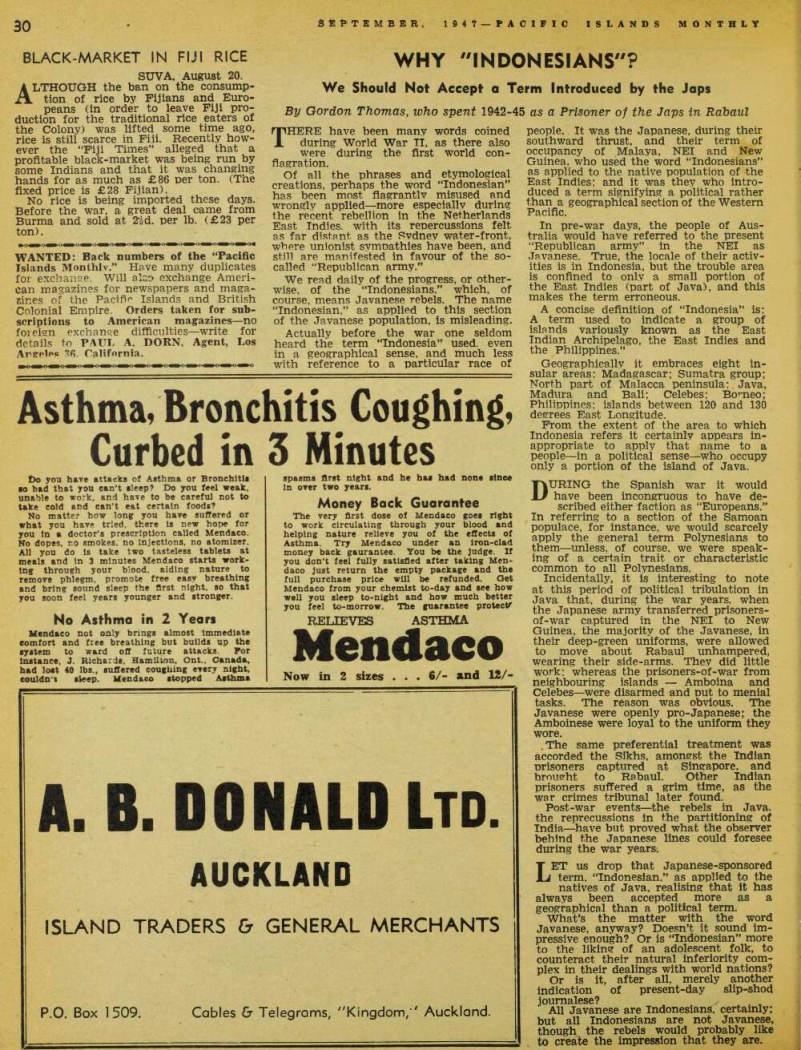
We Should Not Accept o Term Introduced by the Japs
By Gordon Thomas, who spent 1942-45 as a Prisoner of the Japs in Rabaul
THERE have been many words coined during World War 11, as there also were during the first world con flagration.
Of all the phrases and etymological creations, perhaps the word “Indonesian” has been most flagrantly misused and wrongly applied—more especially during the recent rebellion in the Netherlands East Indies, with its repercussions felt as far distent as the Svdnev water-front, where unionist symnathles have been, and still are manifested in favour of the so called “Republican army.”
We read daily of the progress, or other wise. of the “Indonesians.” which, of course, means Javanese rebels. The name “Indonesian,” as applied to this section of the Javanese population, is misleading.
Actually before the war one seldom heard the term “Indonesia” used, even in a geographical sense, and much less with reference to a particular race of
people. It was the Japanese, during their southward thrust, and their term of occupancy of Malaya, NEI and New Guinea, who used the word “Indonesians” as applied to the native population of the East Indies; and it was they who intro duced a term signifying a political rather than a geographical section of the Western Pacific.
In pre-war days, the people of Aus tralia would have referred to the present “Republican army” in the NEI as Javanese. True, the locale of their activ ities is in Indonesia, but the trouble area is confined to only a small portion of the East Indies (part of Java), and this makes the term erroneous.
A concise definition of “Indonesia” is: A term used to indicate a group of islands variously known as the East Indian Archipelago, the East Indies and the Philippines.”
Geographically it embraces eight in sular areas: Madagascar; Sumatra group; North part of Malacca peninsula; Java, Madura and Bali; Celebes; Borneo; Philippines: islands between 120 and 130 degrees East Longitude.
From the extent of the area to which Indonesia refers it certainly appears in appropriate to apply that name to a people—in a political sense—who occupy only a portion of the island of Java.
DURING the Spanish war it would have been incongruous to have de scribed either faction as “Europeans.”
In referring to a section of the Samoan populace, for instance, we would scarcely apply the general term Polynesians to them—unless, of course, we were speak ing of a certain trait or characteristic common to all Polynesians.
Incidentally, it is interesting to note at this period of political tribulation in Java that, during the war years, when the Japanese army transferred prisoners of-war captured in the NEI to New Guinea, the majority of the Javanese, in their deep-green uniforms, were allowed to move about Rabaul unhampered, wearing their side-arms. They did little work; whereas the prisoners-of-war from neighbouring islands Amboina and Celebes—were disarmed and put to menial tasks. The reason was obvious. The Javanese were openly pro-Japanese; the Amboinese were loyal to the uniform they wore. .The same preferential treatment was accorded the Sikhs, amongst the Indian prisoners captured at Singapore, and brought to Rabaul. Other Indian prisoners suffered a grim time, as the war crimes tribunal later found.
Post-war events—the rebels in Java, the reprecussions in the partitioning of India —have but proved what the observer behind the Japanese lines could foresee during the war years.
LET us drop that Japanese-sponsored term, “Indonesian.” as applied to the natives of Java, realising that it has always been accepted more as a geographical than a political term.
What's the matter with the word Javanese, anyway? Doesn’t it sound im pressive enough? Or is “Indonesian” more to the liking of an adolescent folk, to counteract their natural inferiority com plex in their dealings with world nations?
Or is it, after all, merely another indication of present-day slip-shod journalese?
All Javanese are Indonesians, certainly; but all Indonesians are not Javanese, though the rebels would probably like to create the impression that they are.