No Tropic Nymph, No Pearls, No Oil!
p. 62 · Read in the full issue
"Gippsland" Founders Off Papuan Coast
From a Special Correspondent
WHEN the steamer “Gippsland” founded off Yule Island, in the Papuan Gulf, on July 24, she took with her to the ocean bed a considerable amount of bally-hoo, as well as the finances and inspiration of the brothers Mcßae, of Melbourne, who had hoped to turn the venture into solid cash.
The “Sunday Telegraph” started the nonsense when the ship left Sydney.
According to the “Telegraph,” this brave band of happy adventurers was out to solve the legend of a beautiful white woman who had been sighted among the natives on some remote and wild island in Eastern Papua.
The discovery of this female was not the party’s only objective, however. They were also going to peer around the bottom of the Coral Sea for pearlshell and treasure trove, peep into the abandoned shafts of the Misima goldfields, and comb the ocean bed for anything else that fortune might bestow.
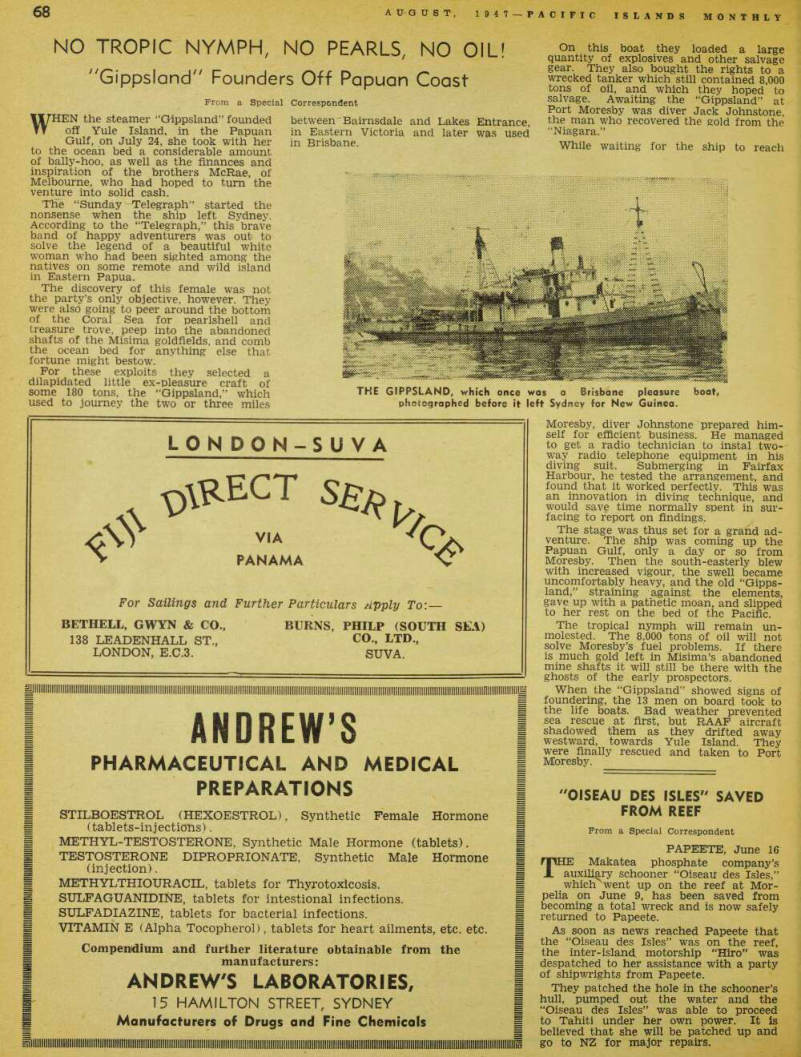
For these exploits they selected a dilapidated little ex-pleasure craft of some 180 tons, the “Gippsland,” which used to journey the two or three miles
between and Lakes Entrance, in Eastern Victoria and later was used in Brisbane.
On this boat they loaded a large quantity of explosives and other salvage gear. They also bought the rights to a wrecked tanker which still contained 8,000 tons of oil, and which they hoped to salvage. Awaiting the “Gippsland” at Port Moresby was diver Jack Johnstone, the man who recovered the gold from the “Niagara.”
While waiting for the ship to reach
Moresby, diver Johnstone prepared him self for efficient business. He managed to get a radio technician to instal two way radio telephone equipment in his diving suit. Submerging in Fairfax Harbour, he tested the arrangement, and found that it worked perfectly. This was an innovation in diving technique, and would save time normally spent in sur facing to report on findings.
The stage was thus set for a grand ad venture. The ship was coming up the Papuan Gulf, only a day or so from Moresby. Then the south-easterly blew with increased vigour, the swell became uncomfortably heavy, and the old “Gipps land,” straining against the elements, gave up with a pathetic moan, and slipped to her rest on the bed of the Pacific.
The tropical nymph will remain un molested. The 8,000 tons of oil will not solve Moresby’s fuel problems. If there is much gold left in Misima’s abandoned mine shafts it will still be there with the ghosts of the early prospectors.
When the “Gippsland” showed signs of foundering, the 13 men on board took to the life boats. Bad weather prevented sea rescue at first, but RAAF aircraft shadowed them as they drifted away westward, towards Yule Island. They were finally rescued and taken to Port Moresby.
THE GIPPSLAND, which once was a Brisbane pleasure boat, photographed before it left Sydney for New Guinea.