In New Guinea
p. 55 · Read in the full issue
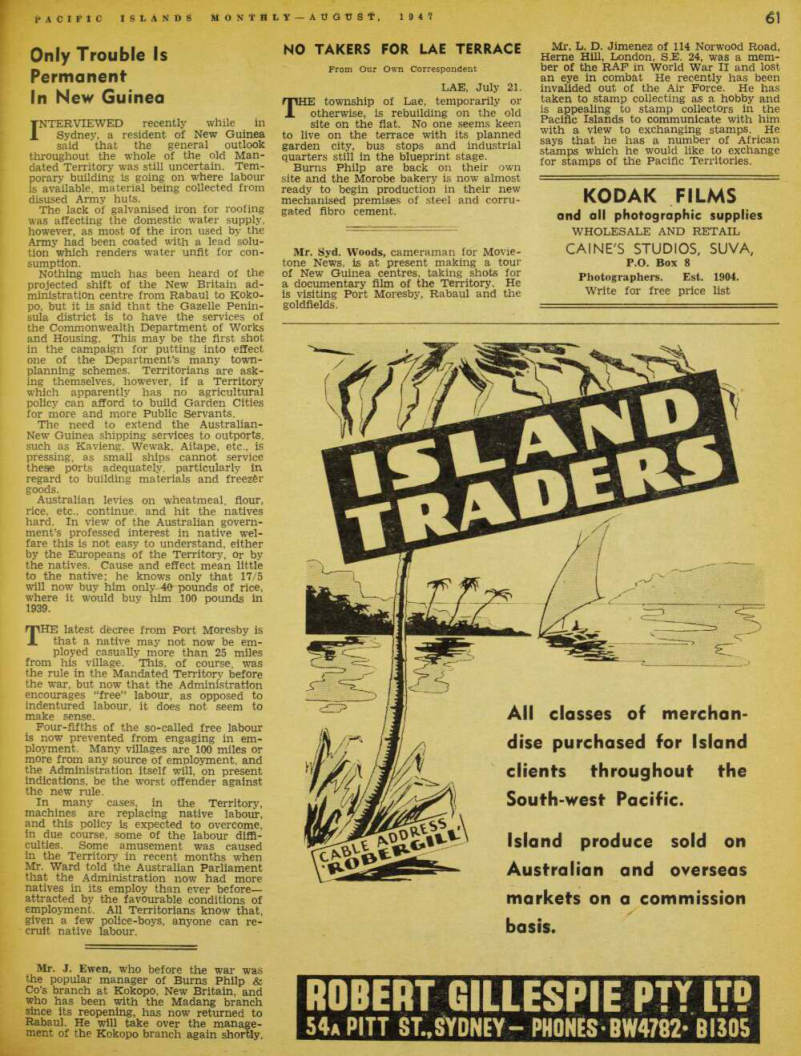
Only Trouble Is Permanent In New Guinea
INTERVIEWED recently while in Sydney, a resident of New Guinea said that the general outlook throughout the whole of the old Man dated Territory was still uncertain. Tem porary building is going on where labour is available, material being collected from disused Army huts.
The lack of galvanised iron for roofing was affecting the domestic water supply, however, as most of the iron used by the Army had been coated with a lead solu tion which renders water unfit for con sumption.
Nothing much has been heard of the projected shift of the New Britain ad ministration centre from Rabaul to Koko po, but it is said that the Gazelle Penin sula district is to have the services of the Commonwealth Department of Works and Housing. This may be the first shot in the campaign for putting into effect one of the Department’s many town planning schemes. Territorians are ask ing themselves, however, if a Territory which apparently has no agricultural policy can afford to build Garden Cities for more and more Public Servants.
The need to extend the Australian- New Guinea shipping services to outports, such as Kavieng. Wewak, Aitape, etc., is pressing, as small ships cannot service these ports adequately, particularly in regard to building materials and freezfer goods.
Australian levies on wheatmeal, flour, rice, etc., continue, and hit the natives hard. In view of the Australian govern ment’s professed interest in native wel fare this is not easy to understand, either by the Europeans of the Territory, or by the natives. Cause and effect mean little to the native; he knows only that 17/5 will now buy him only 40 pounds of rice, where it would buy him 100 pounds in 1939.
THE latest decree from Port Moresby is that a native may not now be em ployed casually more than 25 miles from his village. This, of course, was the rule in the Mandated Territory before the war, but now that the Administration encourages “free” labour, as opposed to indentured labour, it does not seem to make sense.
Four-fifths of the so-called free labour is now prevented from engaging in em ployment. Many villages are 100 miles or more from any source of employment, and the Administration itself will, on present indications, be the worst offender against the new rule.
In many cases, in the Territory, machines are replacing native labour, and this policy is expected to overcome, in due course, some of the labour diffi culties. Some amusement was caused in the Territory in recent months when Mr. Ward told the Australian Parliament that the Administration now had more natives in its employ than ever before attracted by the favourable conditions of employment. All Territorians know that, given a few police-boys, anyone can re cruit native labour.
Mr. J. Ewen, who before the war was the popular manager of Burns Philp & Co’s branch at Kokopo, New Britain, and who has been with the Madang branch since its reopening, has now returned to Rabaul. He will take over the manage ment of the Kokopo branch again shortly.