Analysis of Fiji Copra
pp. 17-18 · Read in the full issue
Fiji Copra Value Doubled In 18 Months
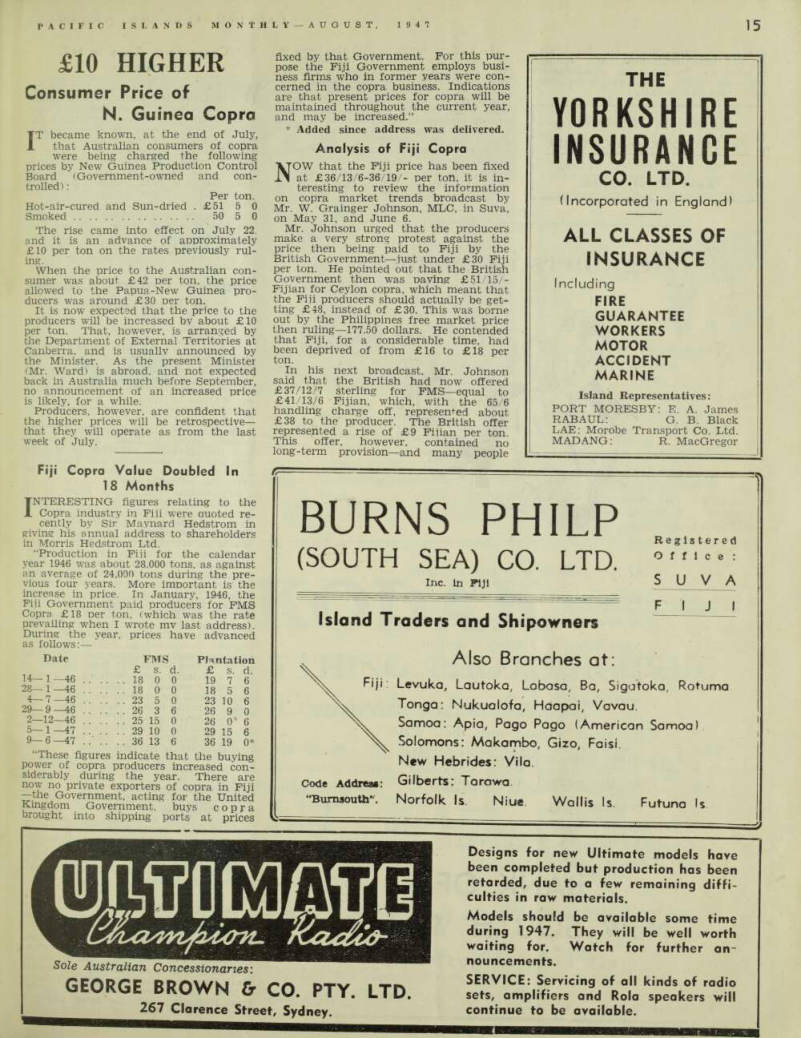
INTERESTING figures relating to the Copra industry in Fiji were Quoted re cently by Sir Maynard Hedstrom in giving his annual address to shareholders in Morris Hedstrom Ltd. ‘‘Production in Fiji for the calendar year 1946 was about 28,000 tons, as against an average of 24,000 tons during the pre vious four years. More important is the increase in price. In January, 1946, the Fiji Government paid producers for FMS Copra £lB per ton, (which was the rate prevailing when I wrote mv last address).
During the year, prices have advanced as follows:
“These figures indicate that the buying power of copra producers increased con siderably during the year. There are now no private exporters of copra in Fiji —the Government, acting for the United Kingdom Government, buys copra brought into shipping ports at prices
fixed by that Government. For this pur pose the Fiji Government employs busi ness firms who in former years were con cerned in the copra business. Indications are that present prices for copra will be maintained throughout the current year, and may be increased.” * Added since address was delivered.
Analysis of Fiji Copra
NOW that the Fiji price has been fixed at £36/13/6-36/19/- per ton, it is in teresting to review the information on copra market trends broadcast by Mr. W. Grainger Johnson, MLC, in Suva, on May 31, and June 6.
Mr. Johnson urged that the producers make a very strong protest against the price then being paid to Fiji by the British Government—just under £3O Fiji per ton. He pointed out that the British Government then was paving £5l/15/- Fijian for Ceylon copra, which meant that the Fiji producers should actually be get ting £4B, instead of £3O. This was borne out by the Philippines free market price then ruling—l77.so dollars. He contended that Fiji, for a considerable time, had been deprived of from £l6 to £lB per ton.
In his next broadcast. Mr. Johnson said that the British had now offered £37/12/7 sterling for FMS—equal to £4l/13/6 Fijian, which, with the 65 6 handling charge off, represented about £3B to the producer. The British offer represented a rise of £9 Fiiian per ton.
This offer, however, contained no long-term provision—and many people
Date FMS Plantation £ s. d. £ s. d. 14—1—46 18 0 0 19 7 6 28- 18 0 0 18 5 6 4— 23 5 0 23 10 6 29- 26 3 6 26 9 0 2—12—46 25 15 0 26 O' 6 5— 29 10 0 29 15 6 9—6—47 ... 36 13 6 36 19 0*
wanted a fixed price for five years, or at least until 1950. Mr. Johnson pointed out that, pending a satisfactory adjustment, Fiji copra was being withheld from the market.
The attempt made to gain the views of the copra producers was useless, how ever—too many small producers, and no time in which to consult them. The British offer was accepted, without any provision for a guaranteed price until 1950 : while the Fiii Board increased the margin between the price paid by Britain, and the price paid to the producers by 35/- (from 3/5/ to £5 per ton).. The producers, therefore, got a net rise of slightly over £7 per ton.
There is now a substantial profit in copra production, and the present prices seem to be assured for at least two years.