French Oceania
p. 12 · Read in the full issue
Kon-Tiki Raft Reaches French Oceania Drift Voyage Proves Possibility of Peruvian Influence on Early Polynesia
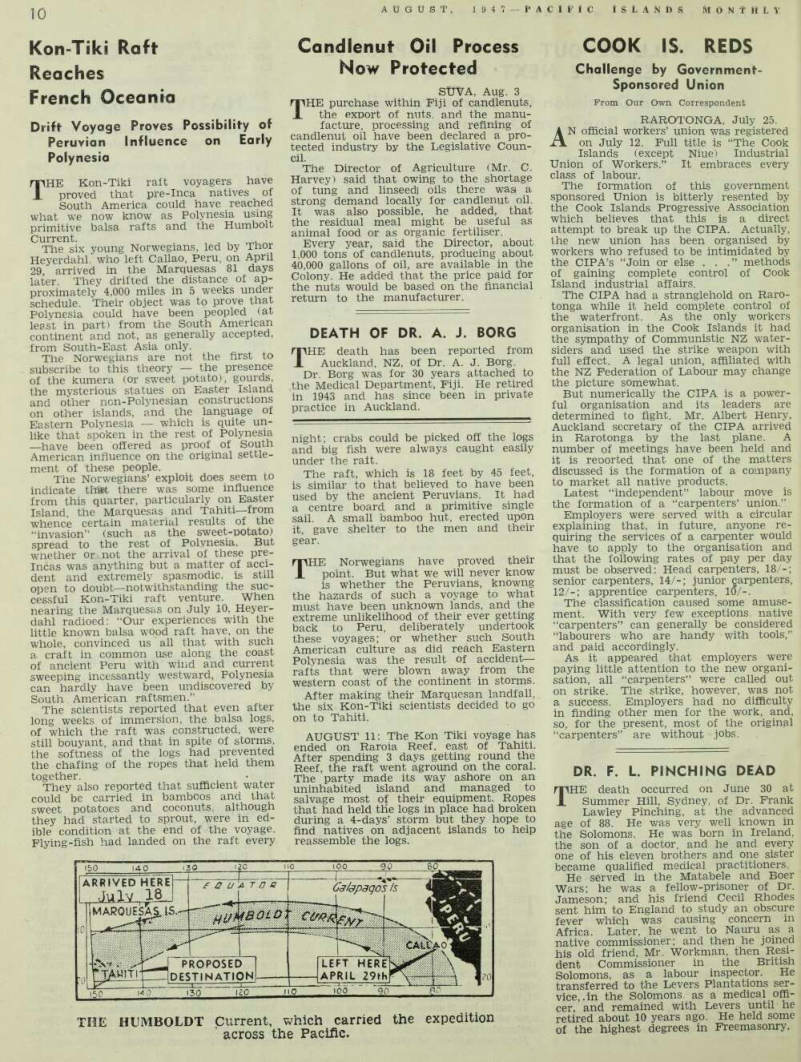
THE Kon-Tiki raft voyagers have proved that pre-Inca natives of South America could have reached what we now know as Polynesia using primitive balsa rafts and the Humbolt Current. , The six young Norwegians, led by Thor Heyerdahl, who left Callao, Peru, on April 29, arrived in the Marquesas 81 days later. They drifted the distance of ap proximately 4,000 miles in 5 weeks under schedule. Their object was to prove that Polynesia could have been peopled (at least in part) from the South American continent and not, as generally accepted, from South-East Asia only.
The Norwegians are not the first to subscribe to this theory the presence of the kumera (or sweet potato), gourds, the mysterious statues on Easter Island and other non-Polynesian constructions on other islands, and the language of Eastern Polynesia which is quite un like that spoken in the rest of Polynesia —have been offered as proof of South American influence on the original settle ment of these people.
The Norwegians’ exploit does seem to indicate that there was some influence from this quarter, particularly on Easter Island, the Marquesas and Tahiti—from whence certain material results of the “invasion” (such as the sweet-potato) spread to the rest of Polynesia. But whether or not the arrival of these pre- Incas was anything but a matter of acci dent and extremely spasmodic, is still open to doubt— notwithstanding the suc cessful Kon-Tiki raft venture. When nearing the Marquesas on July 10, Heyer dahl radioed: “Our experiences with the little known balsa wood raft have, on the whole, convinced us all that with such a craft in common use along the coast of ancient Peru with wind and current sweeping incessantly westward, Polynesia can hardly have been undiscovered by South American raftsmen.”
The scientists reported that even after long weeks of immersion, the balsa logs, of which the raft was constructed, were still bouyant, and that in spite of storms, the softness of the logs had prevented the chafing of the ropes that held them together.
They also reported that sufficient water could be carried in bamboos and that sweet potatoes and coconuts, although they had started to sprout, were in ed ible condition at the end of the voyage.
Flying-fish had landed on the raft every
night; crabs could be picked off the logs and big fish were always caught easily under the raft.
The raft, which is 18 feet by 45 feet, is similar to that believed to have been used bv the ancient Peruvians. It had a centre board and a primitive single sail. A small bamboo hut, erected upon it, gave shelter to the men and their gear.
THE Norwegians have proved their point. But what we will never know is whether the Peruvians, knowng the hazards of such a voyage to what must have been unknown lands, and the extreme unlikelihood of their ever getting back to Peru, deliberately undertook these voyages; or whether such South American culture as did reach Eastern Polynesia was the result of accident— rafts that were blown away from the western coast of the continent in storms.
After making their Marquesan landfall, the six Kon-Tiki scientists decided to go on to Tahiti.
AUGUST 11: The Kon Tiki voyage has ended on Raroia Reef, east of Tahiti.
After spending 3 days getting round the Reef, the raft went aground on the coral.
The party made its way ashore on an uninhabited island and managed to salvage most of their equipment. Ropes that had held the logs in place had broken during a 4-days’ storm but they hope to find natives on adjacent islands to help reassemble the logs.
THE HUMBOLDT Current, which carried the expedition across the Pacific.