Exhausted World
pp. 7-8 · Read in the full issue
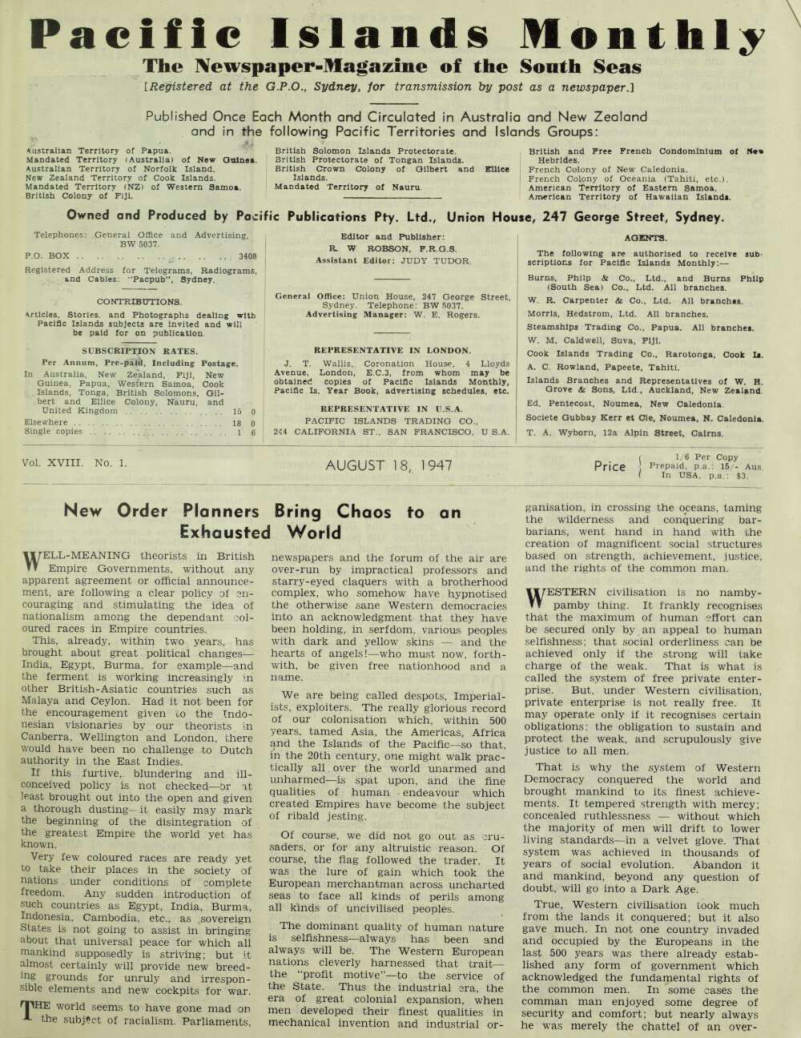
New Order Planners Bring Chaos to an Exhausted World
W ELL-MEANING theorists in British Empire Governments, without any apparent agreement or official announce ment, are following a clear policy of en couraging and stimulating the idea of nationalism among the dependant col oured races in Empire countries.
This, already, within two years, has brought about great political changes— India, Egypt, Burma, for example—and the ferment is working increasingly in other British-Asiatic countries such as Malaya and Ceylon. Had it not been for the encouragement given to the Indo nesian visionaries by our theorists in Canberra, Wellington and London, there would have been no challenge to Dutch authority in the East Indies.
If this furtive,, blundering and ill conceived policy is not checked—or at least brought out into the open and given a thorough dusting—it easily may mark the beginning of the disintegration of the greatest Empire the world yet has known.
Very few coloured races are ready yet to take their places in the society of nations under conditions of complete freedom. Any sudden introduction of such countries as Egypt, India, Burma, Indonesia, Cambodia, etc., as sovereign States is not going to assist in bringing about that universal peace for which all mankind supposedly is striving; but it almost certainly will provide new breed ing grounds for unruly and irrespon sible elements and new cockpits for war. fPHE world seems to have gone mad on the subject of racialism. Parliaments,
newspapers and the forum of the air are over-run by impractical professors and starry-eyed claquers with a brotherhood complex, who somehow have hypnotised the otherwise sane Western democracies into an acknowledgment that they have been holding, in serfdom, various peoples with dark and yellow skins and the hearts of angels!—who must now, forth with, be given free nationhood and a name.
We are being called despots, Imperial ists, exploiters. The really glorious record of our colonisation which, within 500 years, tamed Asia, the Americas, Africa and the Islands of the Pacific —so that, in the 20th century, one might walk prac tically all. over the world unarmed and unharmed—is spat upon, and the fine qualities of human endeavour which created Empires have become the subject of ribald jesting.
Of course, we did not go out as cru saders, or for any altruistic reason. Of course, the flag followed the trader. It was the lure of gain which took the European merchantman across uncharted seas to face all kinds of perils among all kinds of uncivilised peoples.
The dominant quality of human nature is selfishness—always has been and always will be. The Western European nations cleverly harnessed that trait— the “profit motive”—to the service of the State. Thus the industrial era, the era of great colonial expansion, when men developed their finest qualities in mechanical invention and industrial or
ganisation, in crossing the oceans, taming the wilderness and conquering bar barians, went hand in hand with the creation of magnificent social structures based on strength, achievement, justice, and the rights of the common man.
WESTERN civilisation is no namby pamby thing. It frankly recognises that the maximum of human effort can be secured only by an appeal to human selfishness: that social orderliness can be achieved only if the strong will take charge of the weak. That is what is called the system of free private enter prise. But, under Western civilisation, private enterprise is not really free. It may operate only if it recognises certain obligations: the obligation to sustain and protect the weak, and scrupulously give justice to all men.
That is why the system of Western Democracy conquered the world and brought mankind to its finest achieve ments. It tempered strength with mercy; concealed ruthlessness without which the majority of men will drift to lower living standards —in a velvet glove. That system was achieved in thousands of years of social evolution. Abandon it and mankind, beyond any question of doubt, will go into a Dark Age.
True, Western civilisation took much from the lands it conquered; but it also gave much. In not one country invaded and occupied by the Europeans in the last 500 years was there already estab lished any form of government which acknowledged the fundamental rights of the common men. In some cases the comman man enjoyed some degree of security and comfort; but nearly always he w’as merely the chattel of an over
lord, something to be trodden upon, en slaved and sacrificed, at will.
The European nations,- and especially the British, brought to every race over whieh they unfurled their flags some form of orderliness, security and common justice. The peoples were given medical service, education and religion; to their lands were introduced roads and ports, public services and wealth-producing in dustries.
SUCCEEDING generations of these subject races, having imbibed from their masters a little education, a little technical knowledge, some idea of or derly government, and a little Marxism, are now howling for national freedom; and the bumblefooted New Planners of London, Paris and Canberra are listen ing to their howls and hastening to greet them as brothers.
Suppose that all these peoples were given full freedom and national respon sibility. Let us see what would happen.
India is dividing itself between Hindu stan and Pakistan; and, as the British move out, an orgy of throat-cutting begins. Whoever imagined that those mutually antagonistic races could live together in peace? Not only will there‘be fearful fighting within India: but bad internal conditions inevitably will make the country a breeding ground lor greater wars and one of her richest markets is lost to Britain.
Burma is to get “independence.” The country is torn between savagely con tending parties who already have com menced murdering each other’s leaders.
In Malaya, now crying for independ ence, there are three mutually antagon istic communities —Malays, Indians and Chinese; they will be at each other’s throats as soon as British rule is with drawn. It is the same in Ceylon, with its Tamil and Christian minorities, and in North Borneo and Sarawak where the dominant Chinese and Malays are a min ority in the population.
We have the example of Indonesia right under our eyes, British and Ameri can New Planners abandoned the Dutch after the Dutch had given to us, in 1942- 45, every ounce of their strength; and the Jap-inspired Indonesians temporarily took possession. Under Dutch rule, these people were orderly, economically and politically secure. Since 1945, under In donesian rule, the country has been a shambles, a place of disorder, famine, murder and panic. All the Chinese and most of the Indonesians now pray daily for the complete restoration of Dutch rule; but our “Great Western Demo cracies” are moving to hamstring the Dutch.
We might range over all Asia and much of Africa and multiply these ex amples endlessly. A little thought is enough to show that we dare not, for the sake of human orderliness and world peace, intoxicate these unprepared people with too copious draughts of the heady wine of freedom.
Nationhood and complete freedom they must have eventually; but the prepara tion of a people for self-government is a slow process. Any attempt by the New Planners to hurry the process will lead only to disaster, political and economic;
and already we see political - and econ omic disasters without number develop ing. within our sight.
HERE in the Pacific we have little to worry us, compared with the terri fying picture presented by the events of the bigger world.
There is a problem in Samoa —which is being discussed by th.e Samoans with typical Polynesian courtesy, and for which a solution undoubtedly will be found.
There is a sharp racial problem in Fiji —but so long as the British are left alone, to combine strength and wisdom with plain justice, Fiji will remain happy —the problem there actually is incapable of solution, anyway—except by Dr. Mal thus.
There is a kind of problem in Papua- New Guinea —but it is only the mischiev ous creation of the amateur New Plan ners of Canberra and eventually will dis appear—along with Mr. Ward.
MANY observers looking out on the frantic world of August, 1947 exactly 33 years after the Kaiser drove the nations into World War I—are in despair. They cannot understand that this dreadful confusion in economics and in politics, which seems to be carrying us rapidly into World War 111. is merely the impact of muddled thinking on post-war problems of an attempt by Marxist planners to do by State instrumentalities what can be achieved only by individual ism.
It is no time for despair. If they are not caught bending the British peoples presently will throw the poor little well meaning demagogues out of Whitehall.
Canberra and Wellington, and drag their crippled governmental machines out of the morass and will build again—build something that again will be the admira tion of the world. A great and glorious Britain surely will arise out of this mess —if in the meantime we are not caught bending by the assembling hordes of Tar tary.
ONE hundred years ago Macaulay had occasion to thus rebuke the poet Southey (who, like present-day dreamers, was all for Socialism and the brother hood of man): “It is not the intermeddling of Mr.
Southey’s idol, the omniscient and omnipotent State, but by the produce and energy of the people that England has hitherto been carried forward in civilisa tion; and it is to the same prudence and the same energy that we now look with comfort and good hope.
“Our rulers will best promote the im provement of the nation by strictly con fining themselves to their own legitimate duties, by leaving capital to find its most lucrative course, commodities their fair price, industry and intelligence their natural reward, idleness and folly their natural punishment; by maintaining peace, by defending property, by diminish ing the price of law, and by observing strict economy in every department of State. Let the Government do this; the people will assuredly do the rest.”
At St. Peter’s Church, Lautoka, Fiji, 6>n Julv 12 Miss Jean Brandon Snowsill. only daughter of Mrs. J. M. Snowsill. was married to Mr. Stanley Buckle, of Sydney.