Na Ronga Of Yadua
p. 50 · Read in the full issue
A Story of Old Fiji
yADUA, a small island off the Bua coast of Vanua Levu, may become the setting for the filming of Stackpoole’s “Blue Lagoon.” Colour shots of the island are now being examined in London with a view to making a decision.
Tlie following story by Mrs. H. B. P. Parham tells of a native heroine of the island who lived about 150 years ago; her story was compiled from notes left by a William Lockerby, then a young man, and one of the first Europeans to visit the island.
IT was in the year 1808, while he was indebted to Tui Bua for hospitality, that William Lockerby made the acquaintance of the chief’s very attractive niece. She was not only amiable, clever and courteous, but she was also of a splendid physique, and quite an athletic young person, into the bargain. Her cap able ways and the stories of her prowess made a great impression on the young man, who was evidently an admirer of the gentler sex, despite the fact—or perhaps on account of it—that he had left a wife at home, of whom he was very fond. He showed his appreciation of the dark beauty's many excellent points by writing for us a charming history of her valorous deeds.
He had certainly better reason for his admiring words than is often the case, for the old chief’s niece was an heroic figure, who, moreover, had the courage to set national customs and established laws at defiance. She was, unconsciously, a leader in the fight for women’s rights versus man’s decrees!
This amiable and enterprising young woman bore the musical name of Na Ronga, and was only 20, when Lockerby made her acquaintance.
But though still so young in years, she had already been married and widowed. Her husband was a man of some note on a nearby island, which from its description must have been Yadua, off the Bua coast of Vanua Levu.
Unfortunately she had been mar ried only a brief space of time, when her husband went to war, and was slain early in the fray. In accord ance with the prevalent custom, Na Ronga, together with the departed chief’s older wives, was set apart to be strangled. The others made no objections. It was the custom, and who were they to rebel? The chief would need them on his long journey to the spirit land.
But Na Ronga was of a different mind. She thought she could honour her chiefly husband better by living and so, carefully watching her chance, she escaped the awful fate by running—or more precisely, by swimming—away from the island.
She determined to seek the great Rawaiki. Tui Bua, and her uncle, and throw herself under his protection.
It was far to the mainland from the island, but she was strong, and undaunted by danger, so she set out on her daring journey.
It was not because she feared death that she did this, for, as she
assured Lockerby, she considered it a great honour to die with one’s hus band; but she felt it was a still greater honour to live to be the mother of his child. It was for this that she had braved the dangers of the “waitui’ and the sharp jteeth of hungry sharks; for this she had struggled on, hour after hour, till at last she had reached the coast of Bua, weary and exhausted.
Her uncle, though greatly sur prised and perturbed, nevertheless afforded her the shelter she craved.
He understood and, leaving her to herself and Nature, he met the mes sengers from the island with his usual dignity, heard their tale, and then sent them away, unsatisfied.
Yet he was troubled. He loved his niece, but he was also a staunch upholder of all the old native customs.
While the Chief was weighing these conflicting emotions, away in the forest Na Ronga had the joy she had craved—the joy of becoming the mother of her husband’s offspring. A fine infant lay on the grass beside her, and Na Ronga felt well repaid for what she had suffered. She had justified, she felt, her rebellion against the cruel law of the priest.
Her aunt secretly agreed with her, and took care that both Na Ronga and her new-born babe should have all the attention necessary. No cus tomary observance was omitted, as was befitting the chiefly rank of the tiny stranger. The Chief’s wife showed where her wishes lay and, having a great influence over Rawaiki, she easily persuaded him to grant Na Ronga his continued protection.
It was against his chiefly con science. The priest, too, warned him of the danger that might follow such a lapse from established custom— and, indeed, it was a very unpopular act to shelter a woman under these circumstances, even when the reason was good. However, Raiwaiki was a ruler, and what he said became law.
He decided that Na Ronga should live to care for her child, and smiled on it and her. She was given a home and treated as befitted her rank.
IT was at this time that Lockerby comes into the story. He was in difficulties and begged help from the old Tui, and was kindly received by all, including Na Ronga. Her ambiability was its own reward. It was thus she earned her place in the annals of Vanua Levu, for gratitude guided Lockerby’s pen, and left the story of this young woman’s courage,
endurance and vigour as a legacy to succeeding generations.
It is possible that Uraga Point got its native name from this girl, whose brave deeds have been recounted.
Although the spelling differs, there is a great similarity of sound in the native dialect. This headland is the one nearest Yadua, the island where Na Ronga spent her short married life. Such an unusually long swim, of course, made an impression on the impressionable natives, and such a story might well be commemorated by giving her name to some point in the locality.
Lockerby had good reason to re joice that this amiable girl’s life was spared, for she actually saved his life on one occasion. It appears that by some means the grass house next to the one in which he was sleeping had been set alight. Lockerby was quite unconscious of his danger, until Na Ronga shouted to him to wake and escape. Thanks to her timely warn ing he was. just in time to get away.
Na Ronga’s swim was rightly as counted as worthy of being remem bered, but one must, in fairness to the native women, remark that it was not so much the distance covered, as the circumstances under which she made her successful swim, that make it remarkable.
The distance was probably not much more than eight miles, and native belles often swim as far with out making any fuss about it, but Na Ronga was far advanced in pregnancy and had to escape observation. Thus handicapped, the swim was indeed a wonderful one, and in those classical days probably was made the theme of numberless stanzas in some grand old epic tale.
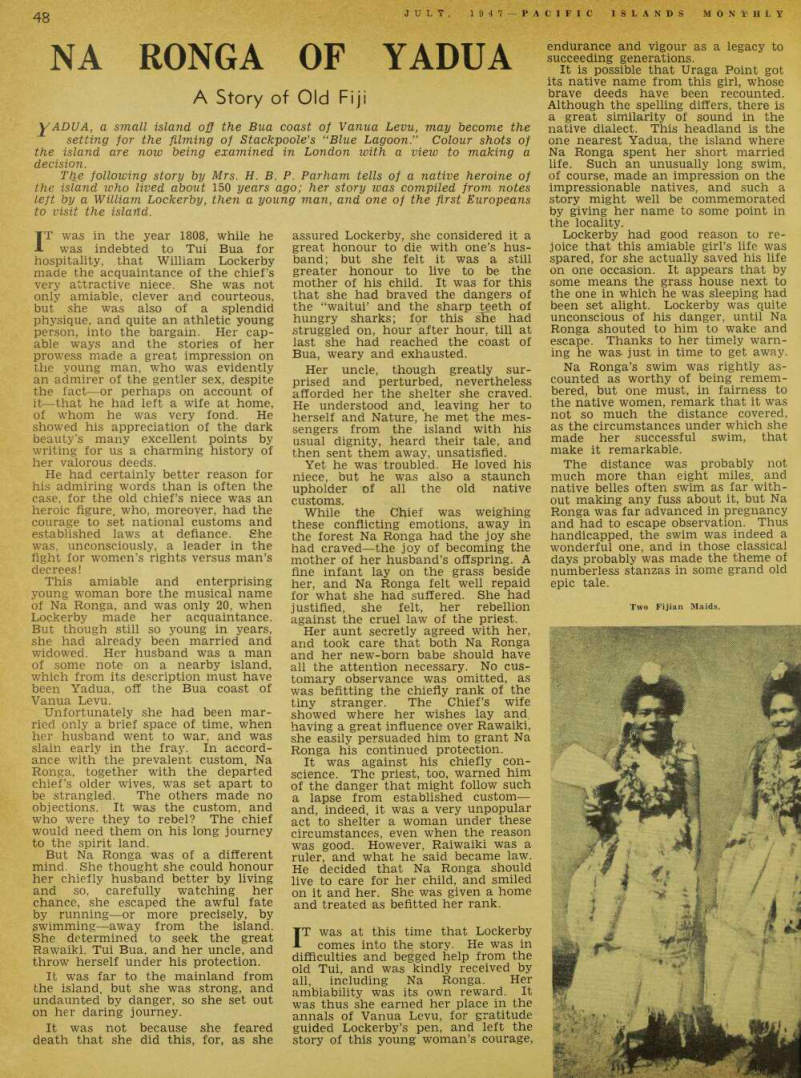
Two Fijian Maids.