The Longest Way Round
pp. 46-47 · Read in the full issue
If this_ journey, which is described here by "Ansel," wcs not the sweetest way home/' at least it did not lack variety
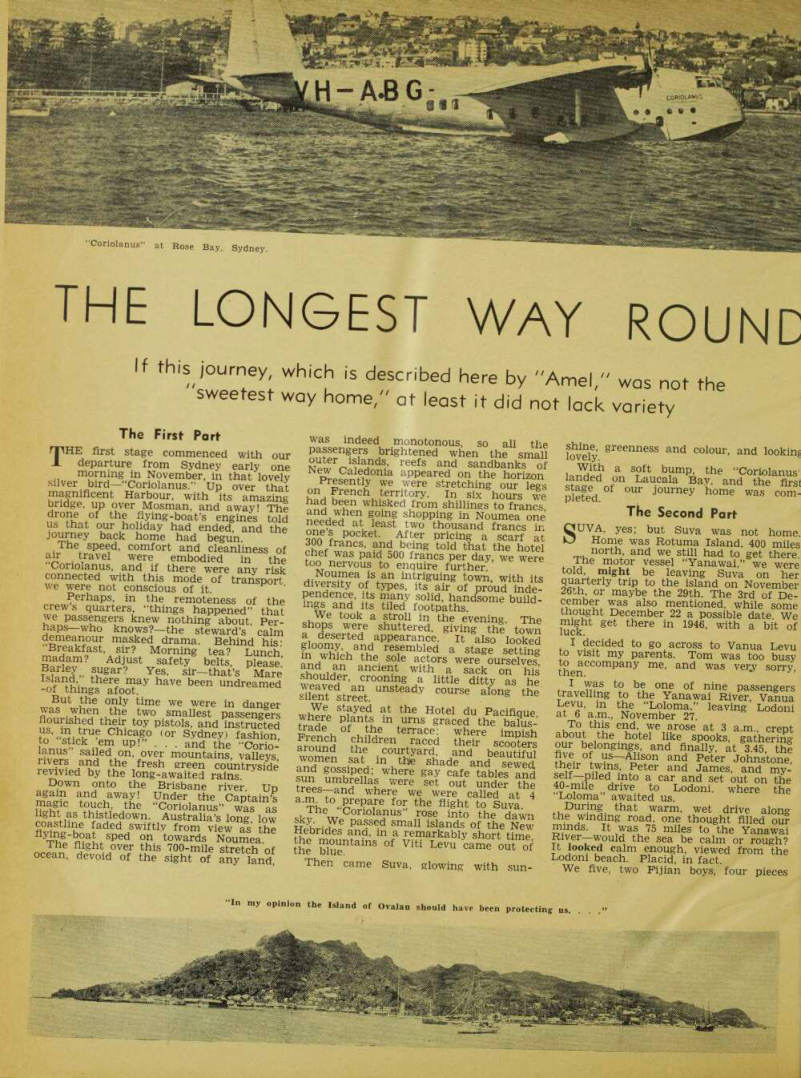
The First Part THE first stage commenced with our departure from Sydney early one morning in November, in that lovely silver bird—“ Coriolanus.” Up over that magnificent Harbour, with its amazing bridge, up over Mosman, and away! The drone of the flying-boat’s engines told us that our holiday had ended, and the journey back home had begun . The + s P e( ; d > comfort and cleanliness of air travel were embodied in the Coriolanus, and if there were any risk connected with this mode of transport we were not conscious of it. P Perhaps, in the remoteness of the crews quarters, “things happened” that we passengers knew nothing about. Per haps—who knows?—the steward’s calm d^i a w OU f masked drama. Behind his: Breakfast, sir? Morning tea? Lunch Adjust safety belts, please.’ ?_Fjf y sugar? Yes. sir—that’s Mare things e afoSt aV aVe been undreamed But the only time we were in danger was when the two smallest passenglrs n? U i*iwv d toy P istols > and instructed us, m true Chicago (or Sydney) fashion farmc» ICk i 6 *? up! ” •• • and the “Corio lanus sailed on, over mountains, vallevs rivers and the fresh green coVtrS revivied by the long-awaited rains.
Down onto the Brisbane river Un egain and away! Under the Captain’s ffucK’i 116 “Coriolanus” was a? light as thistledown. Australia’s long low aded . swiftly from view as ’ the L sped ?£. towards Noumea, °ver this 700-mile stretch of ocean, devoid of the sight of any land,
was indeed monotonous, so all the passengers brightened when the small reefs and sand banks of N^p?al f! donia a PP eared on the horizon Presently we were stretching our legs on French territory, in six hours we «nH whlsked from shillings to francs, neod^ h « t m f s , h in Noumea one ™«v. ed ast two thousand francs in 2|Sf ? r po „ cket - , 4 ft . er Pricing a scarf at ’ being told that the hotel chef was paid 500 francs per day, we were too nervous to enquire further Noumea is an intriguing town, with its diversity of types, its air of proud inde ?n?<? V\ any soli d, handsome build mgs and its tiled footpaths. took a Scroll in evening. The « h ri P iLT^ e shutter ed. giving the town a deserted appearance, it also looked fn°w?i?ph a t 1 h re^ embl f d a stage setting in u hich the sole actors were ourselves a .V d , ancient with a sack on his' shoulder, crooning a little ditty as he unsteady course alon S the We stayed at the Hotel du Pacificue J*?ere P l an Jl in , urns graced the ba?us trade of the terrace: where imnish around thi ldren f rac^ d their scooters around the courtyard, and beautiful women sat in the shade and sewed and gossiped; where gay cafe tables and sun umbrellas were set out unde? the n r m S 7^ and wher we we re called at 4 TiJ ‘£ r6l?a i re for the flight t 0 Suva. .w he w Coriolanus rose into the dawn HPhrinX 6 pa J s ® d sma H islands of the New Hebrides and, in a remarkably short time the biue 11^1118 ° f Levu came out of Then came Suva, glowing with sun
lOTdy greetmess and colour, and looking , W*/ 1 a “It bump, the “Coriolanus' landed on Laucala Bav. and the first pitted ° f ° Ur journey home was com-
The Second Part
SUVA, yes; but Suva was not home.
Home was Rotuma Island. 400 miles north and we still had to get there.
The motor vessel “Yanawai,” we were told might be leaving Suva on her trip to the isl an d on November 26th or maybe the 29th. The 3rd of De cember was also mentioned, while some thought December 22 a possible date. We -|ht get there in 1946, with a bit of I decided to go across to Vanua Levu to visit my parents. Tom was too busy then CC ° mPany m6 ’ and WaS ver * y sorr y, I was to be one of nine passengers travelling to the Yanawai River, Vanua Levu, in the “Loloma.” leaving Lodoni at 6 a.m., November 27.
Jo this end we arose at 3 a.m., crept about the hotel like spooks, gathering our belongings, and finally, at 3.45, thl °* V s —-ALson and Peter Johnstone, twins, Peter and James, and my into a car and set out on the 40-mUe drive to Lodoni. where the Loloma awaited us.
During that warm, wet drive along the winding road, one thought filled our minds. It was 75 miles to the Yanawai River—would the sea be calm or rough?
It looked calm enough, viewed from the Lodoni beach. Placid, in fact.
We five, two Fijian boys, four pieces
“Coriolanus” at Rose Bay, Sydney.
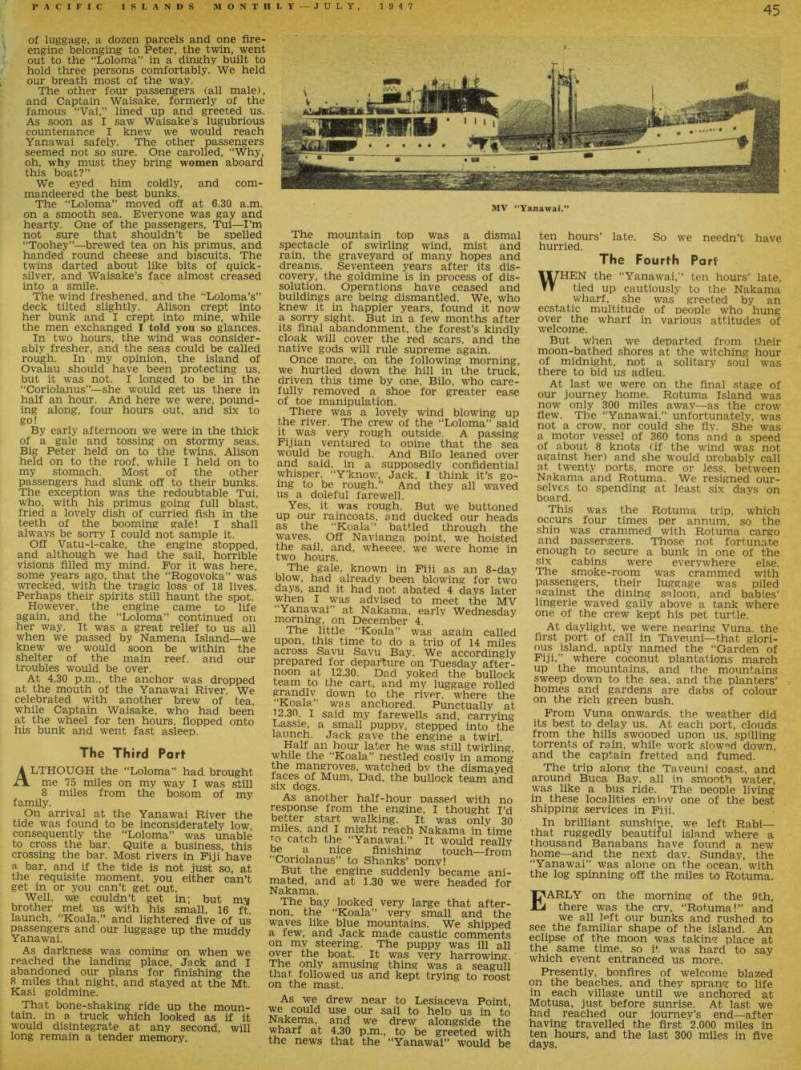
“In my opinion the Island of Ovalau should have been protecting us. ..."
of luggage, a dozen parcels and one fire engine belonging to Peter, the twin, went out to the “Loloma” in a dinghy built to hold three persons comfortably. We held our breath most of the way.
The other four passengers (all male), and Captain Waisake. formerly of the famous “Vai,” lined up and greeted us.
As soon as I saw Waisake’s lugubrious countenance I knew we would reach Yanawai safely. The other passengers seemed not so sure. One carolled, “Why, oh, why must they bring women aboard this boat?”
We eyed him coldly, and com mandeered the best bunks.
The “Loloma” moved off at 6.30 a.m. on a smooth sea. Everyone was gay and hearty. One of the passengers, Tui —I’m not sure that shouldn’t be spelled “Toohey”—brewed tea on his primus, and handed round cheese and biscuits. The twins darted about like bits of quick silver, and Waisake’s face almost creased into a smile.
The wind freshened, and the “Loloma’s” deck tilted slightly. Alison crept into her bunk and I crept into mine, while the men exchanged I told you so glances.
In two hours, the wind was consider ably fresher, and the seas could be called rough. In my opinion, the island of Ovalau should have been protecting us, but it was not. I longed to be in the “Coriolanus” —she would get us there in half an hour. And here we were, pound ing along, four hours out, and six to go!
By early afternoon we were in the thick of a gale and tossing on stormy seas.
Big Peter held on to the twins. Alison held on to the roof, while I held on to my stomach. Most of the other passengers had slunk off to their bunks.
The exception was the redoubtable Tui, who, with his primus going full blast, fried a lovely dish of curried fish in the teeth of the booming gale! I shall always be sorry I could not sample it.
Off Vatu-i-cake, the engine stopped, and although we had the sail, horrible visions filled my mind. For it was here, some years ago, that the “Rogovoka” was wrecked, with the tragic loss of 18 lives.
Perhaps their spirits still haunt the spot.
However, the engine came to life again, and the “Loloma” continued on her way. It was a great relief to us all when we passed by Namena Island—we knew we would soon be within the shelter of the main reef, and our troubles would be over.
At 4.30 p.m., the anchor was dropped at the mouth of the Yanawai River. We celebrated with another brew of tea, while Captain Waisake. who had been at the wheel for ten hours, flopped onto his bunk and went fast asleep.
The Third Fort
ALTHOUGH the “Loloma” had brought me 75 miles on my way I was still 8 miles from the bosom of my family.
On arrival at the Yanawai River the tide was found to be inconsiderately low consequently the “Loloma” was unable to cross the bar. Quite a business, this crossing the bar. Most rivers in Fiji have a bar, and if the tide is not just so, at the requisite moment, you either can’t get in or you can’t get out.
Well, wje couldn’t get in; but my brother met us with his small, 16 ft. launch, “Koala,” and lightered five of us passengers and our luggage up the muddy Yanawai.
As darkness was coming on when we reached the landing place, Jack and I abandoned our plans for finishing the 8 miles that night, and stayed at the Mt.
Kasi goldmine.
That bone-shaking ride up the moun tain. in a truck which looked as if it would disintegrate at any second, will long remain a tender memory.
The mountain top was a dismal spectacle of swirling wind, mist and rain, the graveyard of many hopes and dreams. Seventeen years after its dis covery, the goldmine is in process of dis solution. Operations have ceased and buildings are being dismantled. We, who knew it in happier years, found it now a sorry sight. But in a few months after its final abandonment, the forest’s kindly cloak will cover the red scars, and the native gods will rule supreme again.
Once more, on the following morning, we hurtled down the hill in the truck, driven this time by one, Bilo, who care fully removed a shoe for greater ease of toe manipulation.
There was a lovely wind blowing up the river. The crew of the “Loloma” said it was very rough outside. A passing Fijian ventured to opine that the sea would be rough. And Bilo leaned over and said, in a supposedly confidential whisper. “Y’know, Jack. I think it’s go ing to be rough/’ And they all waved us a doleful farewell.
Yes, it was rough. But we buttoned up our raincoats, and ducked our heads as the “Koala” battled through the waves. Off Navianga point, we hoisted the sail, and, wheeee, we were home in two hours.
The gale, known in Fiji as an 8-day blow, had already been blowing for two days, and it had not abated 4 days later when I was advised to meet the MV “Yanawai” at Nakama, early Wednesday morning, on December 4.
The little “Koala” was again called upon, this time to do a trio of 14 miles across Savu Savu Bay. We accordingly prepared for departure on Tuesday after noon at 12.30. Dad yoked the bullock team to the cart, and my luggage rolled grandlv down to the river, where the “Koala” was anchored. Punctually at 12.30. I said my farewells and. carrying Lassie, a small puppy, stepped into the launch. Jack gave the engine a twirl.
Half an hour later he was still twirling, while the “Koala” nestled cosily in among the mangroves, watched bv the dismayed faces of Mum, Dad, the bullock team and six dogs.
As another half-hour passed with no response from the engine, I thought I’d better start walking. It was only 30 miles, and I might reach Nakama in time to catch the “Yanawai.” It would really be a nice finishing touch—from Conolanus” to Shanks’ pony!
But the engine suddenly became ani mated, and at 1.30 we were headed for Nakama.
The bay looked very large that after non, the “Koala” very small and the waves like blue mountains. We shipped a few, and Jack made caustic comments on my steering. The puppy was ill all over the boat. It was very harrowing.
The only amusing thing was a seagull that followed us and kept trying to roost on the mast.
As we drew near to Lesiaceva Point, we could use our sail to help us in to Nakema, and we drew alongside the wharf at 4.30 p.m., to be greeted with the news that the “Yanawai” would be
ten hours’ late. So we needn’t have hurried.
The Fourth Part
WHEN the “Yanawai,” ten hours’ late, tied up cautiously to the Nakama wharf, she was greeted by an ecstatic multitude of people who hung over the wharf in various attitudes of welcome.
But when we departed from their moon-bathed shores at the witching hour of midnight, not a solitary soul was there to bid us adieu.
At last we were on the final stage of our journey home. Rotuma Island was now only 300 miles away-as the crow flew. The "Yanawai.” unfortunately, was not a crow, nor could she fly. She was a motor vessel of 360 tons and a speed of about 8 knots (if the wind was not against her) and she would probably call at twenty ports, more or less, between Nakama and Rotuma. We resigned our selves to spending at least six days on board.
This was the Rotuma trip, which occurs four times per annum, so the shin was crammed with Rotuma cargo and nassengers. Those not fortunate enough to secure a bunk in one of the six cabins were everywhere else.
The smoke-room was crammed with passengers, their luggage was piled against the dining saloon, and babies’ lingerie waved gaily above a tank where one of the crew kept his pet turtle.
At daylight, we were nearing Vuna. the first port of call in Taveuni—that glori ous island, aptly named the “Garden of Fiji,” where coconut plantations march up the mountains, and the mountains sweep down to the sea, and the planters’ homes and gardens are dabs of colour on the rich green bush.
From Vuna onwards, the weather did its best to delay us. At each port, clouds from the hills swooned upon us, spilling torrents of rain, while work slowed down, and the captain fretted and fumed.
The trip along the Taveuni coast, and around Buca Bay. all in smooth water, was like a bus ride. The people living in these localities eniov one of the best shipping services in Fiji.
In brilliant sunshine, we left Rabi— that ruggedly beautiful island where a thousand Banabans have found a new home—and the next dav. Sunday, the “Yanawai” was alone on the ocean, with the log spinning off the miles to Rotuma.
EARLY on the morning of the 9th, there was the cry, “Rotuma!” and we all left our bunks and rushed to see the familiar shape of the island. An eclipse of the moon was taking place at the same time, so it was hard to say which event entranced us more.
Presently, bonfires of welcome blazed on the beaches, and they sprang to life in each village until we anchored at Motusa, just before sunrise. At last we had reached our journey’s end—after having travelled the first 2.000 miles in ten hours, and the last 300 miles in five days.
MV “Yanawai.”