Of Cousin, and Fiji-English
pp. 44-45 · Read in the full issue
By Polynesian
WE fell, the horse and I, He was running very fast at that time. He was not hurt, but I myself had all these wounds on my foot.”
Sitting back in the warm tidal shallow at the edge of the lagoon, Nirai waved the afflicted limb aloft for inspection.
I almost had a fit. Not only had the foot been deeply gashed in half-a-dozen different places, but it looked like a septic, festering mess.
Nothing of the sort, said Nirai. The foot was coated with a liberal anoint ing of approved applications from the hospital. It had previously been swilled in antiseptic and, to crown all, Nirai himself had had an anti-tetanus injec tion. From which it mav be gathered that Nirai knew all the answers.
Where, I asked, were the dressing, the sticking-plaster and the bandage I had noted earlier in the day?
“Up yonder, with my sulu,” said Nirai, looking surprised and waving a hand vaguely in the direction of the palm-lined beach. “I took them off. They are good; but for this”—indicating the foot — “clean sea-water is more better. I know it. It is the old Fijian way and I heard you yourself say it when you cut youi foot, Ratu.”
Fifty yards down the lagoon, Nirai’s cousin was inspecting a new fish-trap fence. “Cousin” is a courtesy title which I accepted as fact until I was presented to several more of Nirai’s cousins. In all innocence, I asked if these cousins were the brothers of the first cousin.
Cousin had nothing to do with the con struction of the fish-tran and he is un likely to have any direct interest in the fish it catches. Nevertheless, after a minute inspection he shouted that the whole affair was, in effect, lousy.
At this, Nirai raised one eyebrow and told me, confidentially, that the edifice was really an excellent piece of work —a truly fish-trap.
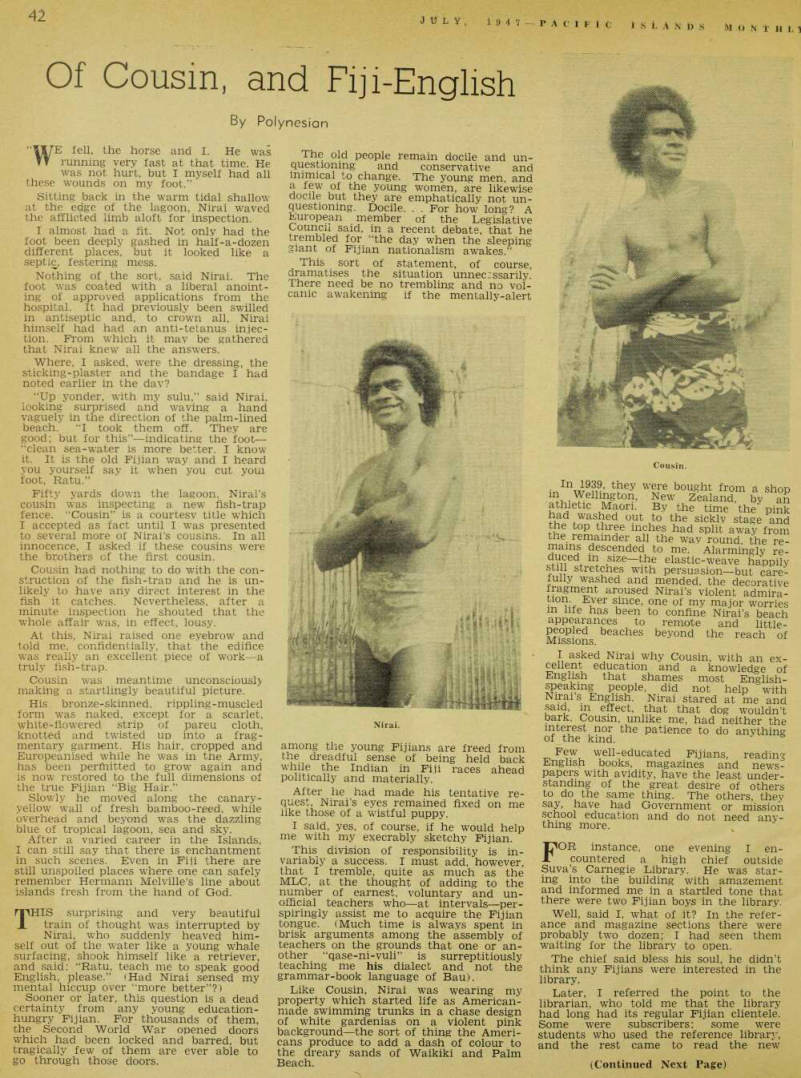
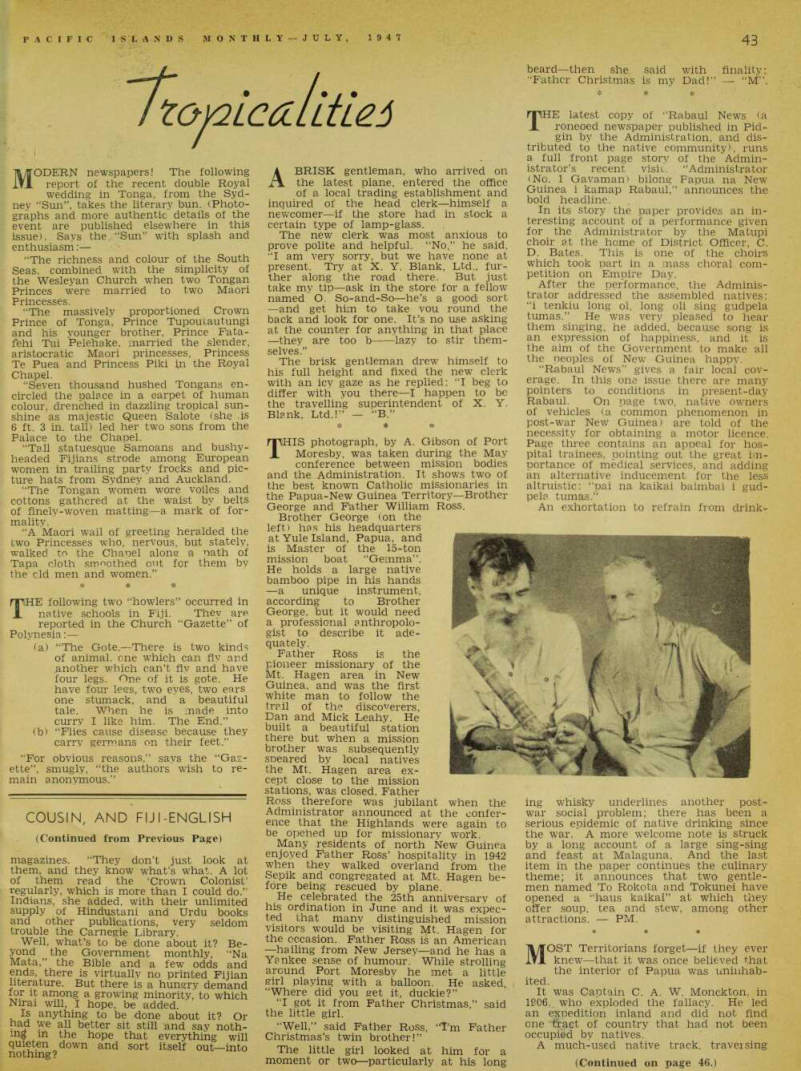
Cousin was meantime unconsciously making a startlingly beautiful picture.
His bronze-skinned, rippling-muscled form was naked, except for a scarlet, white-flowered strip of pareu cloth, knotted and twisted up into a frag mentary garment. His hair, cropped and Europeanised while he was in the Army, has been perfnitted to grow again and is now restored to the full dimensions of the true Fijian “Big Hair.”
Slowly he moved along the canary yellow wall of fresh bamboo-reed, while overhead and beyond was the dazzling blue of tropical lagoon, sea and sky.
After a varied career in the Islands, I can still say that there is enchantment in such scenes. Even in Fiji there are still unspoiled places where one can safely remember Hermann Melville’s line about islands fresh from the hand of God.
THIS surprising and very beautiful train of thought was interrupted by Nirai, who suddenly heaved him self out of the water like a young whale surfacing, shook himself like a retriever, and said: “Ratu, teach me to speak good English, please.” (Had Nirai sensed my mental hiccup over “more better”?) Sooner or later, this question is a dead certainty from any young education hungry Fijian. For thousands of them, the Second World War opened doors which had been locked and barred, but tragically few of them are ever able to go through those doors.
The old people remain docile and un questioning and conservative and inimical to change. The young men. and a few of the young women, are likewise docile but they are emphatically not un questioning. Docile. . . For how long? A European member of the Legislative Council said, in a recent debate, that he trembled for “the day when the sleeping giant of Fijian nationalism awakes.”
This sort of statement, of course, dramatises the situation unnecessarily.
There need be no trembling and no vol canic awakening if the mentally-alert
among the young Fijians are freed from the dreadful sense of being held back while the Indian in Fiji races ahead politically and materially.
After he had made his tentative re quest, Nirai’s eyes remained fixed on me like those of a wistful puppy.
I said, yes, of course, if he would help me with my execrably sketchy Fijian.
This division of responsibility is in variably a success. I must add. however, that I tremble, quite as much as the MLC, at the thought of adding to the number of earnest, voluntary and un official teachers who—at intervals—per spiringly assist me to acquire the Fijian tongue. (Much time is always spent in brisk arguments among the assembly of teachers on the grounds that one or an other “qase-ni-vuli” is surreptitiously teaching me his dialect and not the grammar-book language of Bau).
Like Cousin, Nirai was wearing my property which started life as American made swimming trunks in a chase design of white gardenias on a violent pink background—the sort of thing the Ameri cans produce to add a dash of colour to the dreary sands of Waikiki and Palm Beach.
in 1 wo?r’ t ? ey w^ T re bou ght from a shop 1 W ellmgt ° n , New Zealand, by an athletic Maori. By the time the pink had washed out to the sickly stage and the top three inches had split away from the remainder all the wav round, the re mains descended to me. Alarmingly re huoed in size—the elastic-weave happily still stretches with persuasion—but care fully washed and mended, the decorative iragment aroused Nirai’s violent admira- Uon Ever since, one of my major worries m life has been to confine Nirai’s beach appearances to remote and little peopled beaches beyond the reach of Missions.
I asked Nirai why Cousin, with an ex cellent education and a knowledge of English that shames most English speaking people, did not help with Nirai s English. Nirai stared at me and said, m effect, that that dog wouldn’t bark. Cousin, unlike me, had neither the nor patience to do anything of the kind.
Few well-educated Fijians, reading English books, magazines and news papers with avidity, have the least under standing of the great desire of others to do the same thing. The others, they say, have had Government or mission school education and do not need any thing more.
FOR instance, one evening I en countered a high chief outside Suva’s Carnegie Library. He was star ing into the building with amazement and informed me in a startled tone that there were two Fijian boys in the library.
Well, said I, what of it? In the refer ance and magazine sections there were probably two dozen; I had seen them waiting for the library to open.
The chief said bless his soul, he didn’t think any Fijians were interested in the library.
Later, I referred the point to the librarian, who told me that the library had long had its regular Fijian clientele.
Some were subscribers: some were students who used the reference library, and the rest came to read the new
(Continued Next Page)
Nirai.
Cousin.
magazines. “They don’t just look at them, and they know what’s what. A lot of them read the ‘Crown Colonist’ regularly, which is more than I could do.’’
Indians, she added, with their unlimited supply of Hindustani and Urdu books and other publications, very seldom trouble the Carnegie Library.
Well, what’s to be done about it? Be yond the Government monthly, “Na Mata,” the Bible and a few odds and ends, there is virtually no printed Fijian literature. But there is a hungry demand for it among a growing minority, to which Nirai will, I hope, be added.
Is anything to be done about it? Or had we all better sit still and say noth ing in the hope that everything will quieten down and sort itself out— into nothing?