Resumption
p. 58 · Read in the full issue
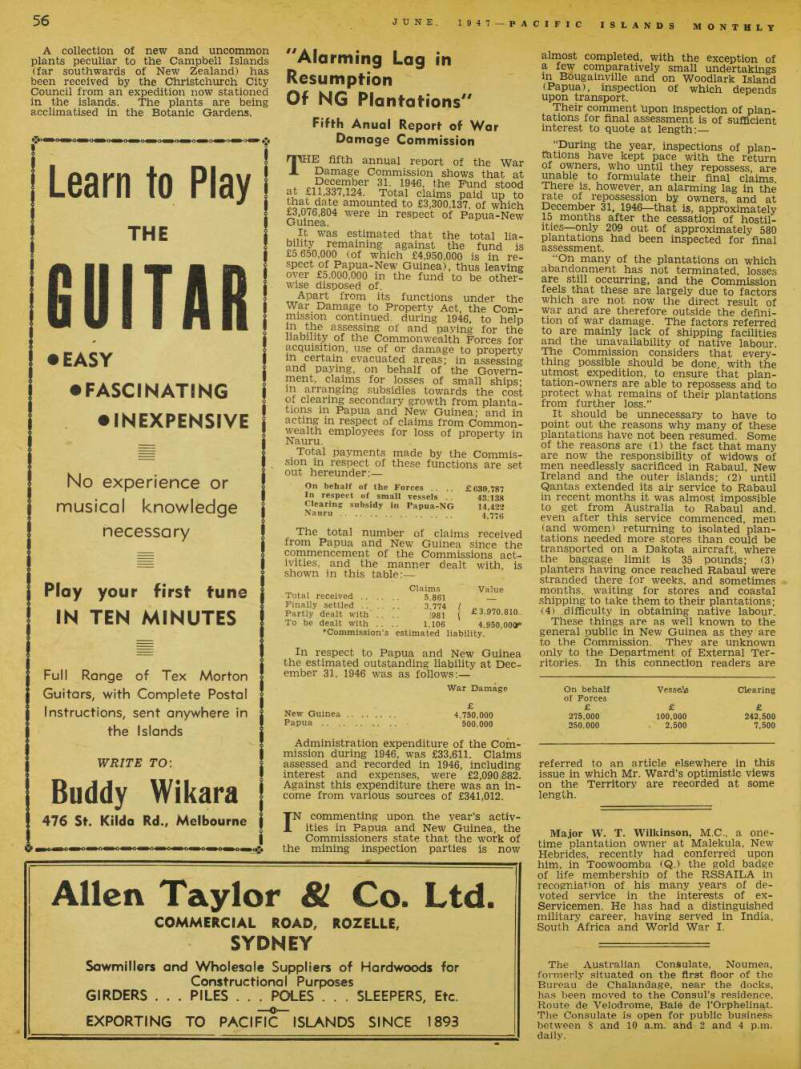
"Alarming Lag in Resumption Of NG Plantations"
Fifth Anual Report of War Damage Commission
rE fifth annual report of the War Damage Commission shows that at , „;9®cember 31 - 1946. the Fund stood Total ciaims paid up to i; a l d n a Je amounted to £3,300,137, of which £3.076,804 were in respect of Papua-New Guinea.
It was estimated that the total lia bility remaining against the fund is £5 650,000 (of which £4,950,000 is in re spect of Papua-New Guinea), thus leaving over £5,000,000 in the fund to be other wise disposed of.
Apart from its functions under the War Damage to Property Act, the Com mission continued, during 1946. to help Jf 1 the assessing of and paying for the liability of the Commonwealth Forces for acquisition, use of or damage to property m certain evacuated areas; in assessing and paying, on behalf of the Govern ment, claims for losses of small ships in arranging subsidies towards the cost of clearing secondary growth from planta tions in Papua and New Guinea; and in acting in respect of claims from Common wealth employees for loss of property in Nauru.
Total payments made by the Commis sion in respect of these functions are set out hereunder:— On behalf of the Forces .. .. £630,787 In respect of small vessels . . 43;138 Clearing subsidy in Papua-NG 14,422 Nauru 4,776 The total number of claims received from Papua and New Guinea since the commencement of the Commissions act ivities, and the manner dealt with, is shown in this table:—
In respect to Papua and New Guinea the estimated outstanding liability at Dec ember 31, 1946 was as follows:
Administration expenditure of the Com mission during 1946, was £33,611. Claims assessed and recorded in 1946, including interest and expenses, were £2,090(882.
Against this expenditure there was an in come from various sources of £341,012.
IN commenting upon the year’s activ ities in Papua and New Guinea, the Commissioners state that the work of the mining inspection parties is now
almost completed, with the exception of a few comparatively small undertakings in Bougainville and on Woodlark Island (Papua), inspection of which depends upon transport.
Their comment upon inspection of plan tations for final assessment is of sufficient interest to quote at length:— “During the year, inspections of plan tations have kept pace with the return of owners, who until they repossess, are unable to formulate their final claims There is, however, an alarming lag in the rate of repossession by owners, and at December 31, 1946—that is, approximately 15 months after the cessation of hostil ities—only 209 out of approximately 580 plantations had been inspected for final assessment.
“On many of the plantations on which abandonment has not terminated, losses are still occurring, and the Commission feels that these are largely due to factors which are not now the direct result of war and are therefore outside the defini tion of war damage. The factors referred to are mainly lack of shipping facilities and the unavailability of native labour.
The Commission considers that every thing possible should be done, with the utmost expedition, to ensure that plan tation-owners are able to repossess and to protect what remains of their plantations from further loss.”
It should be unnecessary to have to point out the reasons why many of these plantations have not been resumed. Some of the reasons are (1) the fact that many are now the responsibility of widows of men needlessly sacrificed in Rabaul, New Ireland and the outer islands; (2) until Qantas extended its air service to Rabaul in recent months it was almost impossible to get from Australia to Rabaul and, even after this service commenced, men (and women) returning to isolated plan tations needed more stores than could be transported on a Dakota aircraft, where the baggage limit is 35 pounds; (3) planters having once reached Rabaul were stranded there for weeks, and sometimes months, waiting for stores and coastal shipping to take them to their plantations; (4) difficulty in obtaining native labour.
These things are as well known to the general public in New Guinea as they are to the Commission. They are unknown only to the Department of External Ter ritories. In this connection readers are
referred to an article elsewhere in this issue in which Mr. Ward’s optimistic views on the Territory are recorded at some length.
Major W. T. Wilkinson, M.C., a one time plantation owner at Malekula, New Hebrides, recently had conferred upon him, in Toowoomba (Q.) the gold badge of life membership of the RSSAILA in recogniation of his many years of de voted service in the interests of ex- Servicemen. He has had a distinguished military career, having served in India, South Africa and World War I.
The Australian Consulate, Noumea, formerly situated on the first floor of the Bureau de Chalandage, near the docks, has been moved to the Consul’s residence, Route de Velodrome, Baie de I’Orphelinat.
The Consulate is open for public business between 8 and 10 a.m. and 2 and 4 p.m. daily.
Total received .. ..
Claims 5.861 Value Finally settled .. 3,774 ( £3.970,810 Partly dealt with .. 1981 To be dealt with .. 1,106 4.950,000*' ♦Commission’s estimated liability.
War Damage £ New Guinea 4.750,000 Papua 500,000
On behalf VessaVs Clearing of Forces £ £ £ 275.000 100,000 242,500 250.000 2,500 7,500