Fanning Island Memories
pp. 40-41 · Read in the full issue
On a Mid-Pacific Cable Station During World War I.
By Morwell Hodges
XN 1915, as a wireless operator in the Royal Australian Naval Wireless Ser vice. I was drafted to Fanning Island, a small coral atoll in mid-Pacific and a connecting link in the trans-Pacific cable. [ was to proceed there with a Navy system wireless receiving set, with instruc tions to erect it and listen-in for enemy radio signals, the cable station having been already devastated by the German war ship Nurnourg.
In Sydney, I saw the gear stowed aboard the Makuru and sailed in her for Auck land, where I joined HM Cable Ship Iris and was given charge of her Marconi in stallation for the voyage beyond the Equator.
Commander W. R. Holmes captained the Iris, with Mr. Hughes chief officer, and Mr. G. B. Winkfield chief electrician.
Among the crew were stalwart seamen of the Christian family of Pitcairn Island, descendants of Fletcher Christian of the Bounty mutineers. Also on board was Mr, Malcolm, construction engineer of Auck land, who built the wharf at Rarotonga and who was to rebuild the Fanning Island cable station.
The wireless shack on Fanning Island was built with the aid of Gilbert Island “boys” employed by the cable station; the aerial was slung between two tall coconut palms; and nightly I swept the ether on all wave lengths for suspicious signals. News from San Francisco buzzed through at midnight, and Kohuku (Hawaii) and China.-Frisco-bound ships made entries for my log-book.
In these days the Jap ships were ex perimenting with the broadcasting of music, some of which caused my eai phones to tingle when the “cat’s whisker” made good point on the crystal.
We had fresh food from the Iris every few months, with Californian tinned food stuffs—even potatoes—on the interim menus. There was plenty of fish in the sea and plenty of coconuts dangling from the palm-trees. There wasn’t much to do, and lots of time to do it in.
WE got the wind up, one day, when we saw a strange steamer bearing down on the atoll, which was out of the tracks of trade. Here was a German raider, we thought, disguised as a peace ful trader and come to blow us sky-high.
We manned our battle-stations —having been drilled for such an emergency by Lieutenant Phil LeCornu who, with a squad of Naval Marines under him. and a Maxim Gun and a twelve-pounder, had been dropped on the island by the Aus tralian warship Encounter —and we ex pected our hour had come.
We watched the sinister stranger drop pick and send a boat ashore. Strange, though, that no guns or bayonets glinted in the noonday sun.
But soon our fears were dispelled and we breathed freely again, our visitor prov ing to be none other than the Union Co.’s SS Wairuna. She had broken a propelior blade and could make only slow progress to Auckland. Would we cable her owners not to worry about her delayed arrival?
Of course we would, for now we our selves needn’t worry!
Pelley and Armstrong’s Fanning Island copra plantation —with Mr. Armstrong resident manager had the steamer Kestrel (formerly a Chilean gunboat) calling for copra cargoes and the exchange of Gilbertese indentured labour; while the schooner Luka sometimes blew down from Honolulu.
Once Father Emmanuel Rougier, the South Seas millionaire, who had been a French Roman Catholic priest and had married a Tahitienne, came ashore from the Luka. He had his daughter with him, and I lost my heart to her. A beauti ful young liquid-eyed French-Tahitienne, she was one of the lovliest girls I have ever seen .
Also on Fanning were the Greig brothers, whose island careers outrivalled any romance. One was married to a Manihiki princess—another ravishing Island beauty to fire my susceptibilities. .
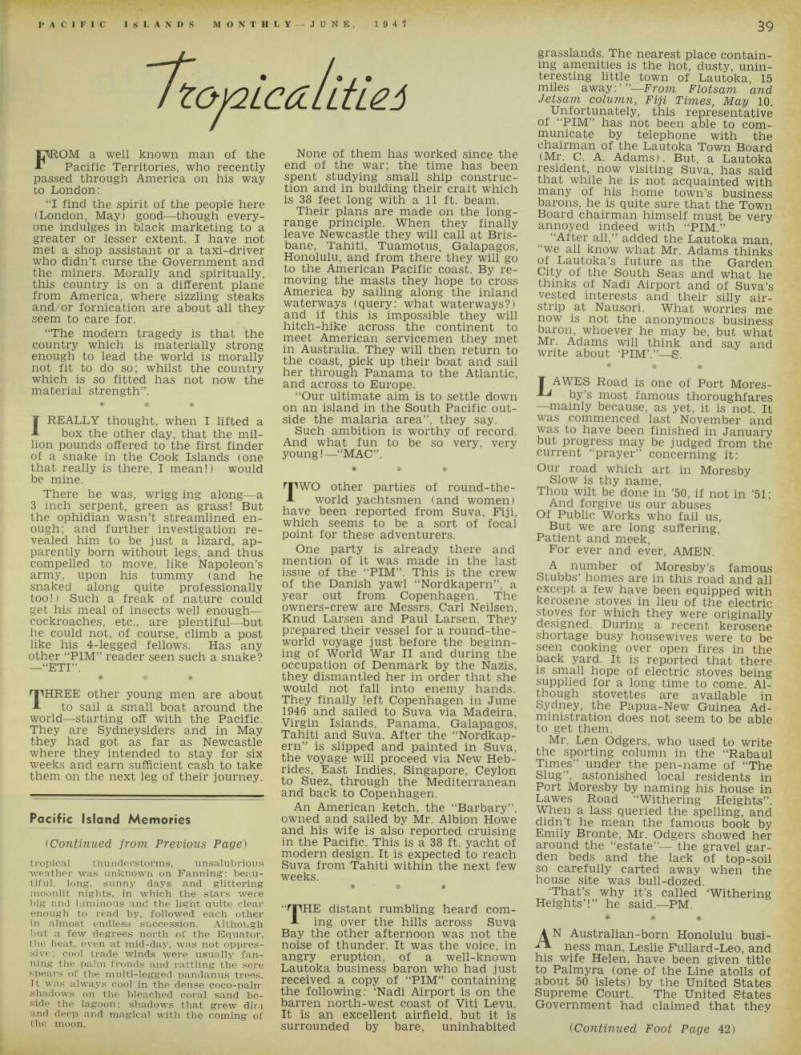
Mr. Hertzlet was resident superinten dent on Fanning in 1915-16. and had his wife and little daughter, Veta. with him. The Pacific Cable Board staff included Messrs. Smith, Bob Black ley, Jack Turnbull, Mugliston, Rama ciotii, Chapman, Hughie Greig, Syd.
Morris, Adrien (“Sloper”) Ohlson.
Grant (with Mrs. Grant and children Jack and Molly), “Pop” Luscombe, Warner, Bartley, Adames, “Jock” Turn bull, “Morty” Mortimer, “Sell” Allom, Price, Tom Andrews, Dr. Treusch (with Mrs. Treusch and little daughter Ivy), “Chan” Chandler.
The cable station was equipped with a billiard room and excellent library, the company forwarding new library books and gramophone records regularly.
“Alexander’s Ragtime Band” and “Oh.
You Beautiful Doll’ were among the musical hits of the day.
SAVE for a month or so in the monsoon season, when torrential downpours of rain could be expected and the heavens were rent asunder by fierce
(Continued Next Page )
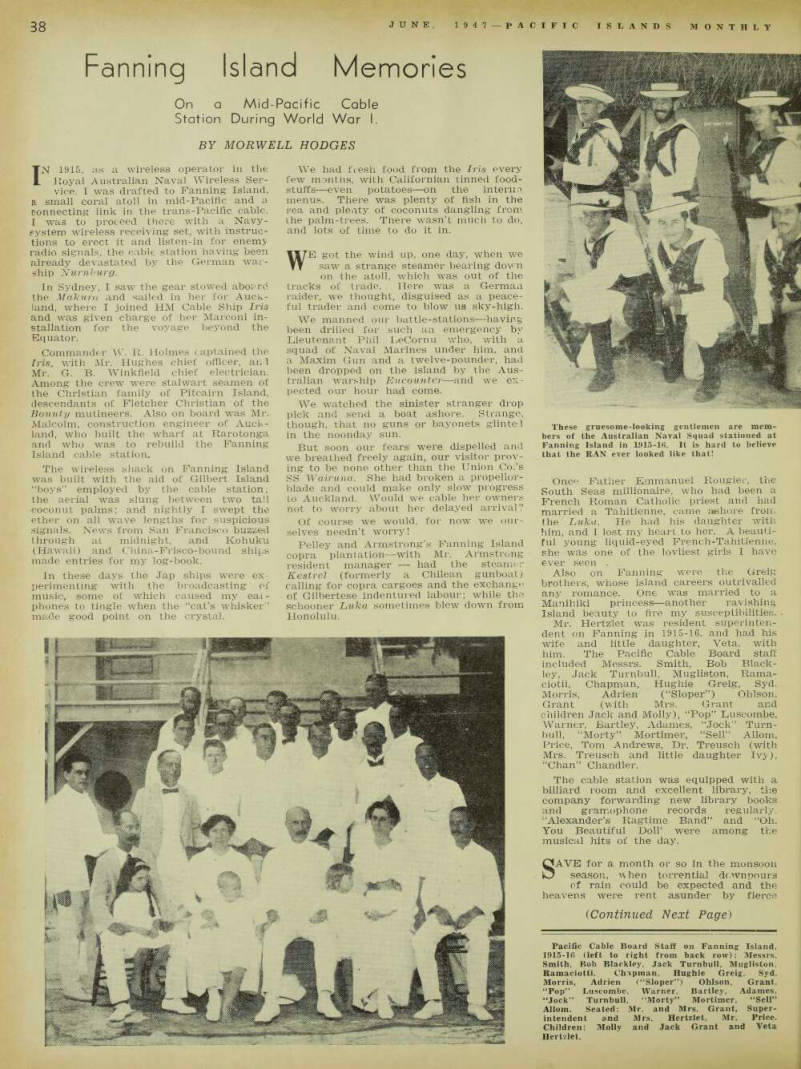
These gruesome-looking gentlemen are mem bers of the Australian Naval Squad stationed at Fanning Island in 1915-16. It is hard to believe that the RAN ever looked like that!
Pacific Cable Board Staff on Fanning Island, 1915-16 (left to right from back row): Messrs.
Smith, Bob Blackley, Jack Turnbull. Mugliston, Ramaciotti. Chapman, Hughie Greig. Syd.
Morris, Adrien (“Sloper”) Ohlson, Grant.
“Pop” Luscombe, Warner, Bartley, Adames.
“Jock” Turnbull, “Morty” Mortimer, “Sell”
Allom. Seated: Mr. and Mrs. Grant, Super intendent and Mrs. Hertzlet, Mr. Price.
Children: Molly and Jack Grant and Veta Hertzlet.
tropical thunderstorms, unsalubrious weather was unknown on Fanning; beau tiful, long, sunny days and glittering moonlit nights, in which the stars were big and luminous and the light quite clear enough to read by, followed each other in almost endless succession. Although but a few degrees north of the Equator, the heat, even at mid-day, was not oppres sive; cool trade winds were usually fan ning the palm fronds and rattling the sere spears of the multi-legged pandanus trees.
It was always cool in the dense coco-palrr shadows on the bleached coral sand be side the lagoon; shadows that grew dim and deep and magical with the coming of the moon.