Stormiest Territory
pp. 35-47 · Read in the full issue

Background To Troubled Samoa
Events in the History of the Pacific's Stormiest Territory
THIS article on the early history of Western Samoa is of particular interest now that the destiny of Samoa is again in the melting pot. It will be remembered that some months ago the Samoan Fono petitioned the United Nations against Western Samoa becoming a Trusteeship territory administered by New Zealand; and that, in May, it was announced that a U.N. committee would visit Western Samoa during July, and August this year.
The article also provides a historical background without which it is impossible to understand Samoan domestic politics.
The author is Mr. C. Phillips, who is Samoan born and who has interested him self in the history and folk-lore of Samoa.
A second article dealing with events from 1914 to the present time will appear in July “PIM.”
Part One
117 HEN fc the Rev. John Williams and Mr.
T? Barff of the London Missionary Society landed on the coast of Savaii, in what is now the Territory of Western Samoa, in August, 1830, they learnt that white men were living among the natives on the neighbouring island of Upolu. Many of these men were convicts S h T? d a r U £ a iihT S S? P k?J r 6C I2 a S f the r vessel and sunk it beyond the reef.
Because they were in possession of firearms and powder, these convicts took a leading part in the local wars of the natives—one of them was known to have killed 200 persons singlehanded with his musket, and to have smeared his body with charcoal and oil to avoid detection, Six years before the arrival of the Rev.
Williams, the people of Upolu had been subdued by a tyrant known as Tamafaiga.
When he was eventually slain by a number of Upolu people, Malietoa, the king of
Samoa, crossed over from Savaii only one week before the missionaries landed and sacked the entire district at the western end of the island. A huge pit had been dug into which several captives were thrown and burnt alive. It was immedi ately after returning from this blood-bath that Malietoa accepted Christianity.
In keeping with custom, the Samoans went out the mission ship with offer ings of food and women, and it was with some difficu i ty that the Tahitian teachers accompanying the Mission expedition ex plained to them that the ship was a “vaa lotu” (a prayer ship), and that though they gratefully accepted the food, they could not accept the women. It is be lieved that this rejection of the women made a marked impression upon the chiefs and had much to do with influenc mg them accept Christianity, By 1855 the white population of Apia was approximately fifty. The harbour had become a port of call for whalers
and other types of ships and the town had been divided into two zones, one being British and the other American. In the American zone a certain Mr. van Camp had set himself up as US Consul, and on the strength of this he con demned as being unseaworthy two Amer ican barques which had called enroute from California to Sydney. He then pur chased the two vessels for himself at a ridiculously low price.
In demonstrations of anger, the mar ooned passengers and crew attacked van Camp who was supported by a gang of desperadoes, and it is said that several scenes of violence ensued in which bowie knives and revolvers were used.
The trade of the European storekeepers included, at the time, the retailing of spirits to the Samoans and the crews of whalers.
Meanwhile, August Unshelm had begun business for J. C. Godeffroy & Son of Hamburg. The islands were becoming of commercial value to Germany, Britain and the United States. In 1870 Godeff roy went bankrupt and the business was then taken over by a German company known as the Deutsche Handels und Plan tagen Geselleschaft fur Sud-See Inseln
zu Hamburg, abbreviated to D. H. & P. G.
This firm invested £150,000 in plantations and imported native labourers from the Solomons and New Guinea to work for a few dollars a month. The whip was freely used and various forms of punish-
ment, such as extending the term of ser vice, were imposed on the “black boys”.
Copra having become an important pro duct, the United States sent Colonel Steinberger to Apia in 1873 to make a report on the situation. Two years later he returned “to assist the Samoans to ward good and stable government,” but he was deported to Fiji in the following year as a result of complaints laid against him by the Samoan King. It was said that he was becoming too pro-German.
By 1880, Apia had become a lively place.
The main part of the township consisted of German bars, stores, and the German Consulate. Missionaries, merchants, clerks, sailors and beachcombers made up the European Section of the township.
Warships, deep-sea packets, small schooners, and vessels of the German firm rode at anchor in the harbour. The bars were always crowded with amateur politicians who knew everything. One merchant would warn the customer against the other merchant. Silently the Samoans stood by and overheard these Europeans accusing each other of trickery.
Meanwhile, the idea of theft as an evil was not clear to the Samoans who re garded the German plantations much as we would regard a holiday park. Through an arrangement between Weber, the genius at the head of D. H. & P. G., and King Malietoa, all natives caught steal ing from the plantations were handed over and imprisoned in the King’s jail, but unfortunately the culprits were often seen a few days later walking about the town ship. Accordingly, the German consul made new arrangements with the king; the offenders were to be imprisoned in a private jail operated by the German firm.
It* was not long, however, before the prisoners began escaping from Weber’s
jail, whereupon the king hastened to build a new jail to which he pretended to con vey the fugitives.
IN 1885, during an absence of the Ger man consul, Weber took it upon him self to communicate to the king a new State paper designed to depose the existing Government and install in its place a council of two Germans and two
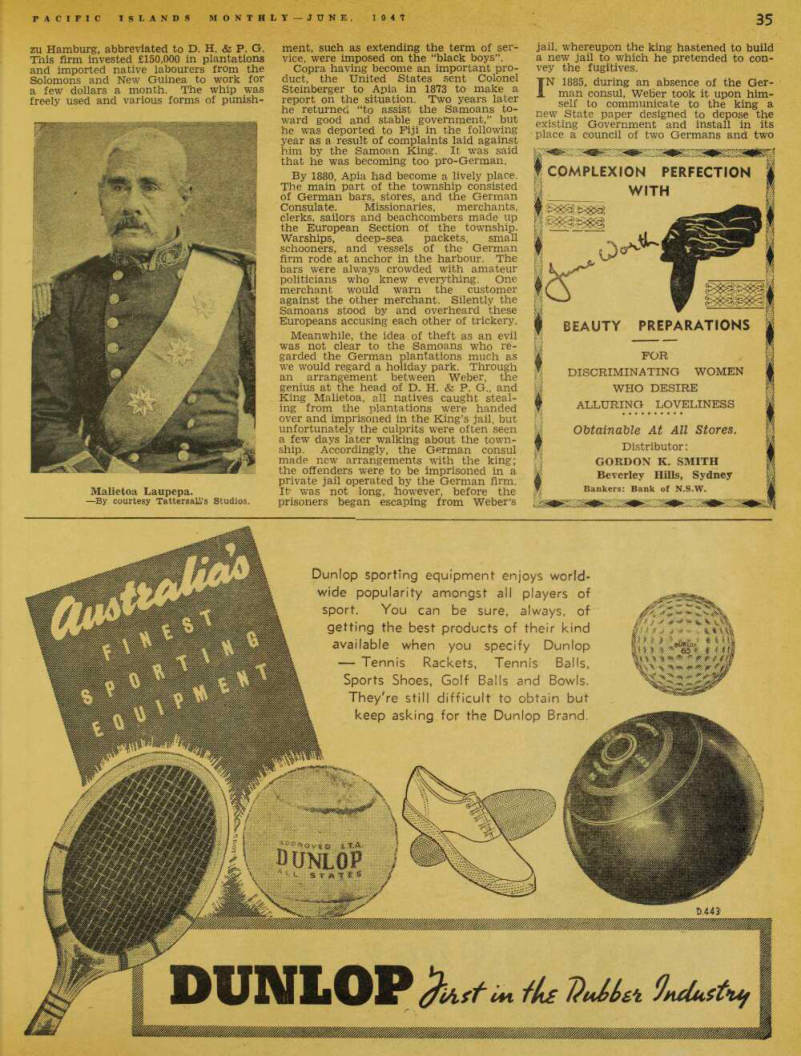
Malietoa Laupepa. —By courtesy Tattersall’s Studios.
Samoans be invested with the right to make laws and impose taxes. The G, e i> mans were to reserve the right to end the agreement on six months’ notice but the Samoans were bound by it indefinitely When the king and his chiefs hesitated to sign, Weber hinted that the two German warships at anchor in the harbour would Intervene Realising that they were in bondage to the Germans, Malietoa and his chiefs held a secret meeting at which a letter was drafted and addressed
to the King of England asking for protection. Five days later Malietoa signed the agreement with Germany, with tongue m cheek, and when in the following month the Germans received a copy of the Samoan address to Britain, they realised that Malietoa was not a man to be trusted.
Weber decided then that all he required was a pretender, and the man he chose was Tamasese formerlv the TCine-’* own accomplice. In January, Seresunmd the Util oT king, “and begln rlisfng an armed force, but because a conference had been called in Europe and it was decided to send a Commission to Samoa, susDense d Ipsed mto state ot P eacetul iKnsrv nf fhe fnitain. ™.r om, the Hawaiian armed cruiser “Kaimiloa” with a delegation under Envoy J. E. Bush, put by Premier Gibson, arrived in Apia deed^of' e th t e o f P rilrit ? o PaClfl S sig^d 3 by A MalStoa f but ie the d affidr >l ended gear were* s bartered for food' 3 plate and tteGerman Em peror’s birthday, a brawl involving a party of Germans and four Samoans developed in one of the hotels, a German subject had his nose broken and the incident was regarded as “the trampling upon the German Emperor by Malietoa.” In August, 1887, Malietoa was ordered to pay a fine of 1 000 dollars for thp affair nf the Kaiser ’ s ’ birthday and an additional 12,000 dollars for the theft of coconuts from the German plantations. In the
Apfa" under
PnVatatog 3
end of March, 1888, a proclamation by
Tamasese declaring war against Malietoa was distributed throughout the islands bv German warships In the village of sttu paitea the proclamation was torn down bv the villagers, whereupon the Germans re turned and shelled the village nn ir - IQQO ® „ ° n September 17, 1888, King Malietoa
MambaAs** 1 Tamasese 3
“en made of g the
+7l? i <9 1 assuming tne
Malietoa “ate which anf®regardedbl
and^before^ fcj? a Sedumber
Samoans beean g Drenarini fnr U ?PhPliin^
under the llade?sMn of 1{ S
Mat aafa. Arms and ammunition were purchased from traders and war broke out on October 9, 1888, at the eastern end oSSiId o firi S M P Mateafa defeate^Tama 3
German enea^St
troms who TOre sunnorted bv the took place Pat Luatuanuu four weksVter
£ o^mSe 3
landed PP a force of 150 at Mb drew ’ marines with- 9 n Ma rch 16, 1889, a hurricane struck A P* a ; Owing to the tenseness of the political situation at the time, the war shlPs. present in the harbour delayed too bating ou t to sea. In consequence the Germans lost the “Adler” and the “ The “ 01 S a ” was beached without ™ uch . damage and refloated later. The
The '‘moZ-wafaLfetched
a ". d ,! ate r- The British battle-
Calu
(Continued on Page 45)
alties were Germans, 92 drowned; Ameri cans, 63 drowned.
In June, 1889, a treaty was concluded in Berlin between Britain, Germany and the US. It provided for the independence of the Samoan Government under King Malietoa Laupepa, the establishment of a Supreme Court, a Municipal Council under a president to govern Apia subject to control of the three cohsuls and the Chief Justice, and a personal tax of 1 dollar per male for the benefit of the Samoan Government. Fees for licences were to be for the benefit of the Muni cipal |Council. On November 8, 1889, Malietoa, therefore, returned from exile and assumed his office as king. Mataafa was his adviser.
AFTER two years of peace Mataafa began drifting away from the cause of the king and eventually moved out of Apia and established himself in dependently at the village of Malie.
By the end of 1889, R. L. Stevenson had arrived in Apia and after a while began associating with Mataafa, but when he tried to act as mediator between Mataafa and the king, the latter rejected his inter cession. It is said that the author be came unpopular with the authorities for taking Mataafa’s side.
Op July 7, 1893, the forces of Malietoa and Mataafa clashed, the latter being defeated. It was Mataafa this time who was taken into custody and deported to the Marshalls; in his company were eleven others, and together they remained in exile for five years. Twenty-seven other chiefs were imprisoned and fined.
Toward the end of the year, Stevenson, his wife and his step-daughter were in vited to a feast held on the prison grounds.
In a speech by one of the Chiefs he was lauded as being the only friend who had stuck by them through the days of their misfortune. A presentation of native gifts was made to him, and after the feast a large number of Samoan people followed him in a procession through the town ship. As a further act of gratitude for the kindness and sympathy he had shown them, the chiefs on release from prison, undertook the building of a road for him from the township to Vailima, which became known as the Road of Loving Hearts. Two months later, on December 5, 1893, Stevenson passed away in his home at Vailima, the cause of his death being cerebral haemorrhage.
When King Malietoa died in August, 1898. Mataafa was brought back from the Marshalls. Under provisions of the Berlin Treaty, Tanumafili Malietoa, the late king’s 19-year-old son. succeeded to the title, but in January 1899 Mataafa’s troops and supporters, being in the majority, commenced hostilities against the new king. Thereupon the US Navy Ship “Philadelphia,” assisted by three British warships, went into action against Mataafa, and in May a party of Com missioners representing the three powers arrived and ordered all arms and am munition in possession of the Samoans to be surrendered, the necessary monetary compensation being made.
The young king resigned and his office was abolished, his official duties being vested in the consuls of the three Powers.
In December, the Berlin Treaty was an nulled and new treaties were made be tween the three powers. Britain re nounced in favour of the US all her claims in respect to the islands now known as American Samoa, and at the same time renounced in favour of Ger many all her claims in Western Samoa (gaining instead the Northern Solomons); and Germany, likewise renounced in favour of the US all her claims in respect to American Samoa. The US also re
nounced, in favour of Germany, all her claims in respect to Western Samoa. On March 1, 1900. the German flag was hoisted in Western Samoa and Dr. Wm.
Solf was appointed German Governor.
Mataafa was made the “Highest Chief” and young Malietoa was sent to Fiji for further education.
With the exception of a few minor political disturbances a remarkable state of peace prevailed throughout the islands until 190*8 in which year, during an absence of Governor Solf a political fac tion under the leadership of a chief named Lauaki demanded changes in the Government and more recognition for Mataafa. When Solf returned he de nounced Lauaki as an agitator and caused him to be arrested and deported with eleven others to Saipan where they re mained in exile until 1915. (To be Concluded in July)