New Wages and Conditions
p. 27 · Read in the full issue
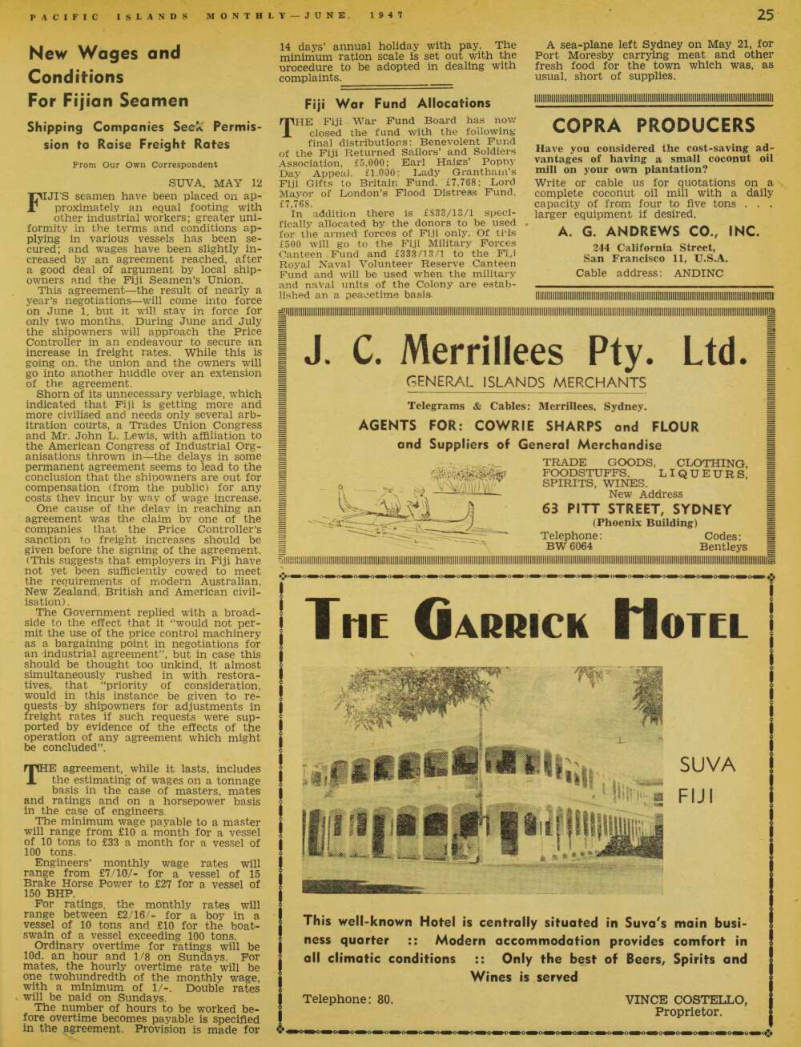
Conditions For Fijian Seamen Shipping Companies Seek Permis sion to Raise Freight Rates
Prom Our Own Correspondent
Suva. May 12
FIJI’S seamen have been placed on ap proximately an equal footing with other industrial workers; greater uni formity in the terms and conditions ap plying in various vessels has been se cured; and wages have been slightly in creased by an agreement reached, after a good deal of argument by local ship owners and the Fiji Seamen’s Union.
This agreement—the result of nearly a year’s negotiations—will come into force on June 1. but it will stay in force for only two months. During June and July the shipowners will approach the Price Controller in an endeavour to secure an increase in freight rates. While this is going on. the union and the owners will go into another huddle over an extension of the agreement.
Shorn of its unnecessary verbiage, which indicated that Fiji is getting more and more civilised and needs only several arb itration courts, a Trades Union Congress and Mr. John L. Lewis, with affiliation to the American Congress of Industrial Org anisations thrown in—the delays in some permanent agreement seems to lead to the conclusion that the shipowners are out for compensation (from the public) for any costs they incur by way of wage increase.
One cause of the delay in reaching an agreement was the claim by one of the companies that the Price Controller’s sanction to freight increases should be given before the signing of the agreement. (This suggests that employers in Fiji have not yet been sufficiently cowed to meet the requirements of modern Australian, New Zealand, British and American civil isation) .
The Government replied with a broad side to the effect that it “would not per mit the use of the price control machinery as a bargaining point in negotiations for an industrial agreement”, but in case this should be thought too unkind, it almost simultaneously rushed in with restora tives, that “priority of consideration, would in this instance be given to re quests by shipowners for adjustments in freight rates if such requests were sup ported by evidence of the effects of the operation of any agreement which might be concluded”. rnHE agreement, while it lasts, includes X the estimating of wages on a tonnage basis in the case of masters, mates and ratings and on a horsepower basis in the case of engineers.
The minimum wage payable to a master will range from £lO a month for a vessel of 10 tons to £33 a month for a vessel of 100 tons.
Engineers’ monthly wage rates will range from £7/10/- for a vessel of 15 Brake Horse Power to £27 for a vessel of
150 Bhp.
For ratings, the monthly rates will range between £2/16/- for a boy in a vessel of 10 tons and £lO for the boat swain of a vessel exceeding 100 tons.
Ordinary overtime for ratings will be lOd. an hour and 1/8 on Sundays. For mates, the hourly overtime rate will be one twohundredth of the monthly wage, with a minimum of 1/-. Double rates will be paid on Sundays.
The number of hours to be worked be fore overtime becomes payable is specified in the agreement. Provision is made for
14 days’ annual holiday with pay. The minimum ration scale is set out with the orocedure to be adopted in dealing with complaints.