Guinea Administration
pp. 15-16 · Read in the full issue
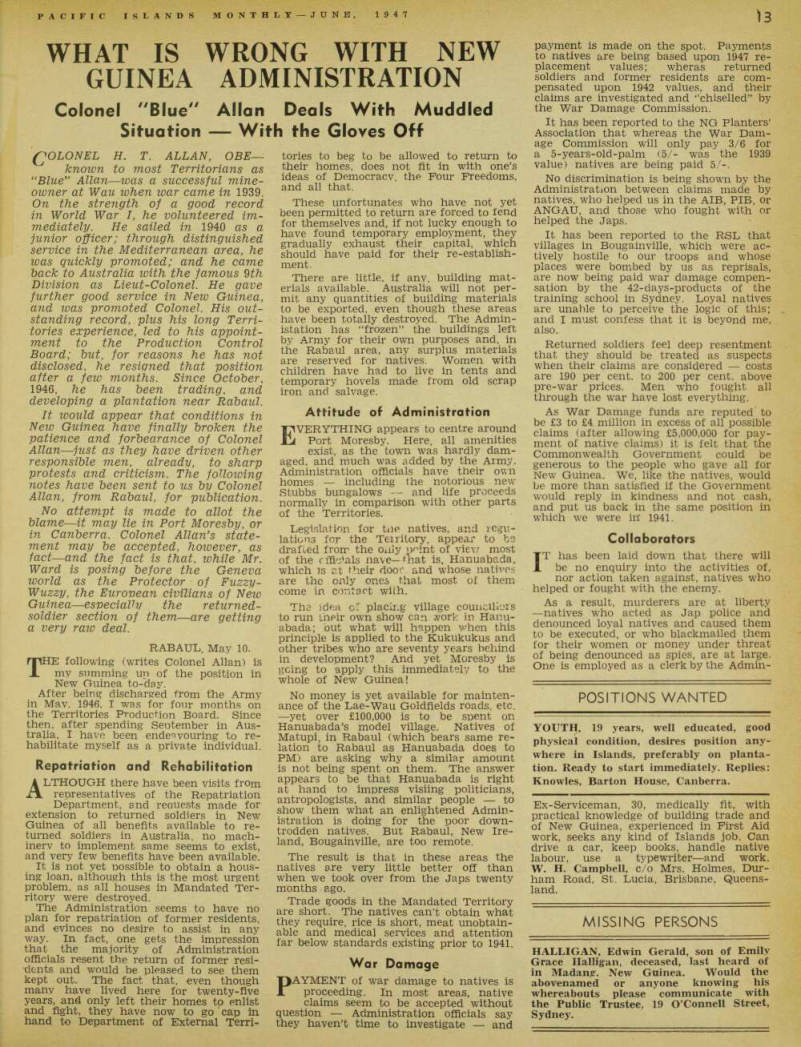

What Is Wrong With New
Colonel "Blue" Allen Deals With Muddled Situation - With the Gloves Off
(Jolonel H. T. Allan, Qbe—
known to most Territorians as “Blue” Allan—was a successful mine owner at Wau when war came in 1939.
On the strength of a good record in World War I, he volunteered im mediately. He sailed in 1940 as a junior officer; through distinguished service in the Mediterranean area, he was quickly promoted; and he came back to Australia with the famous 9th Division as Lieut-Colonel. He gave further good service in New Guinea, and was promoted Colonel. His out standing record, plus his long Terri tories experience, led to his appoint ment to the Production Control Board; but, for reasons he has not disclosed, he resigned that position after a few months. Since October, 1946, he has been trading, and developing a plantation near Rabaul.
It would appear that conditions in New Guinea have finally broken the patience and forbearance of Colonel Allan—just as they have driven other responsible men, already, to sharp protests and criticism. The following notes have been sent to us by Colonel Allan, from Rabaul, for publication.
No attempt is made to allot the blame—it may lie in Port Moresby, or in Canberra. Colonel Allan’s state ment may be accepted, however, as fact—and the fact is that, while Mr.
Ward is posing before the Geneva world as the Protector of Fuzzy- Wuzzy, the Eurovean civilians of New Guinea—especially the returned soldier section of them—are getting a very raw deal.
Rabaul, May 10.
rE following (writes Colonel Allan) is my summing un of the position in New Guinea to-day.
After being discharged from the Army in May. 1946, T was for four months on the Territories Production Board. Since then, after spending Sentember in Aus tralia. I have been endeavouring to re habilitate myself as a private individual.
Repatriation and Rehabilitation ALTHOUGH there have been visits from representatives of the Repatriation Department, and reauests made for extension to returned soldiers in New Guinea of all benefits available to re turned soldiers in Australia, no mach inery to implement same seems to exist, and very few benefits have been available.
It is not yet possible to obtain a hous ing loan, although this is the most urgent problem, as all houses in Mandated Ter ritory were destroyed.
The Administration seems to have no plan for repatriation of former residents, and evinces no desire to assist in any way. In fact, one gets the impression that the majority of Administration officials resent the return of former resi dents and would be pleased to see them kept out. The fact that, even though many have lived here for twenty-five years, and only left their homes to enlist and fight, they have now to go cap in hand to Department of External Terri
tories to beg to be allowed to return to their homes, does not fit in with one’s ideas of Democracv, the Four Freedoms, and all that.
These unfortunates who have not yet been permitted to return are forced to fend for themselves and, if not lucky enough to have found temporary employment, they gradually exhaust their capital, which should have paid for their re-establish ment.
There are little, if any, building mat erials available. Australia will not per mit any quantities of building materials to be exported, even though these areas have been totally destroyed. The Admin istation has “frozen” the buildings left by Army for their own purposes and, in the Rabaul area, any surplus materials are reserved for natives. Women with children have had to live in tents and temporary hovels made from old scrap iron and salvage.
Attitude of Administration EVERYTHING appears to centre around Port Moresby. Here, all amenities exist, as the towm was hardly dam aged, and much was added by the Army.
Administration officials have their own homes including the notorious new Stubbs bungalows and life proceeds normally in comparison with other parts of the Territories.
Legislation for tne natives, and regu lations for the Teiritory, appear to be drafted from the only of view most of the rfacials nave—that is, Hanuabada, which is at their doof and whose natives are the only ones that most of them come in contact with.
The idea of placing village councillors to run their own show can work in Hanu abada ; out what will happen when this principle is applied to the Kukukukus and other tribes who are seventy years behind in development? And yet Moresby is going to apply this immediately to the whole of New Guinea!
No money is yet available for mainten ance of the Lae-Wau Goldfields roads, etc. —yet over £lOO,OOO is to be spent on Hanuabada’s model village. Natives of Matupi, in Rabaul (which bears same re lation to Rabaul as Hanuabada does to PM) are asking why a similar amount is not being spent on them. The answer appears to be that Hanuabada is right at hand to impress visiing politicians, antropologists, and similar people to show them what an enlightened Admin istration is doing for the poor down trodden natives. But Rabaul, New Ire land, Bougainville, are too remote.
The result is that in these areas the natives are very little better off than when we took over from the Japs twenty months ago.
Trade goods in the Mandated Territory are short. The natives can’t obtain what they require, rice is short, meat unobtain able and medical services and attention far below standards existing prior to 1941.
War Damage
PAYMENT of war damage to natives is proceeding. In most areas, native claims seem to be accepted without question Administration officials say they haven’t time to investigate and
payment is made on the spot. Payments to natives are being based upon 1947 re placement values; wheras returned soldiers and former residents are com pensated upon 1942 values, and their claims are investigated and “chiselled” by the War Damage Commission.
It has been reported to the NG Planters’
Association that whereas the War Dam age Commission will only pay 3/6 for a 5-years-old-palm (5/- was the 1939 value) natives are being paid 5/-.
No discrimination is being shown by the Administration between claims made by natives, who helped us in the AIB, PIB, or ANGAU, and those who fought with or helped the Japs.
It has been reported to the RSL that villages in Bougainville, which were ac tively hostile to our troops and whose places were bombed by us as reprisals, are now being paid war damage compen sation by the 42-days-products of the training school in Sydney. Loyal natives are unable to perceive the logic of this; and I must confess that it is beyond me, also.
Returned soldiers feel deep resentment that they should be treated as suspects when their claims are considered costs are 190 per cent, to 200 per cent, above pre-war prices. Men who fought all through the war have lost everything.
As War Damage funds are reputed to be £3 to £4 million in excess of all possible claims (after allowing £5,000,000 for pay ment of native claims) it is felt that the Commonwealth Government could be generous to the people who gave all for New Guinea. We, like the natives, would be more than satisfied if the Government would reply in kindness and not cash, and put us back in the same position in which we were in* 1941.
Collaborators IT has been laid down that there will be no enquiry into the activities of, nor action taken against, natives who helped or fought with the enemy.
As a result, murderers are at liberty —natives who acted as Jap police and denounced loyal natives and caused them to be executed, or who blackmailed them for their women or money under threat of being denounced as spies, are at large.
One is employed as a clerk by the Admin-
Ex-Serviceman, 30, medically fit, with practical knowledge of building trade and of New Guinea, experienced in First Aid work, seeks any kind of Islands job. Can drive a car, keep books, handle native labour, use a typewriter—and work.
W. H. Campbell, c/o Mrs. Holmes, Dur ham Road, St. Lucia, Brisbane, Queens land.
istration at Rabaul, and another is promi nent in the RPC in Rabaul. Many who, for their services to the Japs, were made luluais and tultuls, still retain their office.
The natives who were loyal to us are bewildered and resentful. They are losing their respect for law and order and the present regime is being referred to more and more as “Government Gammon.”
Many natives have asked me why things are not “all the same before”— why they are unable to get the stores,
trucks, etc., that they had before why. after twenty months, they are still unable to market rheir copra, etc., in places like Manus, Bougainville, New Ire land. Some say (and I think truly) that they are no better off now than when under the Japs.
A decline in morality is most evident.
Thieving is becoming more and more prevalent; and in Rabaul recently, pil laging from wharves has assumed large proportions. In Rabaul, thirty Matupi natives who worked on stevedoring under Administrative supervision are now in cus tody for being In possession of stolen goods.
In the villages, the people of the younger generation have lost their res pect for the older men (and this was the basis of village life) and the authority of the elders is being openly flouted.
This younger generation is not inter ested in planting food or producing copra —in areas, like Rabaul, they are leaving the villages and living in Chinatown.
Shipping and Transport
rE Shipping Board has failed to provide any reliable or efficient service between Island ports. Ships do not run to schedule, and they spend a large part of their time waiting for now masters, or crews, or engine parts.
It is quite impossible for an individual to plan a business or recruiting trip on a timed schedule, because the shipping service functions so spasmodically.
The Minister’s recent statement in reply to Monsignor Hannan, that there was an efficient service operating and ports better serviced than they had ever been, is completely contrary to facts.
New Ireland, Bougainville and outports Bre desperately short of necessities, and the position is deteriorating through lack of regular and reliable shipping.
Preference to Notives
GENERAL policy seems to be to ignore or harrass European efforts and concen trate on natives.
In Rabaul area, all Administration haulage business was given to native truck-owners, whilst returned soldiers who were endeavouring to rehabilitate them selves were not employed.
Lately, this has broken down because the natives pillaged so much cargo from recent shipments. Now, the returned soldier truck-owners have been asked to work the night shift because it has be come impossible to trust the natives.
Any complaint by a native receives prompt attention by the Administrator.
Recently, a native from Rabaul wrote to Moresby that he had been put through the Third Degree in Rabaul goal, and beaten up. Urgent signals were immedi ately despached to Judge Phillips, then in Rabaul, to have an enquiry and report back to Administration.
Investigation proved the native had never been in gaol and that he was notorious as having been one of the Japs’ best collaborators, and a denouncer of loyal natives.
Yet appeals from RSL for investigation into theft of Jap petrol by natives (which has occurred on a large scale) and other similar matters, remain unattended to.
Loss of Cargo
PILFERING on ships and wharves is on a large scale, and heavy losses have occurred in all recent ship ments.
Now the Shinping Board refuses to accept any liability for cargo lost en route, even though there is a legal liability on any transport contractor for goods whilst in his custody.
The Customs insist upon duty being naid on all goods manifested before any goods can be collected.
As a result Customs duty is accepted for goods which subsenuentlv mav be found to have been stolen en route, or not received, and are therefore not actually landed to the Customs.
When application is made for refund of this duty, the Customs sav that they will not refund until the Shipping Board has naid the claim for loss of goods— and the Shinning Board declines to accept any responsibility or to pay.
The result is that firms and individuals are out-of-pocket big sums of monev. for goods lost or stolen, and the Administra tion is holding large sums of money taken by them for dutv on goods that have not arrived. Many think that this is equiva lent to taking money under false pre tences, and it seems certain that legal action will soom be taken against Admin istration.