The Polynesians and Peru
pp. 73-74 · Read in the full issue
Reviving Interest in Theory of South American Influence in Ancient Polynesia
rE long drift on the balsa wood-raft which is being undertaken by six young Norwegian scientists to prove that natives of South America could have arrived In some of the islands of Poly nesia before the Polynesians, has begun.
The raft set out on its 4,000 mile voyage from Callao, Peru on April 28.
The leader of the expedition is Thor Heyerdahl, an anthropologist. He expects the voyage to take about four months.
The raft, which is 18 feet by 45 feet, like those of ancient Peruvians who Heyerdahl believes peopled the Tuomotus, is lashed together by ropes. It has a primitive square sail, a rudder, oars and a bamboo deck and cabin. By May 10 it had drifted 500 miles.
Heyerdahl is not by any means the first European to believe that parts of Polynesia were inhabited long before the arrival of the Polynesians. It is more than likely that this was so but whether the settlement was other than accidental or anything but on a small scale is open to doubt. Those who favour the Peru vian theory point out language affinities between certain parts of Polynesia and Peru; the fact that the kumera, or sweet potato, which is now common to most of Polynesia, is not indigenous to those islands or to Indonesia from whence the Polynesians are popularly believed to have come, but is indengenous to South America: the mysterious statues on Easter Island; and various other facts.
AMONG those who believe that the Eastern Pacific was first settled by Peruvians is Mr. A. C. Rowland of Papeete who has given a great deal of study to the subject. Writing recently he ouoted the great Polynesian scholar.
William Churchill, whose monumental work on Polynesian languages and other books, have contributed largely to our knowledge of Polynesia.
Rowland writes: “Churchill made a surprising discovery in South Eastern Polynesia—that the five dialects of the archipelagoes comprising this area con tain a large vocabulary of words which are peculiar to that area and do not appear in any of the many dialects spoken elsewhere in Polynesia. In other words, the dialects of Tahiti. Marquesas.
Tuamotu, Mangareva and Easter Island contain an element of speech quite un known in Hawaii, Samoa, Tonga and the rest of Polynesia.
“To quote Mr. Churchill: ‘We find one element of unknown antiquity, a corpus of Polynesian speech summed up at 16 000 vocables which have passed from the use and memory of the race Tr> the Paumotu group slightly less than half of the sneech equipment, and in the other subdivisions of the province a shade more than two-thirds of the speech equipment, are wholly unidentifiable else where in Polynesia; so far as we know, they are quite unknown anywhere in the world.’
“This may be explained by the proba bility that the language from which this volume of words has been taken had passed out of use in the country of its origin centuries before the first European entered the Western World.
“The fact that these words, as we find them, conform to the Polynesian idiom, does not exclude the probabilitv of their extra-Polynesian origin. Our English speech abounds with words from other languages which have become so trans formed to the Anglo-Saxon idiom that
their origin is known only through the of Philologists.
This discovery by Mr. William Churchill adds a weighty element to the evidence which has convinced this writer that, when the first wave of Polynesians approached the island now called Ra latea—their first landfall after Samoa —they had their first sight of a coconut
palm; and on landing were given to eat the first sweet potato which had ever passed their lips “The sun god, Tane-Ahu-Ura (Tane of the crimson feather cloak) and the statues on Easter Island, bear the hail mark of South America. The large lexi con of strange vocables points in the same direction.”
Col. Murray Visits
"Veilomani Ii"
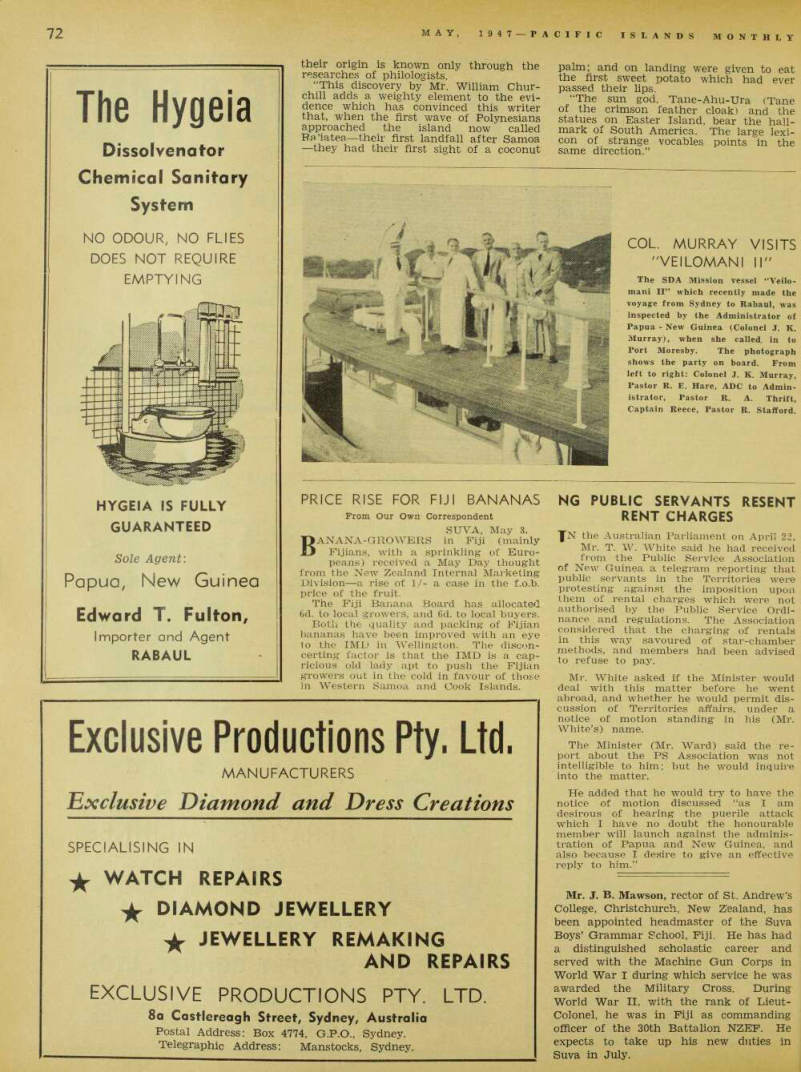
The SDA Mission vessel “Veilo mani II” which recently made the voyage from Sydney to Rabaul, was inspected by the Administrator of Papua-New Guinea (Colonel J. K.
Murray), when she called in to Port Moresby, The photograph shows the party on board. From left to right: Colonel J. K. Murray, Pastor R. E. Hare, ADC to Admin istrator, Pastor R. A. Thrift, Captain Reece, Pastor R. Stafford.