"Backward Melanesians"
p. 63 · Read in the full issue
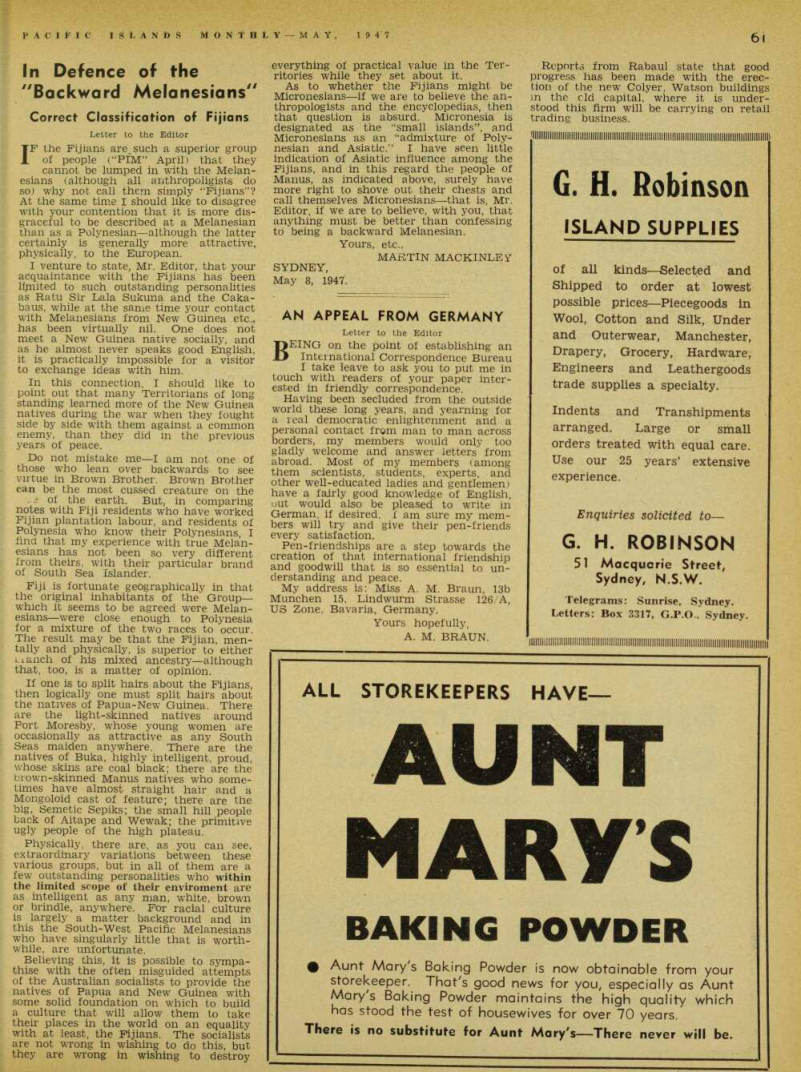
In Defence of the "Backward Melanesians"
Correct Classification of Fijians
Letter to the Editor IF the Fijians are_such a superior group of people (“PIM” April) that they cannot be lumped in with the Melan esians (although all anthropoligists do so) why not call them simply “Fijians”?
At the same time I should like to disagree with your contention that it is more dis graceful to be described at a Melanesian than as a Polynesian—although the latter certainly is generally more attractive, physically, to the European.
I venture to state, Mr. Editor, that your acquaintance with the Fijians has been limited to such outstanding personalities as Ratu Sir Lala Sukuna and the Caka baus, while at the same time your contact with Melanesians from New Guinea etc., has been virtually nil. One does not meet a New Guinea native socially, and as he almost never speaks good English, it is practically impossible for a visitor to exchange ideas with him.
In this connection, I should like to point out that many Territorians of long standing learned more of the New Guinea natives during the war when they fought side by side with them against a common enemy, than they did in the previous years of peace.
Do not mistake me—l am not one of those who lean over backwards to see virtue in Brown Brother. Brown Brother can be the most cussed creature on the - of the earth. But, in comparing notes with Fiji residents who have worked Fijian plantation labour, and residents of Polynesia who know their Polynesians, I find that my experience with true Melan esians has not been so very different from theirs, with their particular brand of South Sea Islander.
Fiji is fortunate geographically in that the original inhabitants of the Group— which it seems to be agreed were Melan esians—were close enough to Polynesia for a mixture of the two races to occur.
The result may be that the Fijian, men tally and physically, is superior to either Li anch of his mixed ancestry—although that, too, is a matter of opinion.
If one is to split hairs about the Fijians, then logically one must split hairs about the natives of Papua-New Guinea. There are the light-skinned natives around Port Moresby, whose young women are occasionally as attractive as any South Seas maiden anywhere. There are the natives of Buka, highly intelligent, proud, whose skins are coal black; there are the brown-skinned Manus natives who some times have almost straight hair and a Mongoloid cast of feature; there are the big, Semetic Sepiks; the small hill people back of Aitape and Wewak; the primitive ugly people of the high plateau.
Physically, there are, as you can see, extraordinary variations between these various groups, but in all of them are a few outstanding personalities who within the limited scope of their enviroment are as intelligent as any man, white, brown or brindle, anywhere. For racial culture is largely a matter background and in this the South-West Pacific Melanesians who have singularly little that is worth while, are unfortunate.
Believing this, it is possible to sympa thise with the often misguided attempts of the Australian socialists to provide the natives of Papua and New Guinea with some solid foundation on which to build a culture that will allow them to take their places in the world on an equality with at least, the Fijians. The socialists are not wrong in wishing to do this, but they are wrong in wishing to destroy
everything of practical value in the Ter ritories while they set about it.
As to whether the Fijians might be Micronesians —if we are to believe the an thropologists and the encyclopedias, then that question is absurd. Micronesia is designated as the “small islands”, and Micronesians as an “admixture of Poly nesian and Asiatic,” I have seen little indication of Asiatic influence among the Fijians, and in this regard the people of Manus, as indicated above, surely have more right to shove out their chests and call themselves Micronesians—that is. Mr.
Editor, if we are to believe, with you, that anything must be better than confessing to being a backward Melanesian.
Yours, etc.,
Martin Mackinley
Sydney,
May 8, 1947.