by "C. Coral"
p. 46 · Read in the full issue
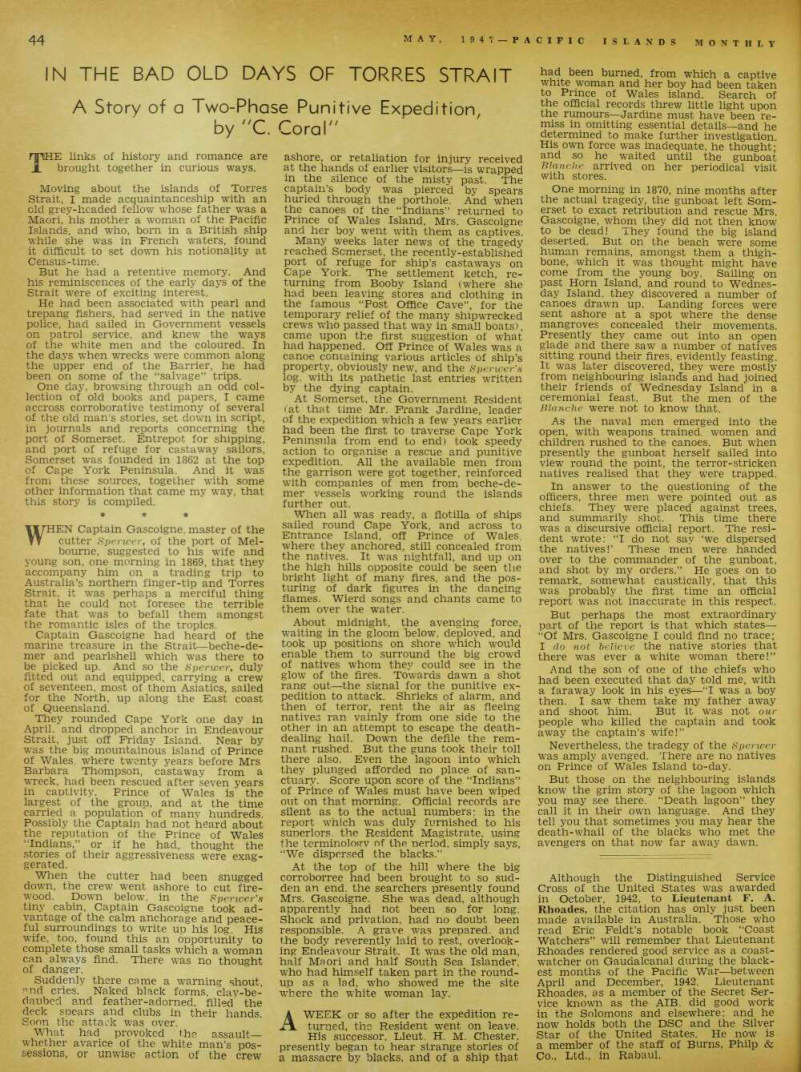
IN THE BAD OLD DAYS OF TORRES STRAIT A Story of a Two-Phase Punitive Expedition,
rE links of history and romance are brought together in curious ways.
Moving about the islands of Torres Strait, I made acquaintanceship with an old grey-headed fellow whose father was a Maori, his mother a woman of the Pacific Islands, and who, born in a British ship while she was in French waters, found it difficult to set down his notionality at Census-time.
But he had a retentive memory. And his reminiscences of the early days of the Strait were of exciting interest.
He had been associated with pearl and trepang fishers, had served in the native police, had sailed in Government vessels on patrol service, and knew the ways of the white men and the coloured. In the days when wrecks were common along the upper end of the Barrier, he had been on some of the “salvage” trips.
One day, browsing through an odd col lection of old books and papers, I came accross corroborative testimony of several of the old man’s stories, set down in script, in journals and reports concerning the port of Somerset. Entrepot for shipping, and port of refuge for castaway sailors, Somerset was founded in 1862 at the top of Cape York Peninsula. And it was from these sources, together with some other information that came my way, that this story is compiled. * ♦ ♦ ¥¥THEN Captain Gascoigne, master of the TT cutter Sperwer , of the port of Mel bourne, suggested to his wife and young son, one morning in 1869, that they accompany him on a trading trip to Australia’s northern finger-tip and Torres Strait, it was perhaps a merciful thing that he could not foresee the terrible fate that was to befall them amongst the romantic isles of the tropics.
Captain Gascoigne had heard of the marine treasure in the Strait —beche-demer and pearlshell which was there to be picked up. And so the Sperwer, duly fitted out and equipped, carrying a crew of seventeen, most of them Asiatics, sailed for the North, up along the East coast of Queensland.
They rounded Cape York one day in April, and dropped anchor in Endeavour Strait, just off Friday Island. Near by was the big mountainous island of Prince of Wales, where twenty years before Mrs Barbara Thompson, castaway from a wreck, had been rescued after seven years in captivity. Prince of Wales is the largest of the group, and at the time carried a population of many hundreds.
Possibly the Captain had not heard about the reputation of the Prince of Wales “Indians,” or if he had, thought the stories of their aggressiveness were exag gerated.
When the cutter had been snugged down, the crew went ashore to cut fire wood. Down below, in the Sperwer’s tiny cabin, Captain Gascoigne took ad vantage of the calm anchorage and peace ful surroundings to write up his log. His wife, too, found this an opportunity to complete those small tasks which a woman can always find. There was no thought of danger.
Suddenly there came a warning shout, and cries. Naked black forms, clay-be daubed and feather-adorned, filled the deck spears and clubs in their hands.
Soon the attack was over.
What had provoked the assault— whether avarice of the white man’s pos sessions, or unwise action of the crew
ashore, or retaliation for injury received at the hands of earlier visitors—is wrapped in the silence of the misty past. The captain’s body was pierced by spears hurled through the porthole. And when the canoes of the “Indians” returned to Prince of Wales Island, Mrs. Gascoigne and her boy went with them as captives.
Many weeks later news of the tragedy reached Somerset, the recently-established port of refuge for ship’s castaways on Cape York. The settlement ketch, re turning from Booby Island (where she had been leaving stores and clothing in the famous “Post Office Cave”, for the temporary relief of the many shipwrecked crews who passed that way in small boats), came upon the first suggestion of what had happened. Off Prince of Wales was a canoe containing various articles of ship’s property, obviously new, and the Sperwer’s log, with its pathetic last entries written by the dying captain.
At Somerset, the Government Resident (at that time Mr. Prank Jardine, leader of the expedition which a few years earlier had been the first to traverse Cape York Peninsula from end to end) took speedy action to organise a rescue and punitive expedition. All the available men from the garrison were got together, reinforced with companies of men from beche-de mer vessels working round the islands further out.
When all was ready, a flotilla of ships sailed round Cape York, and across to Entrance Island, off Prince of Wales, where they anchored, still concealed from the natives. It was nightfall, and up on the high hills opposite could be seen the bright light of many fires, and the pos turing of dark figures in the dancing flames. Wierd songs and chants came to them over the water.
About midnight, the avenging force, waiting in the gloom below, deployed, and took up positions on shore which would enable them to surround the big crowd of natives whom they could see in the glow of the fires. Towards dawn a shot rang out —the signal for the punitive ex pedition to attack. Shrieks of alarm, and then of terror, rent the air as fleeing natives ran vainly from one side to the other in an attempt to escape the death dealing hail. Down the defile the rem nant rushed. But the guns took their toll there also. Even the lagoon into which they plunged afforded no place of san ctuary. Score upon score of the “Indians” of Prince of Wales must have been wiped out on that morning. Official records are silent as to the actual numbers: in the report which was duly furnished to his superiors, the Resident Magistrate, using the terminolosrv of the period, simply says, “We dispersed the blacks.”
At the top of the hill where the big corroborree had been brought to so sud den an end. the searchers presently found Mrs. Gascoigne. She was dead, although apparently had not been so for long.
Shock and privation, had no doubt been responsible. A grave was prepared, and the body reverently laid to rest, overlook ing Endeavour Strait. It was the old man, half Maori and half South Sea Islander, who had himself taken part in the round up as a lad, who showed me the site where the white woman lay.
A WEEK or so after the expedition re turned, the Resident went on leave.
His successor, Lieut H. M. Chester, presently began to hear strange stories of a massacre by blacks, and of a ship that
had been burned, from which a captive white woman and her boy had been taken to Prince of Wales island. Search of the official records threw little light upon the rumours—Jar dine must have been re miss in omitting essential details—and he determined to make further investigation.
His own force was inadequate, he thought; and so he waited until the gunboat Blanche arrived on her periodical visit with stores.
One morning in 1870, nine months after the actual tragedy, the gunboat left Som erset to exact retribution and rescue Mrs.
Gascoigne, whom they did not then know to be dead! They found the big island deserted. But on the beach were some human remains, amongst them a thigh bone, which it was thought might have come from the young boy. Sailing on past Horn Island, and round to Wednes day Island, they discovered a number of canoes drawn up. Landing forces were sent ashore at a spot where the dense mangroves concealed their movements.
Presently they came out into an open glade and there saw a number of natives sitting round their fires, evidently feasting.
It was later discovered, they were mostly from neighbouring islands and had joined their friends of Wednesday Island in a ceremonial feast. But the men of the Blanche were not to know that.
As the naval men emerged into the open, with weapons trained women and children rushed to the canoes. But when presently the gunboat herself sailed into view round the point, the terror-stricken natives realised that they were trapped.
In answer to the questioning of the officers, three men were pointed out as chiefs. They were placed against trees, and summarily shot. This time there was a discursive official report. The resi dent wrote; “I do not say ‘we dispersed the natives!’ These men were handed over to the commander of the gunboat, and shot by my orders.” He goes on to remark, somewhat caustically, that this was probably the first time an official report was not inaccurate in this respect.
But perhaps the most extraordinary part of the report is that which states — “Of Mrs. Gascoigne I could find no trace; I do not believe the native stories that there was ever a white woman there!”
And the son of one of the chiefs who had been executed that day told me, with a faraway look in his eyes—“l was a boy then. I saw them take my father away and shoot him. But it was not our people who killed the captain and took away the captain’s wife!”
Nevertheless, the tradegy of the Sperwer was amply avenged. There are no natives on Prince of Wales Island to-day.
But those on the neighbouring islands know the grim story of the lagoon which you may see there. “Death lagoon” they call it in their own language. And they tell you that sometimes you may hear the death-whail of the blacks who met the avengers on that now far away dawn.
Although the Distinguished Service Cross of the United States was awarded in October, 1942, to Lieutenant F. A.
Rhoades, the citation has only just been made available in Australia. Those who read Eric Feldt’s notable book “Coast Watchers” will remember that Lieutenant Rhoades rendered good service as a coast watcher on Gaudalcanal during the black est months of the Pacific War—between April and December, 1942. Lieutenant Rhoades, as a member of the Secret Ser vice known as the AIB, did good work in the Solomons and elsewhere: and he now holds both the DSC and the Silver Star of the United States. He now is a member of the staff of Burns, Philp & Co., Ltd., in Rabaul.