The Bread Season Opens
p. 45 · Read in the full issue
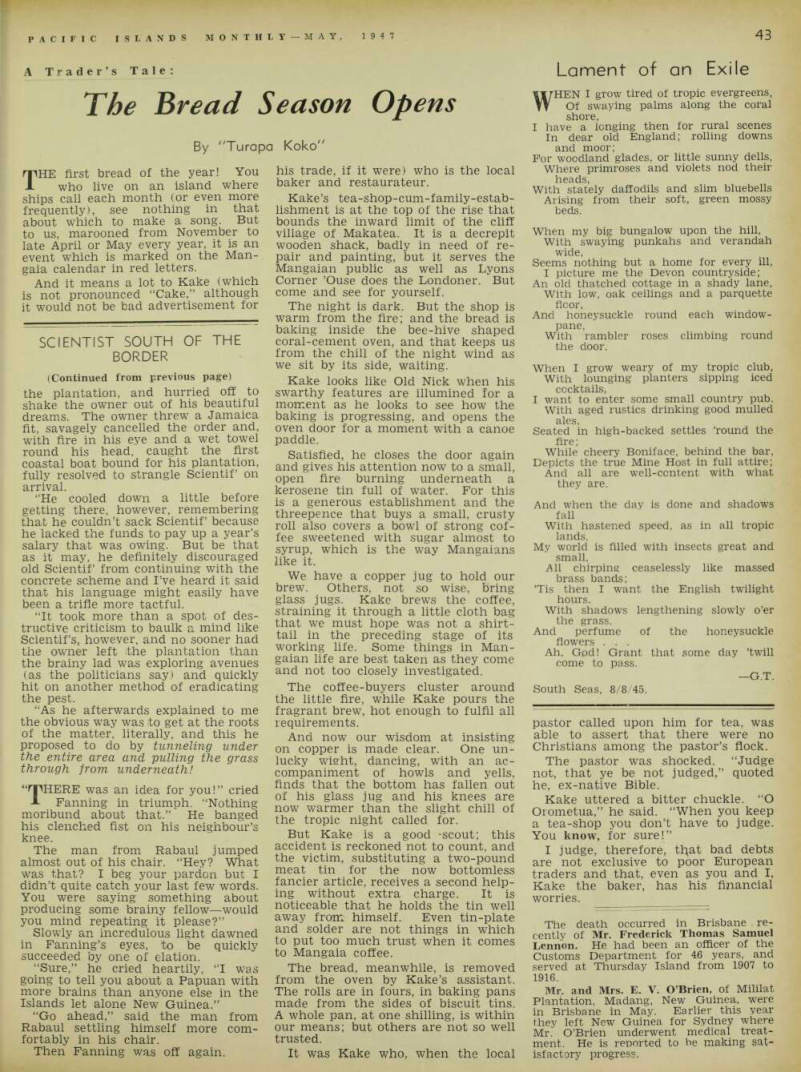
A Trader’s Tale: The Bread Season Opens
By "Turapa Koko"
THE first bread of the year! You who live on an island where ships call each month (or even more frequently), see nothing in that about which to make a song. But to us, marooned from November to late April or May every year, it is an event which is marked on the Man gaia calendar in red letters.
And it means a lot to Kake (which is not pronounced “Cake,” although it would not be bad advertisement for
his trade, if it were) who is the local baker and restaurateur.
Kake’s tea-shop-cum-family-estab lishment is at the top of the rise that bounds the inward limit of the cliff village of Makatea. It is a decrepit wooden shack, badly in need of re pair and painting, but it serves the Mangaian public as well as Lyons Corner ’Ouse does the Londoner. But come and see for yourself.
The night is dark. But the shop is warm from the fire; and the bread is baking inside the bee-hive shaped coral-cement oven, and that keeps us from the chill of the night wind as we sit by its side, waiting.
Kake looks like Old Nick when his swarthy features are illumined for a moment as he looks to see how the baking is progressing, and opens the oven door for a moment with a canoe paddle.
Satisfied, he closes the door again and gives his attention now to a small, open fire burning underneath a kerosene tin full of water. For this is a generous establishment and the threepence that buys a small, crusty roll also covers a bowl of strong cof fee sweetened with sugar almost to syrup, which is the way Mangaians like it.
We have a copper jug to hold our brew. Others, not so wise, bring glass jugs. Kake brews the coffee, straining it through a little cloth bag that we must hope was not a shirt tail in the preceding stage of its working life. Some things in Man gaian life are best taken as they come and not too closely investigated.
The coffee-buyers cluster around the little fire, while Kake pours the fragrant brew, hot enough to fulfil all requirements.
And now our wisdom at insisting on copper is made clear. One un lucky wieht, dancing, with an ac companiment of howls and yells, finds that the bottom has fallen out of his glass jug and his knees are now warmer than the slight chill of the tropic night called for.
But Kake is a good -scout; this accident is reckoned not to count, and the victim, substituting a two-pound meat tin for the now bottomless fancier article, receives a second help ing without extra charge. It is noticeable that he holds the tin well away from himself. Even tin-plate and solder are not things in which to put too much trust when it comes to Mangaia coffee.
The bread, meanwhile, is removed from the oven by Kake’s assistant.
The rolls are in fours, in baking pans made from the sides of biscuit tins.
A whole pan, at one shilling, is within our means; but others are not so well trusted.
It was Kake who, when the local
pastor called upon him for tea, was able to assert that there were no Christians among the pastor’s flock.
The pastor was shocked. “Judge not, that ye be not judged,” quoted he, ex-native Bible.
Kake uttered a bitter chuckle. “O Orometua,” he said. “When you keep a tea-shop you don’t have to judge.
You know, for sure!”
I judge, therefore, bad debts are not exclusive to poor European traders and that, even as you and I, Kake the baker, has his financial worries.
The death occurred in Brisbane re cently of Mr. Frederick Thomas Samuel Lennon. He had been an officer of the Customs Department for 46 years, and served at Thursday Island from 1907 to 1916.
Mr. and Mrs. E. V. O’Brien, of Mililat Plantation, Madang, New Guinea, were in Brisbane in May. Earlier this year they left New Guinea for Sydney where Mr. O’Brien underwent medical treat ment. He is reported to be making sat isfactory progress.