Tragic Death Of
pp. 27-29 · Read in the full issue
Clive Brewster
Joske Family Link With Old Fiji Is Broken
rE death occurred in Delhi, India, on April 23, of Mr. Clive Brewster-, of Suva, Fiji, in somewhat strange circumstances.
Mr. Brewster was on his way back to Fiji, from Britain, to resume his active connection with W. R. Carpenter & Co. (Fiji), Ltd. At the request of the Sydney
office, he broke his journey in India in order to make some inquiries. He went directly from the plane, in Delhi, to the Taj Mahal Hotel, in the company of a man friend, and booked in, on the fifth floor. The friend was away, in the lavatory, for a few minutes. When he re turned, Mr. Brewster was missing, and it was then dis covered that he had fallen from the window , to the street, a distance of 80 feet, and was killed.
A coroner’s inquiry could find no explanation of the occurence, and the verdict was accidental death. It is presumed that Mr. Brewster was leaning out of the win dow, looking at the city, when he became dizzy, and fell.
Thus there disappears one of the outstanding and most picturesque figures of the European community in Fiji.
Brewster was born in Suva 51 years ago, as Clive Brewster Joske, son of that notable Fiji pioneer, Alexander Brewster Joske. About 1938, by legal process, Clive renounced the name of Joske, in favour of the old family name of Brewster.
CLIVE was only 18 when he left the Melbourne* Grammar School to en list in World War I. He served in the Royal Plying Corps from 1914 to 1918; was ADC to the Australian GG 1919-21; joined up with his father’s old firm, Brown and Joske Ltd., on the death of his father in 1922; was chairman and managing director in 1924; and, in the next 15 years,
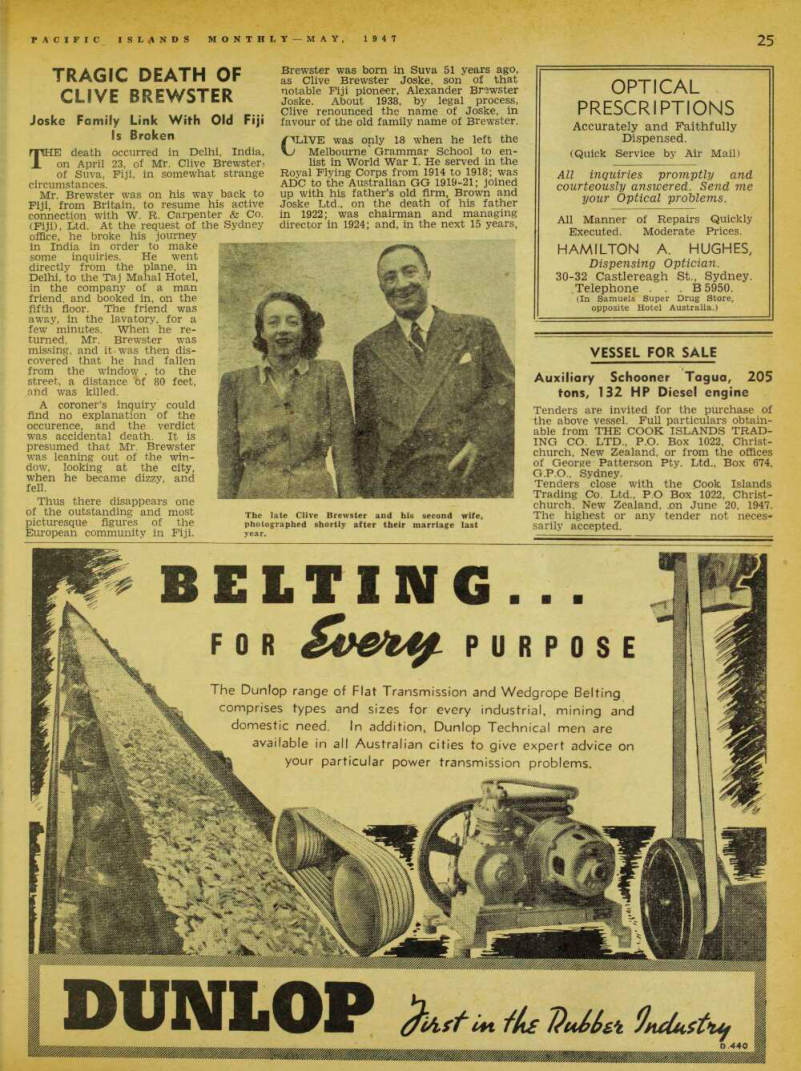
The late Clive Brewster and his second wife, photographed shortly after their marriage last year.
he held various public positions in Fiji, was Consul there for France and Norway, Lieut.-Colonel in charge of the Fiji Defence Force, and was in charge of W. R.
Careen ter & Co (Fiii) Ltd. when that concern absorbed Brown & Joske Ltd.
Out of these activities, Mr Brewster gained the following distinctions:— From World War i.—Military Cross.
From France.—chevalier of Legion of Honour, 1936 - From Norway.—officer of st, oiav, 1936.
From Britain.—Officer of British Empire; Long service Medal, Colonial Aux. Forces, , Within a few weeks of the outbreak of world War 11, Clive Brewster was in Sydney, confidently offering his services, Cokmel P in Yl the*piif°n^erice n rantain £ the Sd Rovaf Flvins Co?Ss To P Ws oSsnoken disgSst he was cSldlv reMived° U “You are 1 43” S said
wlrfn? L]L men ”(Brewster'
incidentalsLwavs loSled Ibout 10 vmfs
1 M lO y less than his age.) In the end, persistence won. He was taken into the RAAF—but with the—to him—lowly rank of Flying Officer. But, once he was inside, nothing could stop him. Within a few months, he was in charge of the training school at Evans Head, NSW; he was promoted and promoted, and soon he was in the thick of the Pacific War, as liaison officer on the staff of Commander-m-Chief MacArthur; and finally he was Group-Captain, in charge of the RAAF School of Admimstration University of Melbourne. Handsome, clever and restless, he was always showing up in some prominent place, His social accomplishments attracted new friends to him, wherever he went. Even when the Jap surrendered, and the war
was over, he made one more striking ap pearance; He claimed to have been in the last plane to bomb the Japs, some where between Indonesia and Australia.
IN 1928, Mr. Brewster married Miss Elizabeth Jean Pearson, daughter of a prominent Indian Civil Servant, and they had one son—he is at school in Victoria. The marriage was not a suc cess, and the couple separated. There was a reconciliation when Mr. Brewster went with the Fijian contingent to the Corona tion in 1937, but it did not endure, and they were divorced during the war period.
Early in 1946, he returned to Suva, to take charge of the big Fiji Company; but he was still restless and unsettled— adventure and romance still were calling.
In July, last year, he startled his in numerable friends, and Suva, by getting married again, at an hour’s notice. Mrs.
Eve Walker, an Englishwoman, was public relations officer for BO AC; and, in that capacity, she visited Suva, en route to Samoa and Rarotonga. She was well known, vivacious and attractive. She and Mr. Brewster had met under war con ditions in Australia, where she then was a member of the WRNS. There was a swift courtship and a swifter marriage— and a few hours later, Mr. and Mrs.
Brewster were on a plane, en route to Auckland, Sydney and London.
For some months past, Mr. Brewster had been acting in Britain as a lecturer for the British Department of Informa tion. But (according to letters from him received recently in Australia) his second marriage was not a success; and he had decided to return to Fiji.
Friends all over the world will mourn the untimely, tragic death of a very un usual and very loveable man.
rpHE death of Clive Brewster ends not JL only a colourful and remarkable career, but also the famous Joske family’s active connection with Fiji.
In 1869, Paul Joske, Polish Jew by descent, came from England with much capital and bought land where Suva now stands. With a Mr. Brewer, he established cotton-growing, cattle farming and saw milling. Mr. Liecester Smith and Mr. j. c. Harrison experimented, and found that the (apparently) indigenous cane had a substantial sugar content. Brewer and joske then began an investigation, which ended in their planting sugar-cane over much of the Suva Point area, and im porting milling machinery. The enter prise was an economic failure, and cost them some £3o,ooo—but they did prove that Fiji could produce good sugar, in 1882 Paul Joske much poorer returned to England, leaving his son, Alexander Brewster Joske, to carry on. Clive was born in 1896.
In 1888, Mr. Joske amalgamated his trading business with that.conducted by Mr. L E. Brown (Hartenstem and Brown, formed in 1884), and in the ensuing 30 years the firm (latterly a company) of Brown & Joske Ltd., had a very large share of the commercial and shipping business of the Colony. In the early part of the century, they were the biggest traders in Lautoka. ° ne monument to the family will re main alwa^s ’ however. In the ranges, west of Suy a, there is a remarkable moun tain called Joske ’ s Thumb—probably the most noticeable feature of the Viti Levu sk y- line > as seen from Suva. Shaped like a thumb, it stands out clear and sharp against the evening sky. Old residents S ay they can foretell the weather from the way the clouds gather—or do not gather —around Joske’s Thumb. R.