Partnership
pp. 25-26 · Read in the full issue
Death Of Charles B.
Nordhoff
Story of Famous Tahiti Partnership
Papeete, Apr. 15
rAT most successful writer of Pacific books, Mr. Charles B. Nordhoff, died at his home in Santa Barbara, Cali fornia, on April 11.
His equally famous collaborator, Mr.
Norman J. Hall, happened to be in the United States at the time —he had gone there to attend the wedding of his daughter Nancy, in New York. He is due back in Tahiti in June. ♦ * * * NORDHOFF was not an old man—fifty ish, maybe—but he was not in good health. He habitually drank strong spirits, which had caused bad conditions
somewhere inside; and he had developed cataract. He wrote to me from his Cali fornian ranch last year, and told me that his sight was nearly gone and soon he would have to undergo a critical operation.
Nordhoff and Hall, in 1914, were two young Americans who joined the French
Air Force in World War I. When America came in, in 1917, they flew planes for Uncle Sam. They were well-educated, im aginative, very sensitive young men, and they did not like the world an they had seen it. When the war was over, they decided to seek some remote, pleasant place, away from it all, and remain there.
Tahiti was their selection. They joined the Anglo-American colony -in that beauti ful island soon after Versailles. Both married Prench-Polynesian girls, and had families.
They both wrote, and wrote well. Some times individually, sometimes in collabora tion, they produced stories and articles — and so made sufficient income to meet their modest needs. Nordhoff wrote a book for boys which is still bringing in royalties.
About 1930, they decided to collaborate in a bock on Bligh, and Pitcairn Island.
By the time they had compiled their notes, it had grown to a trilogy—“ Mutiny”. “Men Against the Sea”, and “Pitcairn’s Island” —which were published between 1932 and 1935. The first won a tremendous market, and the others, thus introduced, sold almost as well. I liked best the least known of them—“ Pitcairn’s Island”.
IN 1934, Nordhoff went to Australia, to see whether they could get enough material there about Bligh, as Gover nor of NSW, to make a fourth book. I saw much of him—we spent a week to gether on a launch on the Hawkesbury River—and the figuies he quoted then gave me a startling indication of how much money can be made in America
by successful authorship. Their royal ties were huge—but they really got money in big lumps from the sale of the film rights. It will be remembered that
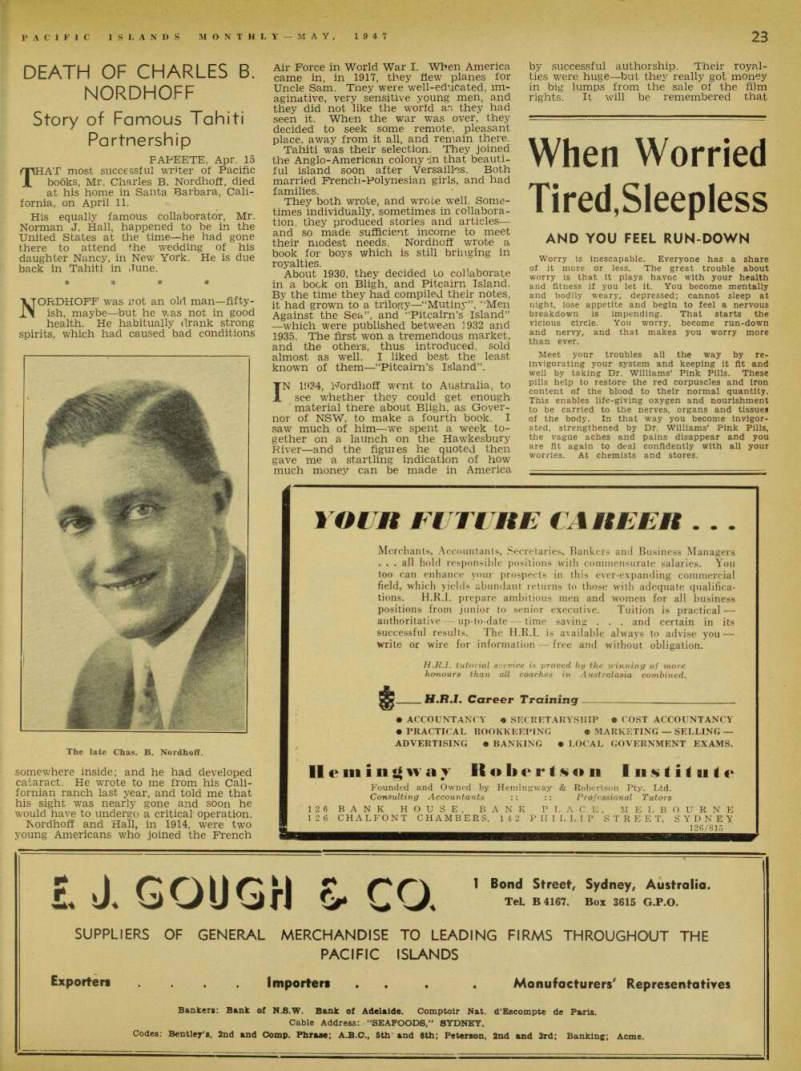
The late Chas. B. Nordhoff.
Mutiny” was filmed, with Laughton as Bligh, in the middle thirties.
After that, Nordhoff and Hall produced various books, stories and plays. I have a bright memory of one film of theirs, “The Tuttles of Tahiti,” with Charles Laughton as Tuttle—a most diverting story of a typical mixed-race family, true to type.
By the later thirties, both men were wealthy, and the partnership tended to break up. Their friendship remained; but while Hall lived a very happy married life in Tahiti, Nordhoff' had be come a wanderer and spent much of his time in America. Finally, he settled in Santa Barbara.
It was one of the hapniest and most successful! collaborations of the Between- Wars period. The two men were individual —widely different in temperament and outlook—yet they were as one in the painstaking care with which thev as sembled their data and strove for a high literary standard. When I was with Nordhoff, I tried, more than once, to say where, in their books, Nordhoff ended and Hall began; but I could never separate their work.
Nordhoff had an amazing memory and fund of general knowledge—he could have won almost any Qtiiz contest. He was a lovable fellow—an entertaining companion and a charming host.
And so the famous Nordhoff-Hall part nership is finished. Apart from anything else it put lovely, isolated Tahiti very prominently upon the literary map of the
world.