Phosphate Production On Ocean Is
p. 21 · Read in the full issue
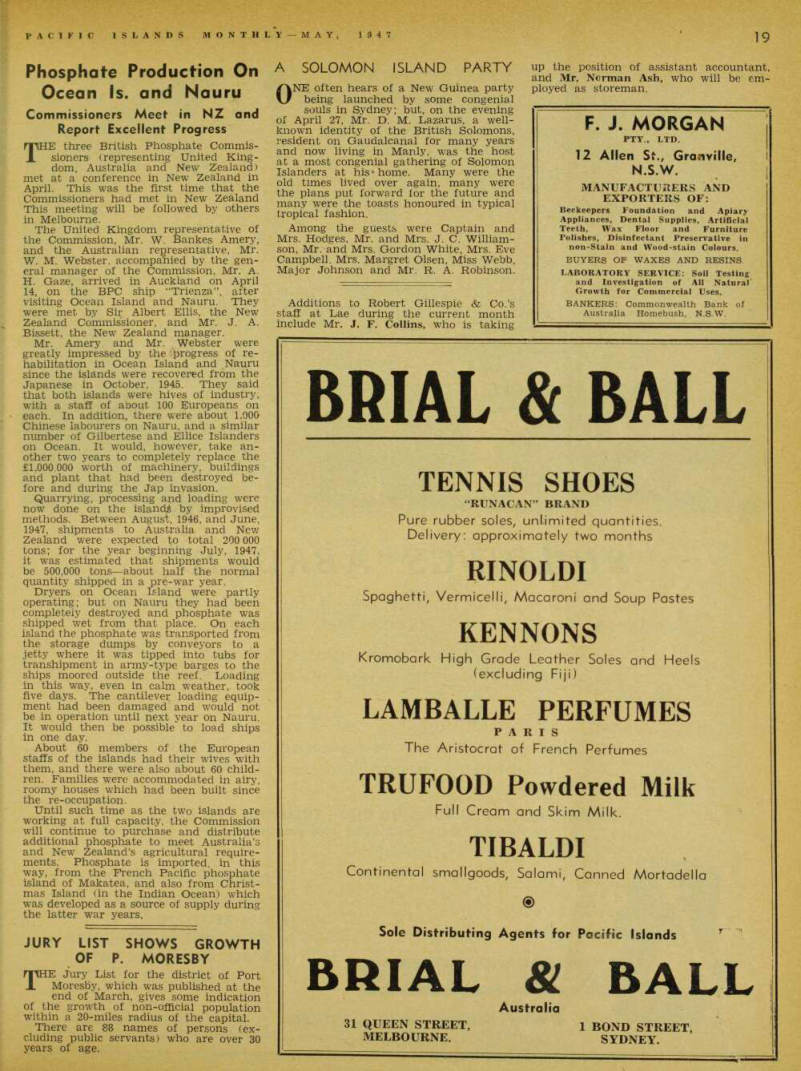
Ocean Is. and Nauru Commissioners Meet in NZ and Report Excellent Progress
rE three British Phosphate Commis sioners (representing United King dom, Australia and New Zealand) met at a conference in New Zealand in April. This was the first time that the Commissioners had met in New Zealand This meeting will be followed by others in Melbourne.
The United Kingdom representative of the Commission, Mr. W. Bankes Amery, and the Australian representative, Mr.
W. M. Webster, accompanied by the gen eral manager of the Commission, Mr. a.
H. Gaze, arrived in Auckland on April 14, on the BPC ship “Trienza”, after visiting Ocean Island and Nauru. They were met by Sir Albert Ellis, the New Zealand Commissioner, and Mr. J. A.
Bissett, the New Zealand manager.
Mr. Amery and Mr. Webster were greatly impressed by the progress of re habilitation in Ocean Island and Nauru since the islands were recovered from the Japanese in October, 1945. They said that both islands were hives of industry, with a staff of about 100 Europeans on each. In addition, there were about 1,000 Chinese labourers on Nauru, and a similar number of Gilbertese and Ellice Islanders on Ocean. It would, however, take an other two years to completely replace the £1,000,000 worth of machinery, buildings and plant that had been destroyed be fore and during the Jap invasion.
Quarrying, processing and loading were now done on the islands by improvised methods. Between August, 1946, and June, 1947, shipments to Australia and New Zealand were expected to total 200 000 tons; for the year beginning July, 1947, it was estimated that shipments would be 500,000 tons—about half the normal quantity shipped in a pre-war year.
Dryers on Ocean Island were partly operating; but on Nauru they had been completely destroyed and phosphate was shipped wet from that place. On each island the phosphate was transported from the storage dumps by conveyors to a jetty where it was tipped into tubs for transhipment in army-type barges to the ships moored outside the reef. Loading in this way, even in calm weather, took five days. The cantilever loading equip ment had been damaged and would not be in operation until next year on Nauru.
It would then be possible to load ships in one day.
About 60 members of the European staffs of the islands had their wives with them, and there were also about 60 child ren. Families were accommodated in airy, roomy houses which had been built since the re-occupation.
Until such time as the two islands are working at full capacity, the Commission will continue to purchase and distribute additional phosphate to meet Australia’s and New Zealand’s agricultural require ments. Phosphate is imported, in this way, from the French Pacific phosphate island of Makatea, and also from Christ mas Island (in the Indian Ocean) which was developed as a source of supply during the latter war years.