BSI Planters
pp. 19-20 · Read in the full issue
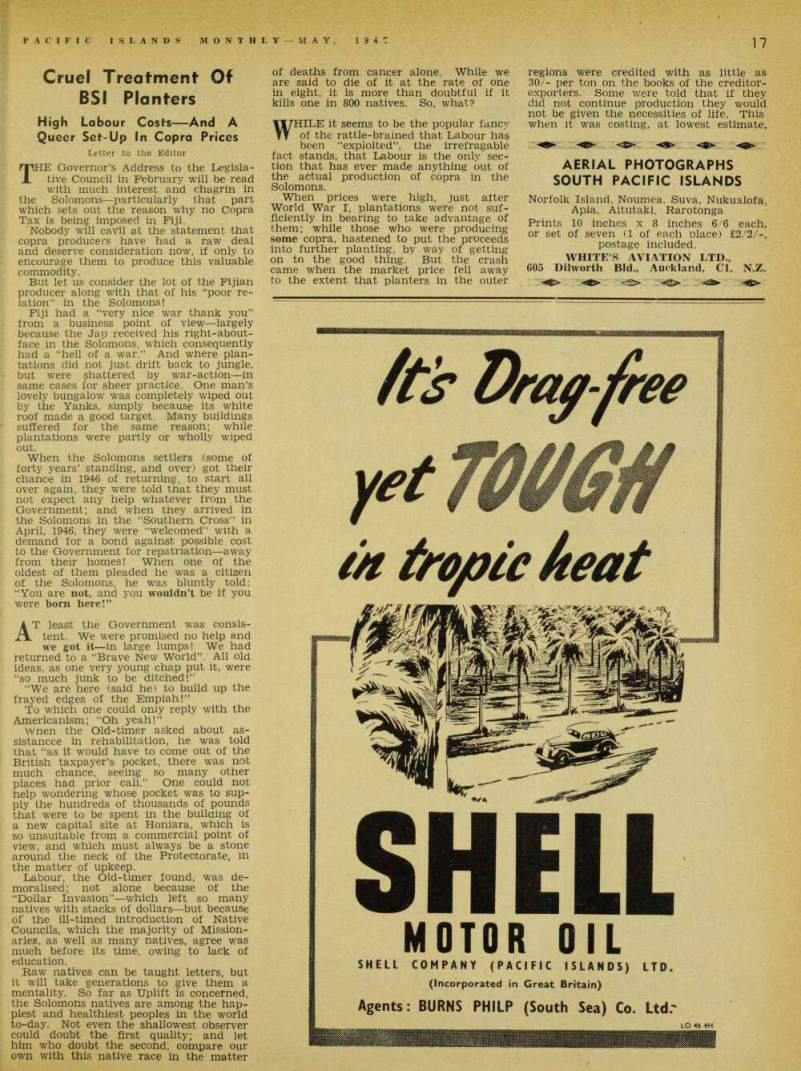
Cruel Treatment Of BSI Planters High Labour Costs—And A Queer Set-Up In Copra Prices
Letter to the Editor rE Governor’s Address to the Legisla tive Council in February will be read with much interest and chagrin in the Solomons —particularly that part which sets out the reason why no Copra Tax is being imposed in Fiji.
Nobody will cavil at the statement that copra producers have had a raw deal and deserve consideration now, if only to encourage them to produce this valuable commodity.
But let us consider the lot of the Fijian producer along with that of his “poor re lation” in the Solomons!
Fiji had a “very nice war thank you” from a business point of view—largely because the Jap received his right-about face in the Solomons, which consequently had a “hell of a war.” And where plan tations did not just drift back to jungle, but were shattered by war-action —in same cases for sheer practice. One man’s lovely bungalow was completely wiped out by the Yanks, simply because its white roof made a good target. Many buildings suffered for the same reason; while plantations were partly or wholly wiped out.
When the Solomons settlers (some of forty years’ standing, and over) got their chance in 1946 of returning, to start all over again, they were told that they must not expect any help whatever from the Government: and when they arrived in the Solomons in the “Southern Cross” in April, 1946, they were “welcomed” with a demand for a bond against possible cost to the Government for repatriation—away from their homes! When one of the oldest of them pleaded he was a citizen of the Solomons, he was bluntly told: “You are not, and you wouldn’t be if you were born here!”
AT least the Government was consis tent. We were promised no help and we got it —in large lumps! We had returned to a “Brave New World”. All old ideas, as one very young chap put it, were “so much junk to be ditched!”
“We are here (said he) to build up the frayed edges of the Empiah!”
To which one could only reply with the Americanism; “Oh yeah!” wnen the Old-timer asked about as sistance in rehabilitation, he was told that “as it would have to come out of the British taxpayer’s pocket, there was not much chance, seeing so many other places had prior call,” One could not help wondering whose pocket was to sup ply the hundreds of thousands of pounds that were to be spent in the building of a new capital site at Honiara, which is so unsuitable from a commercial point of view, and which must always be a stone around the neck of the Protectorate, in the matter of upkeep.
Labour, the Old-timer found, was de moralised; not alone because of the “Dollar Invasion” —which left so many natives with stacks of dollars—but because of the ill-timed introduction of Native Councils, which the majority of Mission aries, as well as many natives, agree was much before its time, owing to lack of education.
Raw natives can be taught letters, but it will take generations to give them a mentality. So far as Uplift is concerned, the Solomons natives are among the hap piest and healthiest peoples in the world to-day. Not even the shallowest observer could doubt the first quality; and let him who doubt the second, compare our own with this native race in the matter
of deaths from cancer alone. While we are said to die of it at the rate of one in eight, it is more than doubtful if it kills one in 800 natives. So, what?
WHILE it seems to be the popular fancy of the rattle-brained that Labour has been “exploited”, the irrefragable fact stands, that Labour is the only sec tion that has ever made anything out of the actual production of copra in the Solomons.
"When prices were high, just after World War I, plantations were not suf ficiently in bearing to take advantage of them; while those who were producing some copra, hastened to put the proceeds into further planting, by way of getting on to the good thing. But the crash came when the market price fell away to the extent that planters in the outer
regions were credited with as little as 30/- per ton on the books of the creditor exporters. Some were told that if they did not continue production they would not be given the necessities of life. This when it was costing, at lowest estimate,
£5 per ton to produce, not including super vision and capital charges.
It was a foregone conclusion that many walked off their holdings penniless and heart-broken, after many years of struggle.
A 50 per cent, reduction in the labour wage, from £1 per month and found, to 10/- and found, was not enough to save them.
AT the first meeting of the “Advisory”
Council after the Jap war, it was agreed that 25/- and found was a fair wage, all things considered.
Many natives who had not participated in the benefits of the “Dollar Invasion”, and some who had, were quite willing to offer for work; but, owing to “Magster”
Councillors (real or bogus) who ordered them NOT to offer for work under threat of punishment unless they were paid £l2 per month (or £lB for married men) they were too scared. And so the unfortunate planter is unable to take full advantage of ruling prices, and the hungry jungle marches on.
Just prior to this year’s “Advisory”
Council Meeting which was timed to be gin on February 17 (particulars not to hand) the Government saw fit to raise the Government Labour wage to £2 per month and found, on the score of HCL— notwithstanding that the employer has to do the “finding”. That the Government did not wait for the Councillors’ advice seems rather a give-away, as to its evalu ation of the Council. It follows naturally that all employers of labour will have to follow Government and raise wages.
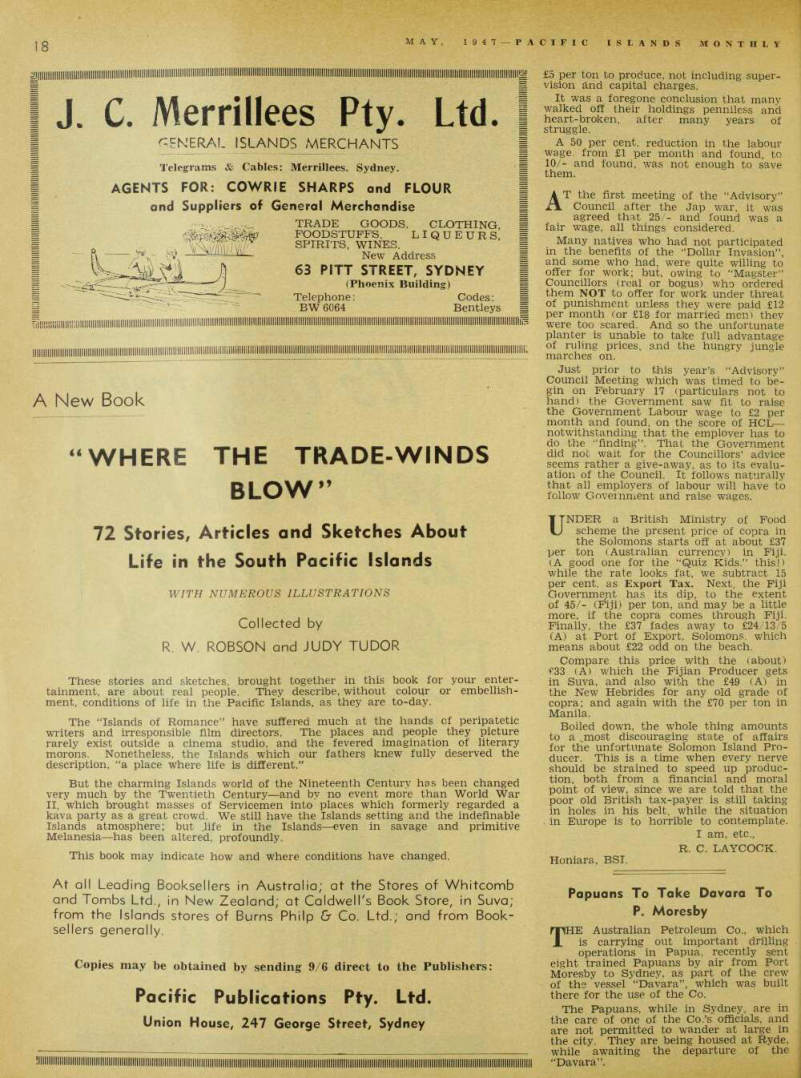
UNDER a British Ministry of Food scheme the present price of copra in the Solomons starts off at about £37 per ton (Australian currency) in Fiji. (A good one for the “Quiz Kids.” this!) while the rate looks fat, we subtract 15 per cent, as Export Tax. Next, the Fiji Government has its dip, to the extent of 45/- (Fiji) per ton, and may be a little more, if the copra comes through Fiji.
Finally, the £37 fades away to £24/13/5 (A) at Port of Export, Solomons, which means about £22 odd on the beach.
Compare this price with the (about) £33 (A) which the Fijian Producer gets in Suva, and also with the £49 (A) in the New Hebrides for any old grade of copra; and again with the £7O per ton in Manila.
Boiled down, the whole thing amounts to a most discouraging state of affairs for the unfortunate Solomon Island Pro ducer. This is a time when every nerve should be strained to speed up produc tion, both from a financial and moral point of view, since we are told that the poor old British tax-payer is still taking in holes in his belt, while the situation ■ in Europe is to horrible to contemplate.
I am, etc.,
R. C. Laycock.
Honiara, BSI.