BP Companies
p. 13 · Read in the full issue
Huge Funds For
Pacific
Annual Accounts of The BP Companies
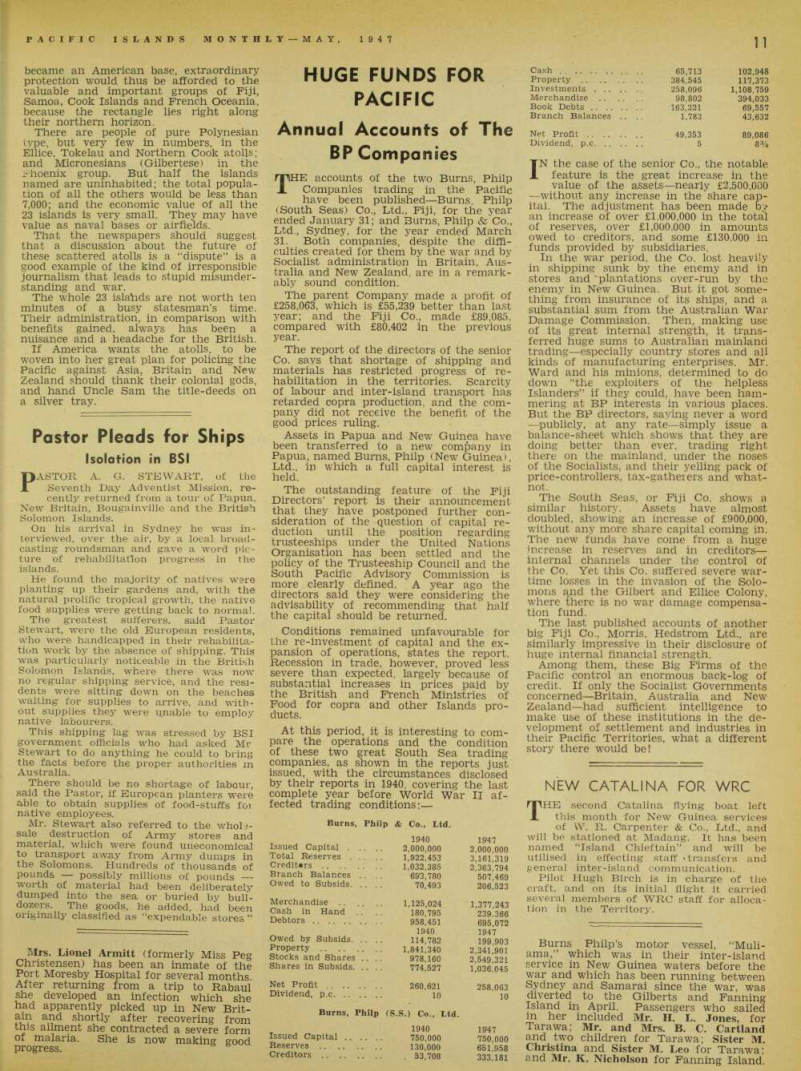
THE accounts of the two Burns, Philp Companies trading in the Pacific have been published—Burns, Philp (South Seas) Co., Ltd., Fiji, for the year ended January 31; and Burns, Philp & Co., Ltd., Sydney, for the year ended March 31. Both companies, despite the diffi culties created for them by the war and by Socialist administration in Britain, Aus tralia and New Zealand, are in a remark ably sound condition.
The parent Company made a profit of £258,063, which is £55,239 better than last year; and the Fiji Co., made £89,085, compared with £80,402 in the previous year.
The report of the directors of the senior Co. says that shortage of shipping and materials has restricted progress of re habilitation in the territories. Scarcity of labour and inter-island transport has retarded copra production, and the com pany did not receive the benefit of the good prices ruling.
Assets in Papua and New Guinea have been transferred to a new company in Papua, named Bums, Philp (New Guinea), Ltd., in which a full capital interest is held.
The outstanding feature of the Fiji Directors’ report is their announcement that they have postponed further con sideration of the question of capital re duction until the position regarding trusteeships under the United Nations Organisation has been settled and the policy of the Trusteeship Council and the South Pacific Advisory Commission is more clearly defined. A year ago the directors said they were considering the advisability of recommending that half the capital should be returned.
Conditions remained unfavourable for the re-investment of capital and the ex pansion of operations, states the report.
Recession in trade, however, proved less severe than expected, largely because of substantial increases in prices paid by the British and French Ministries of Food for copra and other Islands pro ducts.
At this period, it is interesting to com pare the operations and the condition of these two great South Sea trading companies, as shown in the reports just issued, with the circumstances disclosed by their reports in 1940, covering the last complete year before World War II af fected trading conditions;—
IN the case of the senior Co., the notable feature is the great increase in the value of the assets —nearly £2,500,000 —without any increase in the share cap ital. The adjustment has been made by an increase of over £1,000,000 in the total of reserves, over £1,000,000 in amounts owed to creditors, and some £130,000 in funds provided by subsidiaries.
In the war period, the Co. lost heavily in shipping sunk by the enemy and in stores and 'plantations over-run by the enemy in New Guinea. But it got some thing from insurance of its ships, and a substantial sum from the Australian War Damage Commission. Then, making use of its great internal strength, it trans ferred huge sums to Australian mainland trading—especially country stores and all kinds of manufacturing enterprises. Mr.
Ward and his minions, determined to do down “the exploiters of the helpless Islanders” if they could, have been ham mering at BP interests in various places.
But the BP directors, saying never a word —publicly, at any rate—simply issue a balance-sheet which shows that they are doing better than ever, trading right there on the mainland, under the noses of the Socialists, and their yelling pack of price-controllers, tax-gatheiers and what not.
The South Seas, or Fiji Co. shows a similar history. Assets have almost doubled, showing an increase of £900,000, without any more share capital coming in.
The new funds have come from a huge increase in reserves and in creditors— internal channels under the control of the Co. Yet this Co. suffered severe war time losses in the invasion of the Solo mons and the Gilbert and Ellice Colony, where there is no war damage compensa tion fund.
The last published accounts of another big Fiji Co., Morris, Hedstrom Ltd., are similarly impressive in their disclosure of huge internal financial strength.
Among them, these Big Firms of the Pacific control an enormous back-log of credit. If only the Socialist Governments concerned—Britain, Australia and New Zealand —had sufficient intelligence to make use of these institutions in the de velopment of settlement and industries in their Pacific Territories, what a different story there would be!
Burns, Philp & Co., Ltd, 1940 1947 Issued Capital ... 2,000,000 2,000,000 Total Reserves ... . 1,922,453 3,161,319 Creditors 1,032,385 2,363,794 Branch Balances .. . . 69'3,780 507,469 Owed to Subsids 70,493 206.523 Merchandise 1,125,024 1,377,243 Cash in Hand 180,795 239.366 Debtors 958,451 695,072 1940 1947 Owed by Subsids 114,782 199,903 Property 1,841,340 2,341.901 Stocks and Shares .. 978,160 2,549,321 Shares in Subsids 774,527 1,036,045 Net Profit 260,621 258,063 Dividend, p.c 10 10 Burns, Philp (S.S.) Co., Ltd. 1940 1947 Issued Capital 750,000 750,000 Reserves 130,000 651,958 Creditors 53,708 333,181
Cash 65,713 102,948 Property 384,545 117,373 Investments 258,096 1,108,759 Merchandise 98,802 394,033 Book Debts 163,221 69,557 Branch Balances .. . 1,783 43,632 Net Profit 49,353 89,086 Dividend, p.c 5 8%