Cargo-Cult
p. 71 · Read in the full issue
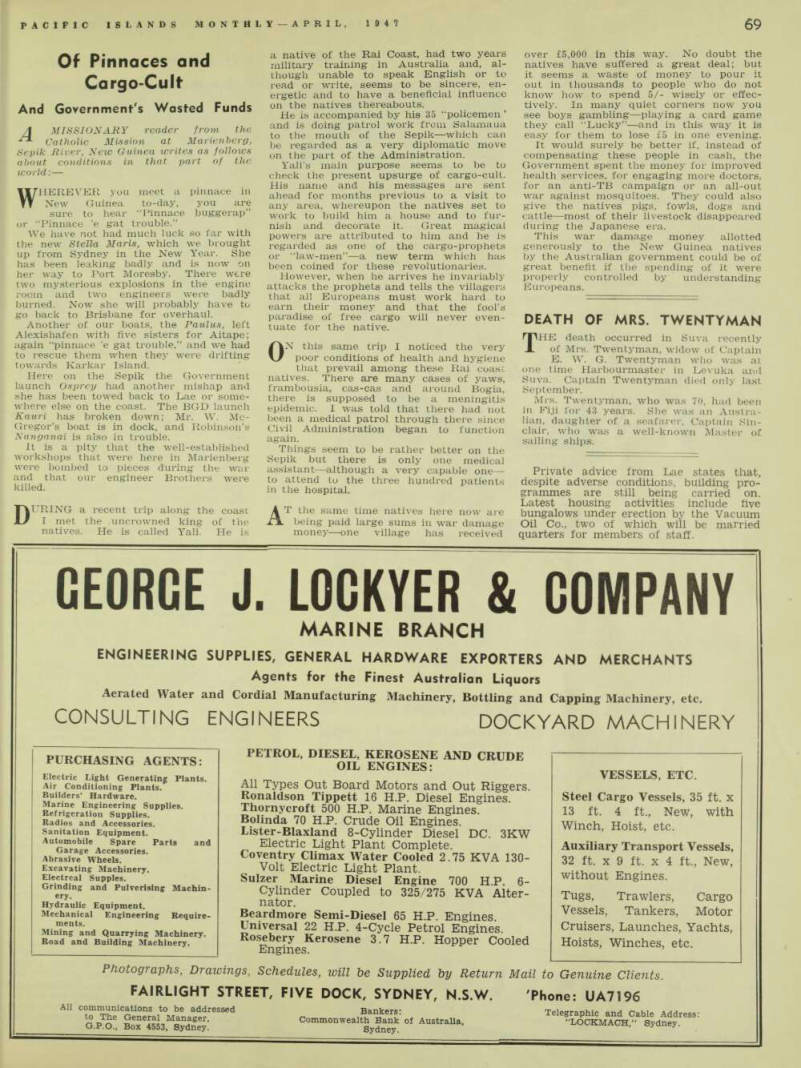
Of Pinnaces and Cargo-Cult And Government's Wasted Funds
A MISSIONARY reader from the Catholic Mission at Marienberg, Sepik River, New Guinea writes as follows about conditions in that part of the world: — WHEREVER you meet a pinnace in New Guinea to-day, you are sure to hear “Pinnace buggerap” or “Pinnace ’e gat trouble.”
We have not had much luck so far with the new Stella Maris, which we brought up from Sydney in the New Year. She has been leaking badly and is now on her way to Port Moresby. There were two mysterious explosions in the engine room and two engineers were badly burned. Now she will probably have to go back to Brisbane for overhaul.
Another of our boats, the Paulus, left Alexishafen with five sisters for Aitape; again “pinnace ’e gat trouble,” and we had to rescue them when they were drifting towards Karkar Island.
Here on the Sepik the Government launch Osprey had another mishap and she has been towed back to Lae or some where else on the coast. The BGD launch Kauri has broken down; Mr. W. Mc- Gregor’s boat is in dock, and Robinson’s Nanganai is also in trouble.
It is a pity that the well-established workshops that were here in Marienberg were bombed to pieces during the war and that our engineer Brothers were killed.
DURING a recent trip along the coast I met the .uncrowned king of the natives. He is called Yali. He is
a native of the Rai Coast, had two years military training in Australia and, al though unable to speak English or to read or write, seems to be sincere, en ergetic and to have a beneficial influence on the natives thereabouts.
He is accompanied by his 35 “policemen ’ and is doing patrol work from Salamaua to the mouth of the Sepik—which can be regarded as a very diplomatic move on the part of the Administration.
Yali’s main purpose seems to be to check the present upsurge of cargo-cult.
His name and his messages are sent ahead for months previous to a visit to any area, whereupon the natives set to work to build him a house and to fur nish and decorate it. Great magical powers are attributed to him and he is regarded as one of the cargo-prophets or “law-men” —a new term which has been coined for these revolutionaries.
However, when he arrives he invariably attacks the prophets and tells the villagers that all Europeans must work hard to earn their money and that the fool’s paradise of free cargo will never even tuate for the native.
ON this same trip I noticed the very poor conditions of health and hygiene that prevail among these Rai coasr. natives. There are many cases of yaws, frambousia, cas-cas and around Bogia, there is supposed to be a meningitis epidemic. I was told that there had not been a medical patrol through there since Civil Administration began to function again.
Things seem to be rather better on the Sepik but there is only one medical assistant—although a very capable one — to attend to the three hundred patients in the hospital.
AT the same time natives here now are being paid large sums in war damage money—one village has received
over £5,000 in this way. No doubt the natives have suffered a great deal; but it seems a waste of money to pour it out in thousands to people who do not know how to spend 5/- wisely or effec tively. In many quiet corners now you see boys gambling —playing a card game they call “Lucky”—and in this way it is easy for them to lose £5 in one evening.
It would surely be better if, instead of compensating these people in cash, the Government spent the money for improved health services, for engaging more doctors, for an anti-TB campaign or an all-out war against mosquitoes. They could also give the natives pigs, fowls, dogs and cattle —most of their livestock disappeared during the Japanese era.
This war damage money allotted generously to the New Guinea natives by the Australian government could be of great benefit if the spending of it were properly controlled by understanding Europeans.