Hit by Cyclone
p. 14 · Read in the full issue
Caledonian Island Hit by Cyclone
From a Special Correspondent NOUMEA, March 19. rE most severe cyclone within living memory has just passed over the island of Mare, dependancy of New Caledonia 50 miles from the mainland.
For several days the barometer had dropped until at 9 a.m. on Wednesday, March 12 the easterly wind suddenly turned to south-east and at mid-day had developed into a hurricane. The winds sweeping the islands developing into whirl-winds carrying all before them and destroying houses, schools, churches and plantations.
More than half the coco nut palms of the island have been uprooted, the roads are badly damaged and will need more that a month of intense labour to put them in order.
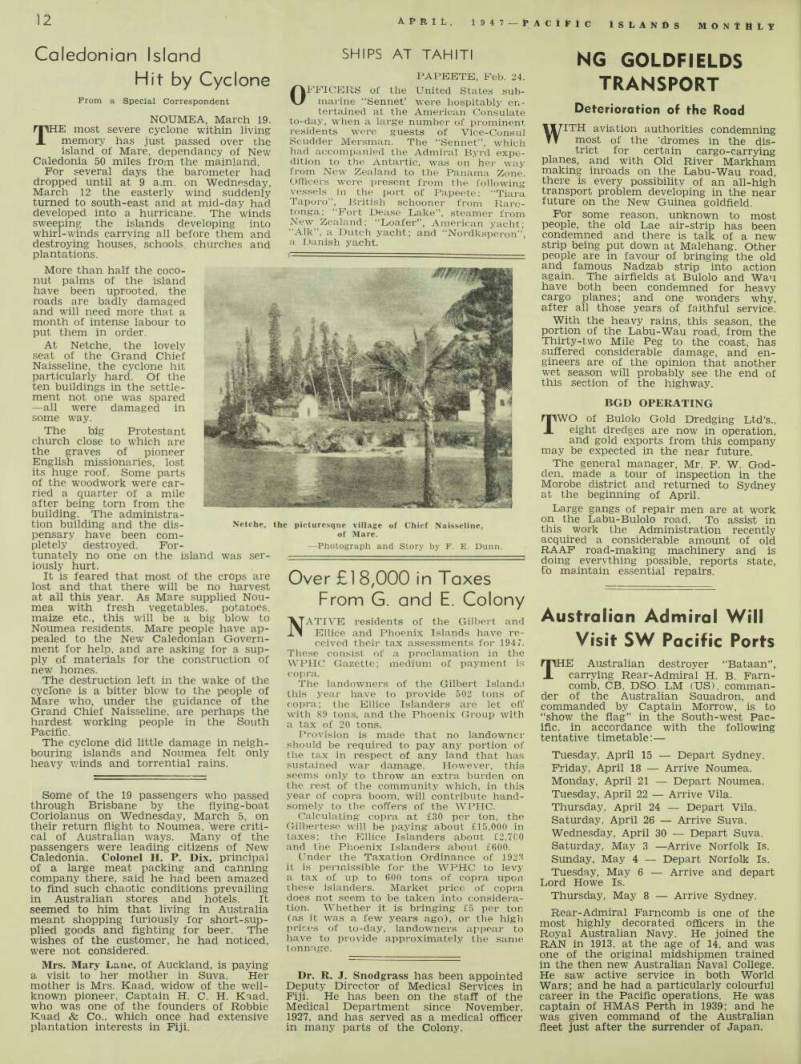
At Netche, the lovely seat of the Grand Chief Naisseline, the cyclone hit particularly hard. Of the ten buildings in the settle ment not one was spared —all were damaged in some way.
The big Protestant church close to which are the graves of pioneer English missionaries, lost its huge roof. Some parts of the woodwork were car ried a quarter of a mile after being torn from the building. The administra tion building and the dis pensary have been com pletely destroyed. For
tunately no one on the island was ser iously hurt.
It is feared that most of the crops are lost and that there will be no harvest at all this year. As Mare supplied Nou mea with fresh vegetables, potatoes, maize etc., this will be a big blow to Noumea residents. Mare people have ap pealed to the New Caledonian Govern ment for help, and are asking for a sup ply of materials for the construction of new homes.
The destruction left in the wake of the cyclone is a bitter blow to the people of Mare who, under the guidance of the Grand Chief Naisseline, are perhaps the hardest working people in the South Pacific.
The cyclone did little damage in neigh bouring islands and Noumea felt only heavy winds and torrential rains.
Some of the 19 passengers who passed through Brisbane by the flying-boat Coriolanus on Wednesday, March 5, on their return flight to Noumea, ‘were criti cal of Australian ways. Many of the passengers were leading citizens of New Caledonia. Colonel H. P. Dix, principal of a large meat packing and canning company there, said he had been amazed to find such chaotic conditions prevailing in Australian stores and hotels. It seemed to him that living in Australia meant shopping furiously for short-sup plied goods and fighting for beer. The wishes of the customer, he had noticed, were not considered.
Mrs. Mary Lane, of Auckland, is paying a visit to her mother in Suva. Her mother is Mrs. Kaad. widow of the well known pioneer, Captain H. C. H. Kaad, who was one of the founders of Robbie Kaad & Co., which once had extensive plantation interests in Fiji.
Netche, the picturesque village of Chief Naisseline, of Mare.
Photograph and Story by F. E. Dunn.