Grave Move in the North Pacific
pp. 12-58 · Read in the full issue
Political Changes May be Part of American Defensive Plans Against Asia and Red Russia
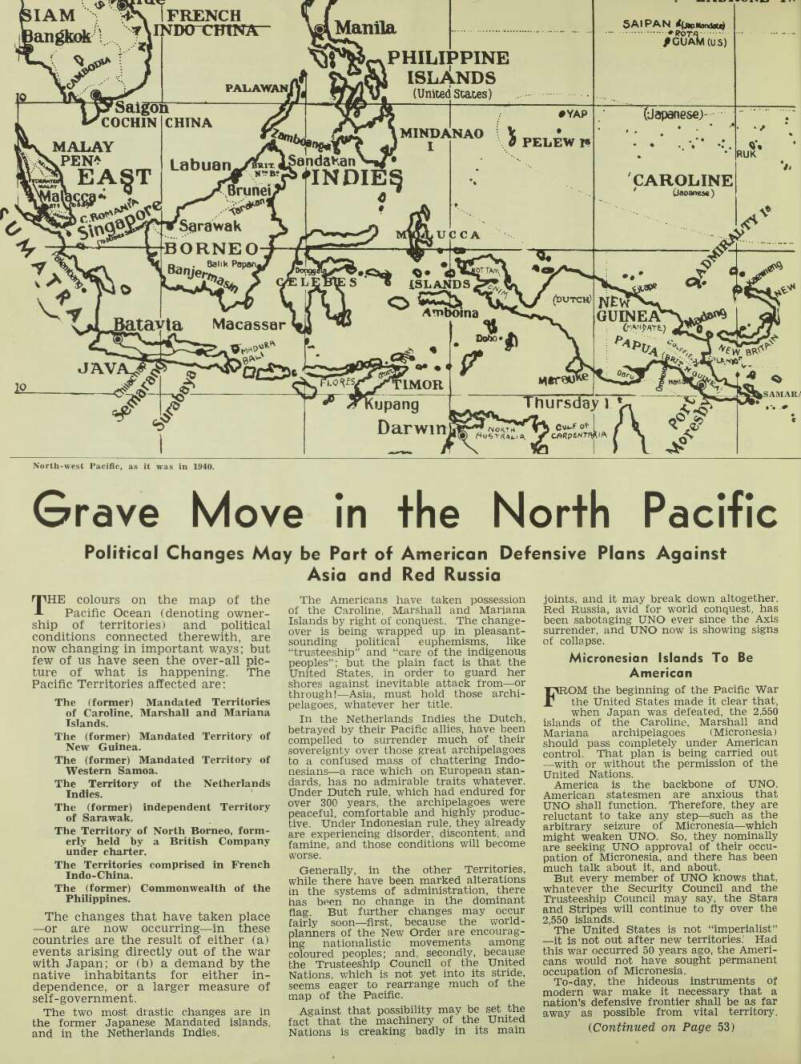
THE colours on the map of the Pacific Ocean (denoting owner ship of territories) and political conditions connected therewith, are now changing in important ways; but few of us have seen the over-all pic ture of what is happening. The Pacific Territories affected are: The (former) Mandated Territories of Caroline, Marshall and Mariana Islands.
The (former) Mandated Territory of New Guinea.
The (former) Mandated Territory of Western Samoa.
The Territory of the Netherlands Indies.
The (former) independent Territory of Sarawak.
The Territory of North Borneo, form erly held by a British Company under charter.
The Territories comprised in French Indo-China.
The (former) Commonwealth of the Philippines.
The changes that have taken place —or are now occurring—in these countries are the result of either (a) events arising directly out of the war with Japan; or (b) a demand by the native inhabitants for either in dependence, or a larger measure of self-government.
The two most drastic changes are in the former Japanese Mandated islands, and in the Netherlands Indies.
The Americans have taken possession of the Caroline, Marshall and Mariana Islands by right of conquest. The change over is being wrapped up in pleasant sounding political euphemisms, like “trusteeship” and “care of the indigenous peoples”; but the plain fact is that the United States, in order to guard her shores against inevitable attack from—or through!—Asia, must hold those archi pelagoes, whatever her title.
In the Netherlands Indies the Dutch, betrayed by their Pacific allies, have been compelled to surrender much of their sovereignty over those great archipelagoes to a confused mass of chattering Indo nesians—a race which on European stan dards, has no admirable traits whatever.
Under Dutch rule, which had endured for over 300 years, the archipelagoes were peaceful, comfortable and highly produc tive. Under Indonesian rule, they already are experiencing disorder, discontent, and famine, and those conditions will become worse.
Generally, in the other Territories, while there have been marked alterations in the systems of administration, there has been no change in the dominant flag. But further changes may occur fairly soon—first, because the world planners of the New Order are encourag ing nationalistic movements among coloured peoples; and, secondly, because the Trusteeship Council of the United Nations, which is not yet into its stride, seems eager to rearrange much of the map of the Pacific.
Against that possibility may be set the fact that the machinery of the United Nations is creaking badly in its main
joints, and it may break down altogether.
Red Russia, avid for world conquest, has been sabotaging UNO ever since the Axis surrender, and UNO now is showing signs of collapse.
Micronesian Islands To Be
American FROM the beginning of the Pacific War the United States made it clear that, when Japan was defeated, the 2,550 islands of the Caroline, Marshall and Mariana archipelagoes (Micronesia) should pass completely under American control. That plan is being carried out —with or without the permission of the United Nations.
America is the backbone of UNO.
American statesmen are anxious that UNO shall function. Therefore, they are reluctant to take any step—such as the arbitrary seizure of Micronesia—which might weaken UNO. So, they nominally are seeking UNO approval of their occu pation of Micronesia, and there has been much talk about it, and about.
But every member of UNO knows that, whatever the Security Council and the Trusteeship Council may say, the Stars and Stripes will continue to fly over the 2,550 islands.
The United States is not “imperialist” —it is not out after new territories. Had this war occurred 50 years ago, the Ameri cans would not have sought permanent occupation of Micronesia.
To-day, the hideous instruments of modern war make it necessary that a nation’s defensive frontier shall be as far away as possible from vital territory.
{Continued on Page 53)
North-west Pacific, as it was in 1940.
Unless present trends alter completely, the United States, comparatively soon, will face an attack from across the North Pacific—perhaps from Asiatics, perhaps from Red Russians, perhaps from both.
It is essential for the defence of North America that Americans shall hold the archipelagoes of the North Pacific—which, from east to west, are Hawaii, the Mar shall Islands, the Caroline Islands, the Mariana Islands, and the Philippines.
It was announced on March 14 that, under an agreement signed that day be tween the United States and the Gov ernment of the new Philippines Repub lic, the former was so given the right to maintain military bases in the Philip pines. There is, in fact, a military al liance between the two.
The pattern of the American defence plan against Asia is clear. That plan is essential to the security of the United States. Nothing—not even the need to maintain harmony within the United Nations—can be permitted to impede it.
UNO seems close to collapse, anyway.
The Americans formally asked the Security Council for permission to annex the Micronesian islands. Unexpectedly, Russia withdrew all the objections she originally advanced —a development re garded as sinister —it was felt that Russia hoped thus to justify the huge territorial gains she has herself made through World War 11.
NO obstruction then was expected; but Australia and New Zealand, by vir tue of their Anzac Pact of 1944, argued that they should be recognised as interested parties in the Security Council discussions. They inferred that America should not annex without their blessing.
This interference by two such small countries was resented by the United States —especially in view of the fact that Australia and New Zealand are in even greater danger from Red Russia particularly, and from Asia generally, than is North America. Instead of being argumentative and obstructionist, the two British Dominions should thank God for American determination to police the Northern Pacific, and should co-operate in that task in every possible way.
Prominent American writers referred to Australia’s “confusion and uncertainty of mind”; and said “the bumbling, fumbling Anzacs are full of noisy confusions as they take their first steps in Big Power politics.”
There was one piquant incident. Aus tralia’s representative on the Security Council was Mr. Paul Hasluck, a clever young public servant who is greatly ad mired by Australian Leftist writers. Mr.
Hasluck, with his head in the clouds, and blind to realities, moved that the Trus teeship Agreement under which the United States was able to take control of the Micronesian islands should be subject to confirmation in the peace treaty be tween Japan and the Allies—whenever that might be made.
The American representative retorted sharply that the United States would not accept that condition. It was obvious that, while America was still anxious to save the face of the United Nations, she was becoming impatient of this bumbling and fumbling by “adolescent Anzacs.”
Best-informed opinion in America is that there may not be too much time available for preparation in the North Pacific—an early attack by Russia, through Asia, is by no means impossible.
Australia’s “Foreign Minister,” Dr.
Evatt, acted promptly. No one knows just what happened—but Mr. Hasluck re
signed his position as Australian repre sentative, and immediately was replaced on the Security Council by Colonel Hodg son. Within a few hours, America was informed officially by Australia that all objections to American control of the Micronesian islands had been withdrawn.
Then the voices of Australia and New Zealand faded out.
IF Australia and New Zealand want to be seriously regarded as “Pacific Powers” they should cease pecking at the United States. They should give ser ious consideration to the facts that “the line of stepping-stones” between South east Asia and Australia is now in charge of utterly unreliable Indonesians; that Russian “sabotage” has so undermined the United Nations plan that UNO now is probably useless as a world force; and that there is no future at all for the European communities in the South Pac ific unless they have the protection of the United States.
They might as well be realists. To-day, the menace to the world’s peace, by Red Russia, is as great as was the menace to our safety in 1938, by Hitler’s Germany.
The Americans recognise it, and have acted accordingly, in Micronesia, as in the Middle East. Why should the Chif leys and the Frasers go about with their heads in the clouds?
That is the political background of re cent events in the North Pacific.
Dufch Hamstrung in Indonesia
AGAINST that background, one must observe recent developments in the Netherlands Indies, where a West ern nation has been compelled to enter into an uneasy partnership with an Asiatic people, who are shot through with nationalism, Communism, and—above all—hatred of the European.
When the Japs invaded the Nether lands Indies early in 1942, this Indonesian Empire of the Dutch contained some 70,000,000 natives—generally a poor type of small Asiatic—and nearly 250,000 Dutch. In the course of 300 years, the Dutch had built up here a well-governed, secure and reasonably well-fed country.
The Japs tore the Dutch economy and
organisation to pieces, and tried to set up in its place an administration of their own. But the only real government which functioned was military in char acter; and the Indonesians got the oppor tunity to create their own organisation, which was intensely anti-Dutch.
As soon as Japan surrendered, the Americans, British and French hurried into the Jap-occupied territories, and quickly restored the former administra
tions. Except in the Netherlands Indies.
There, they did nothing; and the Dutch, their homeland only recently freed from German occupation, were not at once able to occupy the Indies in strength.
Consequently, the Indies were governed,
for a long time after the surrender, by the Jap armies isolated there, and by the Indonesians themselves.
Britain sent in an army to maintain order; but all that the British did was to force the Dutch to negotiate with the Indonesians—who were now being led by visionaries and Communist-inspired ex tremists, and who wanted to get rid of the Dutch. Britain was now controlled by the Attlee Government: and, of all the political crimes for which that ad ministration is responsible, none will stink more in the face of history than the way in which Britain, in 1945-46, de serted her Dutch ally, and threw the rich Indies to the Communist wolves.
Under British pressure, the Dutch and Indonesians signed at Cheribon on Nov
ember 12, 1946, a tentative agreement for the creation of a “United States of In donesia”; and, by the end of November, all British troops had gone. Since then, Dutch and Indonesians have been back ing and filling. The Indonesians, clearly, would like to push out the Dutch, al together; while the Dutch have been steadily building up their armed forces, obviously in the hope that they would be able to restore order in the only way which the natives can understand—with the sword. But the Dutch themselves were fettered by a Socialist Party at The Hague.
There was a good deal of fighting be tween the two sides, and it was plain that they were drifting further apart. Al though both had signed, tentatively, neither seemed inclined to ratify the agreement. Five months ' elapsed.
Then the Dutch said that they would ratify only if there was attached to the original agreement an “interpretation” of tne document, as they saw it.
Finally, something happened in Europe.
Orders to sign went out from The Hague to Batavia. Two prominent members of the Dutch Commission-General in the Indies resigned forthwith.
The Cheribon agreement was ratified in Batavia on March 24. It provides for de facto recognition of the Republic of Java, Sumatra and Madura and the for mation by 1949 of the United States of Indonesia, which will enter into a Union under the Dutch Crown, The principal signatories were Dr. van Mook and Dr.
Sjahrir, so-called premier of the republic.
The two parties are now trying to “co operate in the rebuilding of Indonesia.”
It is not an encouraging prospect.
APART from Holland, the country most affected by this development is Aus tralia. Instead of having the staunch and friendly Dutch on their northern frontier, the white Australians now have the untrustworthy Indonesians, who most certainly will go with the Asiatics when the day comes for the Asiatics to swarm into the empty lands of the South Pacific.
Ever since Japan surrendered, the Australian wharf labourers have tried to help the Indonesians against the Dutch by refusing to handle Dutch ships in Australian ports, or to load Dutch goods onto ships. The Australian Socialist Government—contemptibly weak in all such matters—allowed the waterside workers thus to direct its foreign policy.
Even since the ratification of the agree ment, on March 24, the Australian dockers have assured the Indonesians that they still will refuse to load Dutch ships, unless the Indonesians give the “all clear” sign.
The future of Indonesia will have a marked effect upon all the Pacific Ter ritories; but the future of Indonesia now is completely obscure. If the Dutch should regain control, some sort of order liness may be restored; and the Dutch might regain control if left alone. Un fortunately, most Western nations are suffering to-day under a kind of “brown brother” complex, and all their influence is being exerted on the side of the Indo nesians, and against the Dutch “exploi ters.” It is a depressing picture.
Philippines Guam Eastern
Samoa
IT was announced from Manila, capital of what is now the independent re public of the Philippines, on March 22, that a five-year military assistance agreement integrating the Philippines in American defence plans for the western Pacific has been signed by President Roxas and the United States Ambassa dor, Mr. Paul McNutt. The agreement
makes available to the Philippines arms, munitions and technical advice.
The United States Congress in 1946 authorised the expenditure of 18,000,000 dollars for military supplies needed by the Philippines.
President Roxas announced that 83 ships were being made available to the Philippines for expanding the existing off-shore army patrol.
The United States Secretary of the In terior, Mr. Julius Krug, stated on March 15 that he would ask Congress to grant charters to American Samoa and Guam for their own civil Government. At present, they are administered by the Navy.
He said he wanted a law passed making law enforcement and judicial review ad ministrable in a democratic fashion in stead of being controlled by military ad ministration.
The announcement about Eastern Sam oa directs attention again to the future of Western Samoa. This was explained at length in the March “PIM.”
The United Nations has approved of the Trusteeship Agreement under which New Zealand continues to be responsible for the administration of Western Samoa.
New Zealand, directly and by inference, has undertaken to introduce an increas ing amount of self-government to Samoa, as soon as the Samoans are ready for it.
The Samoan people are asking that Western and Eastern Samoa be united, instead of being divided between the United States and New Zealand.
Future Administration In
New Guinea
IT is presumed that Australia is await ing the meeting of the Trusteeship Council, set up by the Assembly of the United Nations, before making a permanent arrangement in relation to the Administration of Papua and New Guinea.
In 1942, when Japan invaded the South Pacific, Papua was an Australian Ter ritory, and New Guinea was held by Aus tralia under a League of Nations Man date. Both Administrations were with drawn. Papua passed under Australian Army control; and New Guinea was wholly occupied by Japs.
The Australian-New Guinea Adminis trative Unit was created by the Army to administer Papua, and to take over New Guinea as it was recovered piecemeal from the invaders.
For reasons best known to itself, the Australian Socialist Government refused to restore the two former Territories Ad ministrations, to function after ANGAU was withdrawn. Instead, Mr. Ward set up the Papua-New Guinea Provisional Administration, and introduced an en tirely new Administrator in Colonel J. K.
Murray.
As the Japs disappeared, ANGAU moved in; and then, after a certain time, ANGAU handed over to the Provisional Administration —until, by mid-1946, both Territories were under the Provisional Administration, The purpose of this manoeuvre has never been explained. But it is shrewdly suspected that it was designed to (a) get rid of a number of experienced senior officials of the old Civil Administrations who could not be expected to see eye-to eye with the Australian Socialists; (b) clear the decks for replacing the “Big Firms” (the “exploiters”) with Govern ment instrumentalities, which could con trol production, transport and, to a great extent, the distribution of goods.
These things have been accomplished —with the result that confusion and de pression reign in the non-official Euro pean communities of the Australian Paci fic Territories to-day. That, however, is another story. The point is that these
Territories are now under a “Provisional”
Administration.
No one knows definitely whether they are to continue under one Administration.
It was explained that the “Provisional”
set-up was arranged so that the two separate Administrations might be re stored if and when it was found imprac ticable to govern an Australian Territory and a Trusteeship Territory (formerly a
Mandated Territory) by the one Adminis tration. Presumably, the matter awaits certain decisions by the newly-created Trusteeship Council.
We may be quite sure, however, that the Australian Socialist Ministers have done everything possible to ensure that the present Provisional Administration— which, at a cost of over £2,000,000. per annum to the Australian taxpayer, is creating a Brown Brother Elysium and a more or less Socialistic State in the Territories —will become the permanent Administration.
Many high-beating bureaucratic hearts would be broken if the old, pre-1942 Ad ministrations had to be restored, and ac
cursed Private Enterprise were asked to way that the Territorians a S ain paid their There is little danger of that, however, Only a political cataclysm can save Papua and New Guinea from the planners of the New Order. The present Papua-New Guinea Administration is almost certain to become permanent.
French Hit Hard in Indo-China
Propagandists for the Japanese Co-Prosperity planners, and for the Communists, achieved in Indo- China in 1941-45 much the same dis ruption and destruction that they brought about in the Netherlands Indies; and the French, when they were ready to move in again, found a similar set-up—all kinds of native nationalist organisations
demanding independence.
The French Parliament to-day is very near to being under Communist domina tion, and the Government moves warily in all matters concerned with “imperial ism.” But the French are realists. All classes were united in their determination that no part of their colonial empire should be lost. Having resources much greater than those of unhappy Holland, France moved large forces quickly into Indo-China—and then began to nego tiate.
Negotiations were proceeding towards a compromise—which would have given these Indo-Asiatic peoples an increased measure of self-government—when, on December 19, the Vietnamese (apparently a generic term applied to an organisation of nationalists, directed and inspired by Communists) suddenly attacked the French forces, and caused heavy losses and much damage. The French called
it “anther Pearl Harbour”, and reacted
a cc^dmgly.
Since then, France has been vigorously conducting a campaign for the restora tion of order in Indo-China, and is within sight of success. For the present, the new East Indian State will have no companion republic in Indo-China.
Uneasiness in British Indonesia
ris review would be incomplete with out reference to what has been hap pening in and around Malaya.
There is an independence movement in Malaya, as well as in Burma; and the British Administration, reflecting the weak-kneed appeasers in Whitehall, are negotiating gently and tenderly with Brown Brother.
These Indonesian people, of course, are much influenced by events in Java, and by developments in India—where, as Mountbatten takes over the highly un pleasant job of Viceroy, Hindus and Mos lems are busily slitting each other’s throats.
Is it any wonder that even Britain’s friendliest critics are talking about “the inevitable break-up of the Empire'”
Meanwhile, the political picture has changed in Borneo. Sarawak has been taken over from the Brook family, and North Borneo from the British chartered company (the last of its kind); and both are now being administered by the British Colonial Office. Strange as it may seem, there has been no report of a nationalist movement from either of them. Apparently, the Sarawak and North Borneo varieties of Brown Brother have not yet heard from the Moscow Comrades or the London planners of the
New Order.