Tropicalities
pp. 41-46 · Read in the full issue
11HE endless war between the Tilley . and the Coleman lamps in the Paci fic territories has a new angle in Fiji, where a Coleman advertisement in the Spanish language appears occasion ally in the Fiji “Times.” There is much speculation among Fiji people concern ing the reason for the Spanish—but the general opinion is that Coleman’s other wise very alert salesmanager has some how placed Fiji in South America, or Micronesia, or somewhere where Spanish is more or less a lingua franca. * * * THE NZ Air Force Sunderland which now regularly carries passengers be tween Auckland and Suva is divided into four compartments: and people often try to avoid the boredom of the 8i hours’ flight by wandering from com partment to couipartrjient, and striking up pleasant acquaintanceship with strangers.
In this way, not long ago, a pert and pretty schoolteacher from New Zealand entered into conversation with a distin guished-looking naval officer in United States uniform. The talk came around to the ornamental squabble between the rival Governors of Georgia. Someone made reference to the lengths to which people will go in order to achieve high office.
“Pooh!” said the schoolteacher brightly.
“Who wants to be a Governor, anyway!”
“Who, indeed,” said the naval officer, and presently drifted away.
The girl said to her neighbour:, “I wonder who he is?” Her neighbour said: “That is Captain H. A. Houser, Governor of American Samoa.”
The lady, for ten minutes, was quiet and thoughtful. * * * DIRONA ABE, a Papuan student at tending a training centre near Syd ney, journeyed to Canberra to listen in to the South Seas Conference in Jan uary-February.
There newspapermen buttonholed him and he is reported as having told them that although the New Guinea natives hope to gain their freedom ultimately, they plan to work on a mutual basis of co-operaion with Australia.
“We hope,” he is reported to have said, “to solve our problems without the blood shed that has taken place in Indonesia.”
Well, that’s good to know, anyway. We hope so. But “freedom” from what?— G.T. ♦ * * THE whole of Alexishafen mission plan tation, on the north-east coast of New Guinea, is overgrown and sewn with bombs, most of them unexploded and a number of them parachute bombs.
A few men of the RAAF came along to explode them recently, and during one afternoon a heap of 25 and 100 pounders was collected. A fuse was attached, a NCO lit it and everyone ran for shelter.
Anxiously they counted the time—ls minutes, half an hour, a full hour. But no explosion. The RAAF firing squad sent word around the district that all natives were to keep away until they heard a big explosion, then they retired from the scene. The man in charge of the party, however, spent a restless night and then
decided to return to the bomb dump and find out the trouble.
He found it. It appears that shortly after the fuse had been lit and the party had dispersed, a Luluai from a nearby village had come along to get a few coco nuts. He saw the bomb dump and the ourning fuse so calmly he cut the fuse through, collected his coconuts and went home.—“PAT.” * * ♦ ON the coast of Peru, six young Nor wegians are at present preparing for one of the strangest (or craziest) voyages in history. Soon now they will cast themselves upon the Pacific Ocean currents on a balsa wood raft 30 ft. x 12 feet, which they confidently predict will bring them, about four months later, to Tahiti, 4000 miles away.
All this is to prove the theory, held by some anthropologists (amateur and otherwise) that aboriginal inhabitants of Peru crossed the Pacific on similar rafts 1500 years ago and so became the first inhabitants of Polynesia.
Leader of the expedition is Thor Hey erdahl who has spent some time inves tigating the legends of the Marquesas.
He links the Marquesa legend of a white god, Tiki, with the Peruvian legend of a white god called Kontiki who is said to have lived in Peru before the Incas set tled there.
The theory that Polynesia was first settled by voyagers who, either inadvert ently or purposely, drifted from Peru, is an old one; but it has been generally discarded in favour of the theory of migrations from Asia. Heyerdahl’s ex pedition, if successful, may prove that such journeys could have occurred —but to the lay mind it still seems a crazy way of proving a theory.
No shelter will be provided on the raft.
The raft will be awash at all times ex cept a dead calm and, to prevent being washed overboard, crew and equipment will be lashed down. The expedition expects trouble from the equatorial sun and also from the giant squid which sur faces at night to feed. These creatures are alleged to have 10 arms 20 feet long.
The party will have chopping knives to deal with them.
Altogether, it sounds like quite a picnic !—-“LANDLUBBER.” * * ♦ A CIRCLE of jolly fellows in Suva’s Defence Club raised their glasses in unison and chanted —“Here’s to Judy Tudor—curse her!” —and the toast was drunk with gusto.
Naturally, I was a little startled. But I had no difficulty in getting the story.
It appears that when my assistant was here 15 months ago, she commented in widely distributed articles upon the abundance of Australian beer in Fiji— the angle of the comment that we un happy mortals in Australia could not buy beer at any price. Whereupon High Authority snarled and swooped, and Fiji’s quota of beer was substantially re duced. It was a foul dead done in innocence, with no thought or intention of causing suffering in Suva but the thing was done, unfortunately, before we realised its implications; and the un happy clubmen of Suva suffered accord
ingly.
Naturally, on behalf of my assistant, I presented our regrets. But regrets have no currency in the Defence Club. They
had to be expressed in terms of cash— and the Australian pound is worth only 17/6 in Fiji!—R. W. ROBSON. * * * THE Sydney representative of a large Fiji company is due for a caning. He engaged and sent to Fiji a depart mental man who has since left Fiji, but who, in his brief residence, made minor history.
He was in charge of a particular de partment. A very old customer, who had been purchasing certain supplies there for uncounted years, called as usual for his quota, and tendered a cheque. “Have you an account?” queried Mr. Blank, sharply.
“No.” said the old customer. “I always pay this way.”
“Cheques from unknown people are no good to us,” said Mr. Blank, and took the precious goods back into his custody.
The howls of the outraged old customer echoed through the building. The highest manager in the place took the matter in hand. Mr. Blank was severely repri manded.
Mr. Blank was bitter about it. One thing led to another, and finally he re signed. Feeling himself carrying a bur den of incredible grievance, he took him self up the hill to Government House, to place his woes before the highest offi cial of the land. He was gently turned away. That night, for reasons undefined, he slept in the Fire Station.
Arrangements were made to ship him back to Australia, unostentatiously but very firmly. The final blow came when
(Continued on page 42)
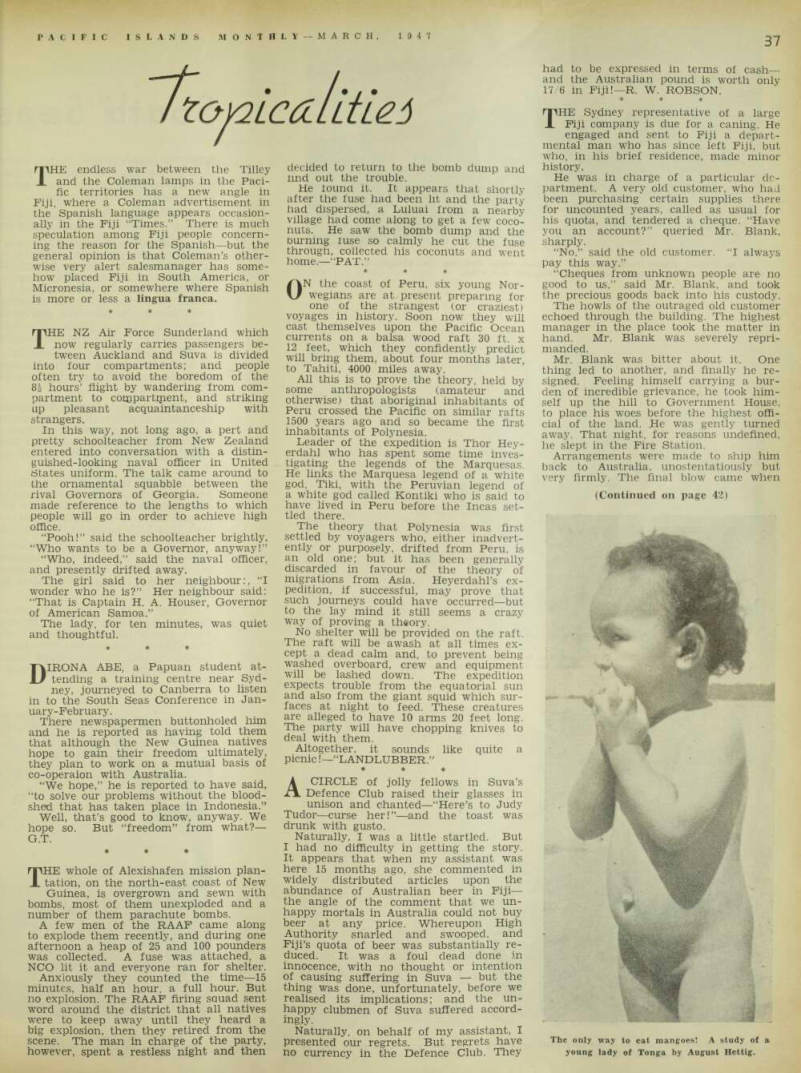
The only way to eat mangoes! A study of a young lady of Tonga by August Hettig.
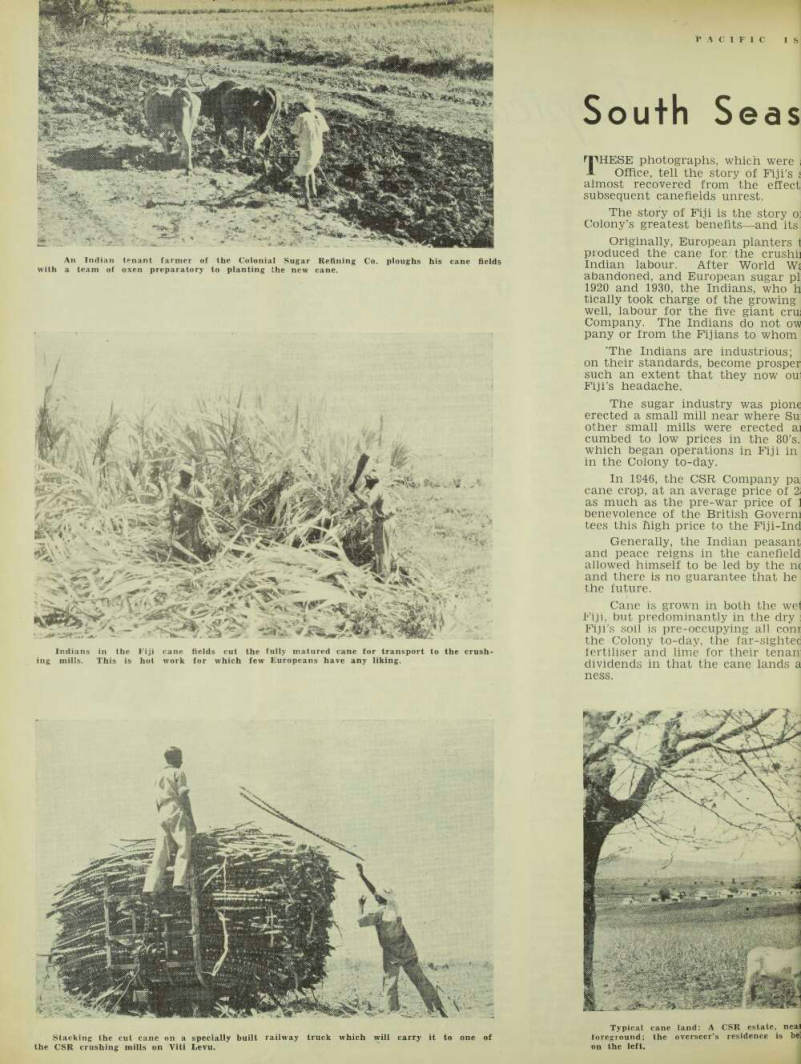
An Indian tenant farmer of the Colonial Sugar Refining Co. ploughs his cane fields with a team of oxen preparatory to planting the new cane.
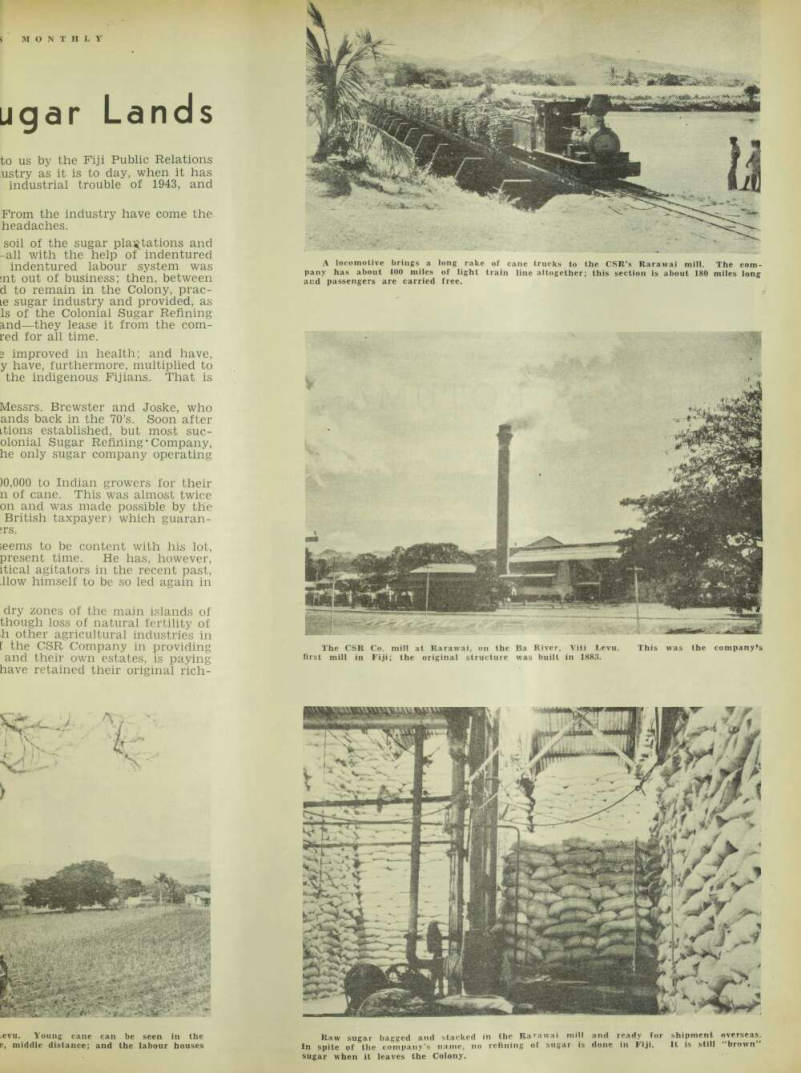
Indians in the Fiji cane fields cut the fully matured cane for transport to the crush ing mills. This is hot work for which few Europeans have any liking.
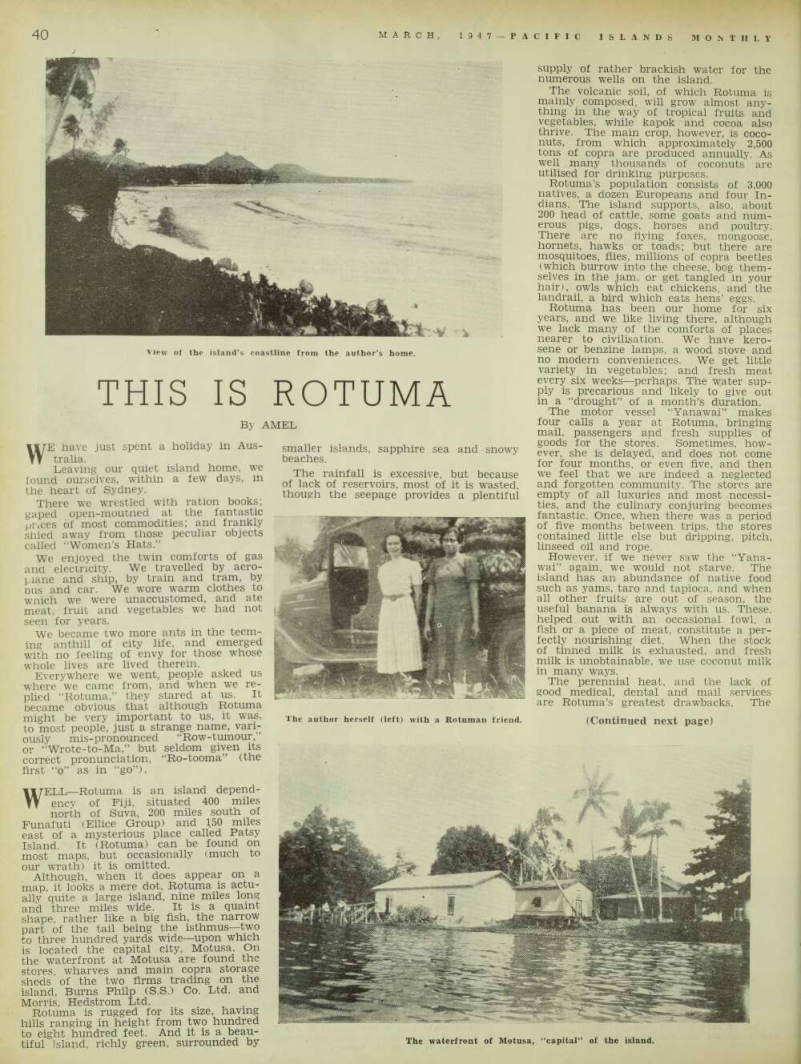
Stacking the cut cane on a specially built railway truck which will carry it to one of the CSR crushing mills on Viti Levu.
he told the highest manager: “I have Incurred various bills in this town. I am not leaving here until those bills are paid.”
He was shipped away. I do not know who paid the bills. I did not have the heart to ask the highest manager about it.—R.W.R. * * » FOR many years now Mangaia has seen no real crop of mangoes a fruit that is consequently very highly appreciated.
A curious law of nature governs the “vi” trees. They are subject to attack by fly in normally dry years; as a result, they do not bear fruit save in a year marked by abnormal rains. Such a year was 1928; mangoes were then abundant, for the fly had all been annihilated by the downpours. Since that time there has been no real mango harvest.
As all local fruit grows wild, and native planters have no surplus cash for the purchase of sprayers and insect poisons, a delicious fruit-is lost to Mangaians (till the next excessviely wet winter in 19 —?)
—“Eti.”
* * * THIS comes from the “ABM Review”: “Seventy-three threepenny bits were sent to the ABM in January from the children of the Tufnell Home for Orphans, Brisbane, which is conducted by the Sisters of the Sacred Advent. The threepenny bits had been taken out of their Christmas nuddings, and came with a message that ‘These were for the little boys in New Guinea wot had no Christ mas puddings, but wot had only worms to eat!’”
Dr. R. Carrick and Mrs. Carrick have left Suva. Fiii for Perth. Western Aus tralia where thev will make their home.
Dr. Carrick. who has been well known Fiii for many years, has now retired from medical practice.
The Most Rev. V. Folev Vicar Apos tolic of Fiji, left the Colony in early February on a visit to Australia and New Zealand.