Umboi II
pp. 59-60 · Read in the full issue
How We Took Umboi II Home to Rooke Is.
r VHE Rev. A. P. H. Freund of the Aus * tralian Lutheran Mission in New Guinea tells here how 46 ft. “Umboi II” was taken from Sydney to Mission Headquarters on Rooke Island, between New Guinea and New Ireland.
“Umboi I” after giving good service in the early stages of the Pacific war was later wrecked on the NG mainland.
GETTING a ship built in Australia in the period immediately following the end of the war was not an easy matter. The keel of the “Umboi II” was laid in October, 1945 and the builders’ contract stipulated that the vessel was to be completed in four months. But it was thirteen months before we were able to take delivery.
Mr. V. Neumann, the manager of our mission plantation at Gizarum, who had been the skipper of our first “Umboi,” both in peace time and when she and we joined the Army, and who was later in charge of various boats in the ANGAU Marine Section, was given command of the vessel. The crew consisted of mem bers of the mission and the plantation staff, as has already been reported in the November, 1946 issue of the “PIM.”
At last, on November 11 everything was ready for our adventure. At 6.45 next morning the pilot stepped on board and five minutes later we were under way. A haze hung over Sydney harbour as we threaded our way between the ferries, and when a small launch from the “Captain Cook” took off our pilot just inside the heads, we realised that the full responsibility of taking the little 48-ft. ship to its destination was ours.
During the first forenoon the sea was slight we caught a sizable fish on the line trailing astern; we passed several fishing boats plying their trade; and we met a submarine. But that afternoon the sea became choppy and soon three of our men were down with seasickness.
Night brought calmness but next after noon we took another belting from a head sea. That night, too, came calm water and our seasick sailors revived. Coff’s Harbour was seen from a glassy sea at sunrise.
We made good progress all day and that night and were considerably cheered by the blinks and flashes of various light houses along the coast necessary for the confidence of such as we who navi gate by dead-reckoning.
Eighty-one hours out from Sydney found us tied up in Brisbane; the success ful completion of the first leg of the journey gave us confidence for the next part of our task.
TAKING on equipment and stores kept us in Brisbane until November 27.
We left at dawn and ran right into dirty weather in Morton Bay; This con tinued with us until we were through Great Sandy Passage and inside the Reef.
Then followed pleasant days but after Bowen we kept our eyes peeled for float ing mines out from Cairns which we left on December 9, we saw a mine, which had been washed ashore, exploded by a disposals crew. The shock and detonation even at that distance made us realise what would happen if we struck one.
On the 10th we started our real ad venture the crossing of the Coral Sea.
We had, of course, been told many times by others that it was crazy of us to attempt the crossing in such a small boat but our first day out was calm— never do I remember having seen such exquisite blue sea as we saw that day.
But by nightfall we were approaching Bougainville Reef where we wished to
check our course by the blinker light.
When we felt we were getting near, thick, black clouds gathered and rain commenced to fall in torrents. Then the wind rose and for five hours we nosed ahead, dead slow. When we had given up all hope of sighting the light, the clouds broke and we saw its welcome blink about seven miles off our port beam.
From <that time on we followed a mechanical grind. One man had left us in Brisbane; another at Cairns. One of the remaining four was seasick for the
rest of the passage. This put a heavy strain on the rest of us, as we crawled slowly across that white-crested, beam sea. But at dawn on December 13, the man at the wheel gave a great, joyous shout the Papuan coast was in sight.
WE anchored in Gabunatawoteri Bay —3O miles from our original objec tive which had been Brumer Island —and that afternoon went on to Fife Bay where we were hospitably received by the Rev. and Mrs. Nixon and Mr.
Fisher, Next day took us to Samarai, and on the following day, we passed through the China Straits and reached Lae on December 17.
Three days was sufficient in this mourn ful spot, and on the 21st we went on to Finschhafen and that night crossed Vitiaz Strait. By noon the following
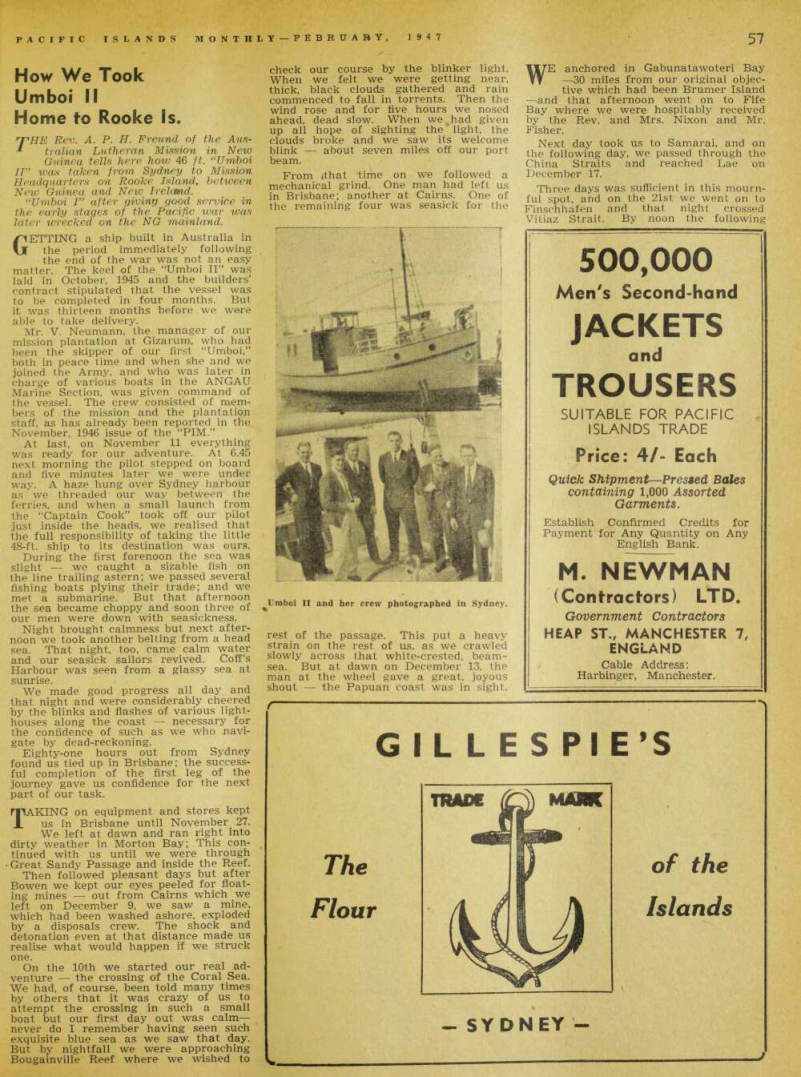
Umboi II and her crew photographed in Sydney.
day we were anchored at Gizarum, our plantation on Rooke Island.
It was 40 days since we had left Sydney but sixteen of those we had spent in port and the actual running time for the 2,357 miles was 370 hours.
In general, although the trip was tough in places, it could be described as pleas ant and uneventful.
One feature of it , of which we cannot speak too highly, was the services ren dered us by the various coastal radio stations with whom we were in contact.
They took a personal interest in us and our progress, and spared no pains to make contact when atmospheric condi tions were difficult.