Force Signals, Fdf
pp. 51-52 · Read in the full issue
Some Reminiscences of 1939-40, and an Appreciation of Mr. D. Jnnor’s Work in Fiji by “Ex-Sig”
DONALD JUNOR came to Fiji some years before the war as a public accountant. In addition to his ac countancy diplomas he held his commis sion as a captain in the Australian Corps of Signals.
Junor was an enthusiast when It came to military communications, knd early in his Fiji career he seized upon the fact that the local forces had no communica tions unit, but it was 1939—early in the
year the war clouds were beginning to gather—before his persistance commenced to get results. He received then official sanction to go ahead with the formation of a small unit.
He soon found 12 volunteers: C. M.
Aitken, L. Emery, G. F. Flemons, R. A.
Hewlett, J. Hudson, V. Jackson, N. G. J.
McNally, R. C. Macpherson. W. P. Ragg, A. Savery, MM., C. D. Somerfield and B. D.
Whitwell, J. Turner and J. J. Griffiths were two other early members of the unit.
OF the original dozen, few had any pre vious experience, though some at least knew morse. Arthur Savery had won his MM, in the 1914-18 war as a signalman, Clem Aitken had done a bit of flag wagging with a New Zealand ter ritorial artillery unit; and the late Noel McNally had once been a railway tele graphist in New Zealand. He was still good for a smooth 25 or 30 words a minute on the key, and proved invaluable as an instructor in key technique.
Then came the trials of learning to send and receive morse with buzzer, flag and lamp, as well as absorbing some of the principles of electricity and magnetism
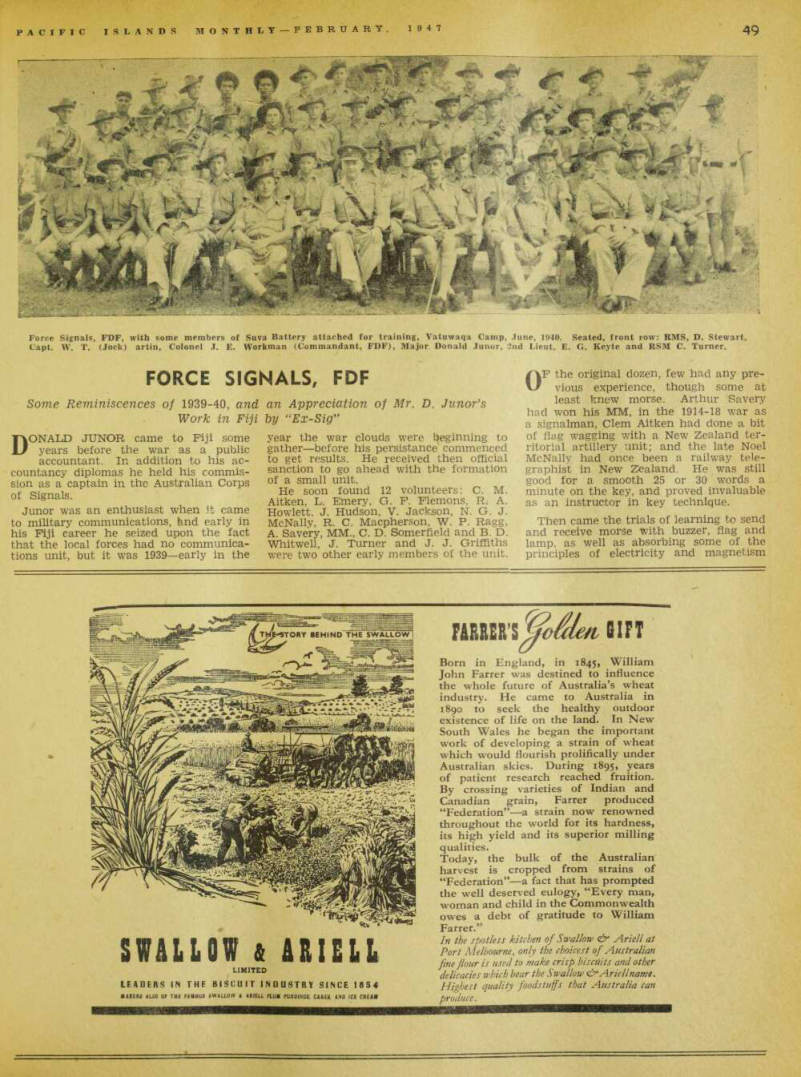
Force Signals, FDF, with some members of Suva Battery attached for training, Vatuwaqa Camp, June, 1940. Seated, front row: RMS, D. Stewart, Capt, W, T. (Jock) artin. Colonel J. E. Workman (Commandant, FDF), Major Donald Junor, Lieut. E. G. Keyte and RSM C. Turner,
and the all important subject of signals procedure as used by the army.
Parades were held weekly, in the even ings but such was the enthusiasm Junor engendered that hardly a night
passed without two or more embryo sig nalmen getting together with a buzzer and key. Some even went out on their own on Saturday afternoons with the flags to per fect their technique.
Lack of equipment was the main bug bear. Morse keys of any vintage were at a premium and so were buzzers. ’Many an old electric bell was unearthed, de nuded of its clapper and made to do strenuous if raucous service in the good cause. There were no proper military signal lamps, but torches served for prac tice, some mounted on old camera tripods.
Later some PWD heavy lamps were issued.
On Sundays and holidays, Fiji’s signal men lugged their heavy equipment about the countryside—the lamps required heavy storage batteries to operate them— and many a curse they earned. They were carted to Mission Hill, to Tamavua, up Flagstaff Hill and over to Nukulau Island.
Early in the piece, Junor obtained for his unit a special “walking out” uniform, modelled on his own Australian “blues”, and soon signal volunteers were cutting something of a dash in blue uniforms, complete with jaunty forage cap, brass buttons and collar badges and a red stripe down the trouser seams. However, Sep tember 3, 1939, saw the blues away for the duration, and thereafter khaki service dress was the order of the day for all occasions.
WITH war came more recruits who threw a fresh strain on Junor and chief assistant, W. T. Martin (new ly arrived Controller of Customs) and the NCO’s, who had by this time been ap pointed by competitive examination.
Lack of proper equipment continued a sore point, but at least it was reported to be on the way from Britain. In the meantime, someone in the Post and Tele graph Department dug out a pair of World War I D Mark 111 field telephones, which, refurbished, did yeoman service.
So, weekend on weekend, Suva saw the flicker of morse lamps and flags and heard the roar of despatch rider’s motor cycles, for several young motor-cyclists had joined in this capacity.
MANY were the stunts in which Signals took part. On one occasion the unit helped to repel a mock landing by men from HMS Leander, in the course of which some of the lads swooped on an unsuspecting naval rating and “captured” his portable radio.
However, friendly relations with the navy were quickly restored and later the unit spent an evening on board studying naval signal gear and procedure. There was also an occasion when the navy played host and took Signals and other FDF units to sea for an AA shoot.
Soon after the equipment from Britain arrived, the military hierarchy demanded a telephone link between a camp near Suva Point and a machine gun emplace ment on the beach. So, one Sunday, Signals sallied forth in force, the line was duly laid and the telephone put in work ing order.
Junor had been away from town for some days at this time, so the job was or ganised by Jock Martin, who decided to celebrate when the installation was com pleted. A collection among the troops soon produced the wherewithal for a keg of beer, and when the job was finished the keg was broached.
Captain Jock Martin was just in the act of quaffing, when a car drew up and Junor, the enthusiast and disciplinarian, almost direct from the boat which had landed him back from Vanualevu that morning, jumped out. There was a look of horror on his face at the sight of his troops gathered around a keg at the road side. His first remark was: “Good God, Captain Martin, is this a parade or a b picnic?”
In June, 1940, came the first unit camp, when the crowd went under canvas at Vatuwaqa and branch units which had been formed at Lautoka and Ba in the interim, under 2nd Lieut. E. G. Keyte, joined in.
Those were the days of hard work and good fun, particularly when two ser geants-major of the NZ Permanent Forces. Don Stewart and Ces Turner, started to teach us something about mili tary drill—something with which most of us had but a perfunctory acquaintance.
There was one occasion when Stewart was instructing a squad to “right turn” and “left turn” and an innocent lad from Lautoka (or Ba) pointed out that that was not the way he had been taught to do it.
Very quietly Stewart called his pal Turner over and politely invited the inno cent one to come out in front to demon strate. He executed a complicated piece of footwork. “See that, Turner,” said Stewart, “that’s the way so-and-so says it should be done.”
“Where did you learn that?” Stewart barked at the recruit.
“In Australia, Sir,” answered the lad.
Stewart looked at Turner, gasped, and then roared: “It must have been before the b white man got there. Rejoin the ranks and learn to do it my way.”
There was also the occasion when in expert handling of a Vickers gun mech anism, caused a spring to bounce away into the undergrowth and so put half the colony’s machine guns out of action (there were only two in the group then).
Tired signalmen spent hours scouring the ground before the missing spring was founds and Fiji’s machine guns brought up to full strength again. rAT camp marked the beginning of the end so far as the unit’s indi viduality was concerned, for it was there we received news of Junor’s promo tion to the rank of major and his recall to Australia to rejoin the forces there for overseas service.
Soon after, we were absorbed in the territorial battalion as “battalion signals.” with a consequent reduction in strength and loss of identity.