Tropicalities
p. 43 · Read in the full issue
DURING the schooner “Tiare’s” recent call, a native of this Mangaia village received a guest from Raro tonga, and made a ceremonial feast for the visitor. Everything went well; but in the very middle of the festivities the host suddenly “passed out cold.” to the consternation of his guest. The body was removed, and laid in state, in local style; and the guest went sorrowfully back to the ship.
It began to look as if the baked meats of the feast would “furnish coldly forth.” as Shakespeare says, a very unseasonable village funeral.
Great was the rejoicing when the “deceased” as suddenly regained consci ousness, and querulously demanded, like Athelstane, “whoffor the obsequies.”—EG. * * ♦ RESIDENTS of the scattered Melane sian field of Bishop Baddeley, both brown and white, are sorry to hear that he has been transferred to England after 14 years of Pacific service. (“PIM” for January.) The Right Reverend W.
H. Baddeley was not only a Bishop to them; he was a “good scout” the type of person around whom legends spring up.
Bishop Baddeley did a good war job too not only by staying with his native flock but in many “unchurchly chores” — as Harold Cooper put it. For instance, he was for a while an Assistant Cipher Officer at BSI military headquarters and was able to decode one message, at least, that baffled all others present. The message, a jumble of letters without
Breaks: Fortressinseaseassesea
Rsgela.
The beginning was easy enough: “Fortress in sea”; and the message ended with the name of an island “Gela,”
The rest was unintelligible until the Bishop came around; one glance was sufficient for him to be able to trans scribe: “Fortress in sea, south-east Asses Ears, Gela.” Asses Ears is a well known landmark thereabouts.
As he tramped hither and yon tending his scattered flock during the war years the Bishop wore out his clothes and had great difficulty in replacing them. In one report to headquarters in Sydney, therefore, he told how he was finally reduced to taking along a native with him whose sole duty it was to sew the soles back on his shoes again at various halts along the road.—“MAC.” * * * THIS is not a bad effort for a primitive: Recently a native of the famous (or infamous) village of Hanuabada near Port Moresby came to Sydney as a member of a ship’s crew. He had been instructed by the village elders to see Leonard Murray (former administrator of Papua) “with his own eye.”
He knew only that Murray lived at a place called Manly, near Sydney; but he asked and kept on asking until he found Manly and still kept on asking.
He was directed to every Murray in that large suburb, and finally by the slow pro cess of elimination, he found the man he wanted, and had an hour’s talk with him.—“L.” * ♦ * WE are told that paper is still scarce —and expensive. But nothing seems to daunt the lads of the Colonial Office who must stay awake at nights devising new and longer regula
tions for the confusion of residents of the more backward Pacific Territories.
We have had great wads of paper covering most aspects of life including full-blown regulations for starting a trade union movement; now we have eight pages setting out Motor Traffic Regula tions for the British Solomon Islands.
When I knew the Solomons pre-war, they didn’t have sufficient roads to warrant any regulations; but perhaps the Yanks altered all that. Such reports as have filtered out of the by-passed Solomons, however, in recent months have indicated such a state of doldrums in the Protectorate that it has been assumed that the place has gone back entirely to the jungle. Apparently we were wrong.
But for those that need them, there are now regulations “to make provision for the control of motor traffic and the licensing of motor vehicles and drivers.”
Nothing has been forgotten; the regula tions could be used as well to regulate the traffic of London.
But if you are contemplating a motor tour of BSI it may please you to know that it costs only £1 to register a motor vehicle there and five bob for a driver’s Iicence.—“ISLANDER.” ♦ ♦ ♦ ACCORDING to Ray Johnson of the Brisbane Courier Mail, who recently visited New Guinea and Papua, Fuzzy-Wuzzy’s wife is also well on the way to emancipation and has left wood chopping and carrying days for behind.
He predicted that within a few years, the male Fuzzies would be agitating for the good old days “along before” when woman’s place was in the thatched hut.
Native women, according to Mr. John son, are being trained as stenographers; they wear pretty dresses and are enjoying the same amenities as their white sisters.
Something else that Port Moresby has got that we haven’t got, apparently.
We’ve seen no dusky stenog, on this side of the border—yet.—“TERRITORIAN.” ♦ * * DR. H. V. EVATT was furious. But the Canberra Grammar School boys were pleased; they had a week’s extra holiday.
Heralded everywhere as the most shat tering event in South Pacific history, the South Seas Advisory Commission con ference which began in Canberra dn January 28 almost had no home. At the last moment, use of Parliament House, Canberra, was refused by the Speaker of the House of Representatives, Mr.
Rosevear, on the grounds that “private members’ rights had already been en croached upon too much.” (The House has been in recess since before Christ mas.) This refusal led to what the news papers of Australia call a “clash” be tween Dr. Evatt, who is chief architect of the Commission, and the Speaker.
Prime Minister Chifley was called In and added his pleas—but Mr. Rosevear wouldn’t budge; he was, in fact, joined by Senator Brown, President of the Upper House, who refused to let Dr.
Evatt have his conference in the Senate chamber, either.
Mr. Chifley, in his usual style, forbore and did not over-ride the gentlemen, although he pointed out that it might cause the Government embarrassment.
That is probably where Dr. Evatt got
furious. Officers of the External Af fairs Department said later that they were astounded at the episode and did not know why Mr. Chifley did not resist the Speaker and President.
Arrangements were then hastily made for the conference to be held in the local Grammar School. Beds were moved from dormitories: telephones quickly installed and transport to and from Hotel Canberra arranged. But no one could arrange Canberra weather.
The Federal Territory was enjoying a two-weeks’ heat wave. Parliament House is air-conditioned; the school, of course, is not.
Presumably Dr. Evatt and Mr. Rosevear know what it is all about. They both be long to the Australian Labour Party.
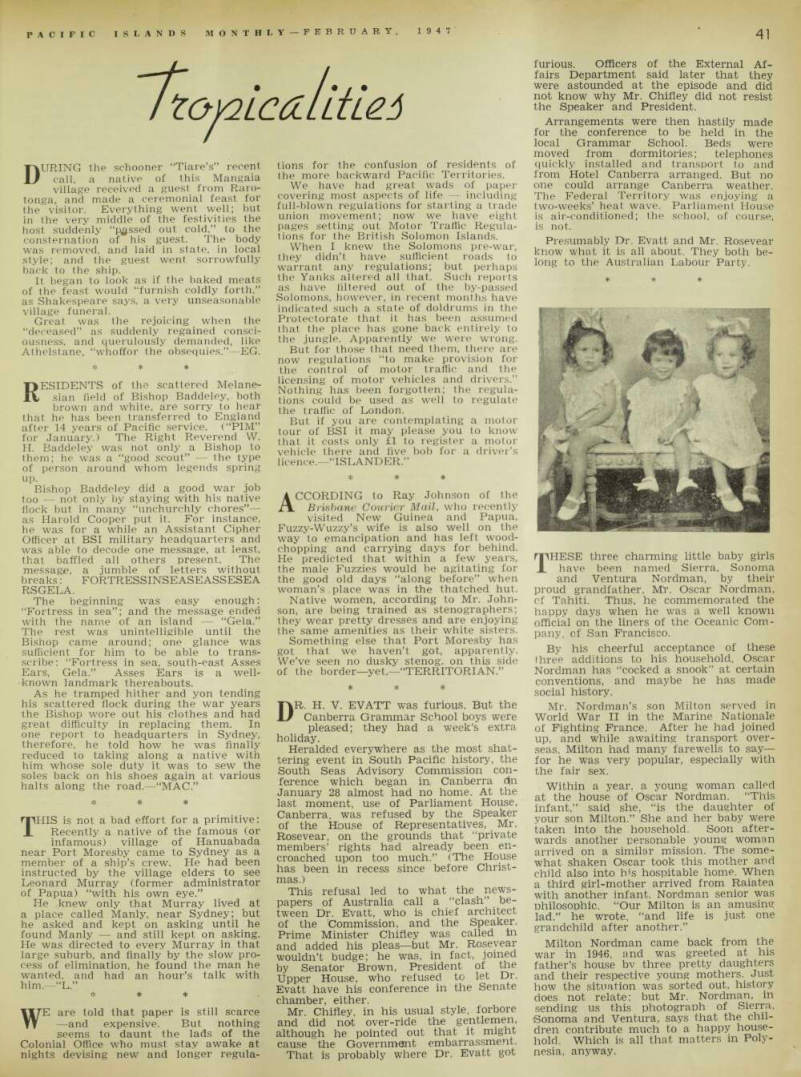
THESE three charming little baby girls have been named Sierra, Sonoma and Ventura Nordman, by their proud grandfather, Mr. Oscar Nordman, of Tahiti. Thus, he commemorated the happy days when he was a well known official on the liners of the Oceanic Com pany, of San Francisco.
By his cheerful acceptance of these three additions to his household, Oscar Nordman has “cocked a snook” at certain conventions, and maybe he has made social history.
Mr. Nordman’s son Milton served in World War II in the Marine Nationale of Fighting France. After he had joined up, and while awaiting transport over seas. Milton had many farewells to say— for he was very popular, especially with the fair sex.
Within a year, a young woman called at the house of Oscar Nordman. “This infant,” said she, “is the daughter of your son Milton.” She and her baby were taken into the household. Soon after wards another personable young woman arrived on a similar mission. The some what shaken Oscar took this mother and child also into Ins hospitable home. When a third girl-mother arrived from Raiatea with another infant, Nordman senior was philosophic. “Our Milton is an amusing lad,” he wrote, “and life is just one grandchild after another.”
Milton Nordman came back from the war in 1946, and was greeted at his father’s house bv three pretty daughters and their respective young mothers. Just how the situation was sorted out, history does not relate: but Mr. Nordman, in sending us this photograph of Sierra, Sonoma and Ventura, says that the chil dren contribute much to a happy house hold. Which is all that matters in Poly nesia, anyway.