All Ways
pp. 40-42 · Read in the full issue
Our South Pacific Islanders Come
Who Will be Their Representatives at Their Own South Seas Conference?
ONE of the results of the South Seas talks which were held in Canberra recently, was the decision to set up an annual conference of native representatives of all the South Pacific Territories, Polynesian, Micronesian and Melanesian.
“Other interests” such as missionaries will attend.
But who will represent the islanders, themselves?
To the European who has no Island affiliations, a Pacific islander is just a Pacific islander, whether he hails from Tahiti, Fiji, New Caledonia or some dim, damp, hidden valley in New Guinea’s interior; whether he has had a century of contact with Europeans or five minutes. But Pacific islanders who meet at the proposed conference will come all ways; or they will, if they are representative.
The results of such a conference might be helpful or they might be nil, but in any event they will be interesting.
Australia, whose natives are among the most primitive, was most enthusiastic about the Conference, and was supported by America and New Zealand. The United Kingdom was doubtful of results, but fell into line. Mr.
Ivor Thomas, leader of the UK delegation to the South Seas Conference, said later that self-govenrment was not a gift to be handed to a primitive people on a plate. Administrative capacity was a rare thing even among so-called advanced peoples.
From Polynesia and Fiji,- suitable
delegates will be easily available. With Melanesia it will be altogether another kettle of fish, yet Melanesia probably needs more and better representation than the rest of the South Seas. mHE Samoans have had opportunity to study the ways of Europeans—good, bad and indifferent since as long ago as 1721, when Roggeveen, a Dutch man on a trip round the world, called there. There was little further contact then however until missionary John Wil liams landed at Savaii in 1830. By 1834, the Samoan language had been reduced to a printed form (for religious tracts) and since that time the Samoan people have weathered, in succession, a period of wars by tribal chiefs aided and abetted by British, German and American Consuls: an increasing German colonisa tion; the partitioning of the group (Western Samoa to Germany; Eastern Samoa to America); the First World War, in which Western Samoa was occupied by units of the New Zealand Expeditionary Force, and from 1920 onwards became a Mandate to New Zealand with subse quent growth of the nationalistic move ment called the Mail.
If these various ups and downs had soured the Samoan people it would not be surprising. But the Samoans have, in all essential details, maintained their old culture and Polynesian charm. If there is any basis for the assertion that they are the Irishmen of the Pacific in that they are a’gin established rule, then
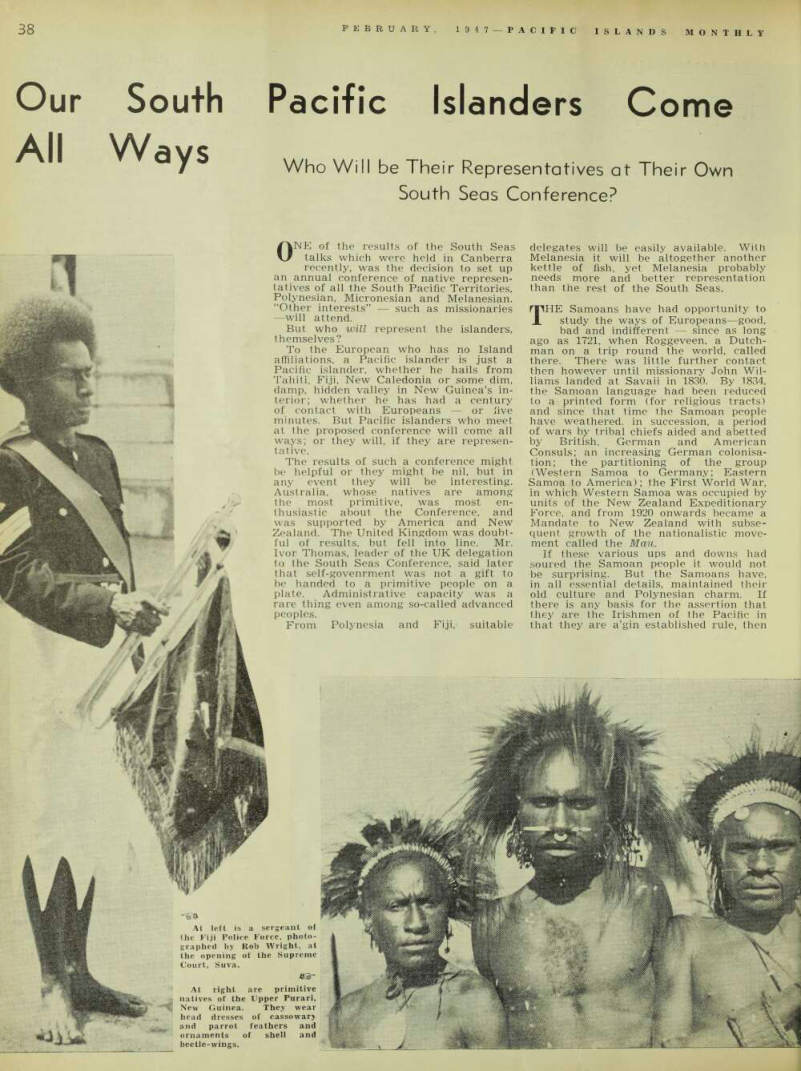
At left is a sergeant of the Fiji Police Force, photo graphed by Rob Wright, at the opening of the Supreme Court, Suva.
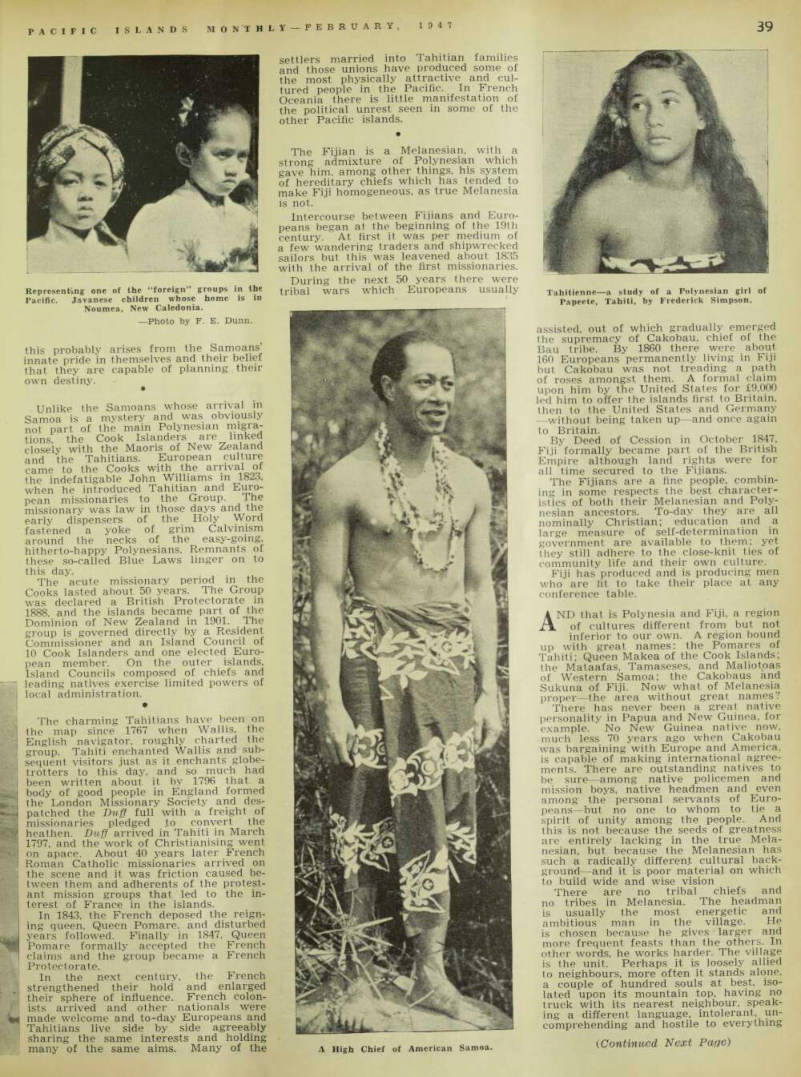
At right are primitive natives of the Upper Purari, New Guinea. They wear head dresses of cassowary and parrot feathers and ornaments of shell and beetle-wings.
this probably arises from the Samoans innate pride in themselves and their belief that they are capable of planning. their own destiny. ♦ Unlike the Samoans whose arrival in Samoa is a mystery and was obviously not part of the main Polynesian migra tions the Cook Islanders are linked closely with the Maoris of New Zealand and the Tahitians. European culture came to the Cooks with the arrival of the indefatigable John Williams in 1823, when he introduced Tahitian and Euro pean missionaries to the Group. The missionary was law in those days and the early dispensers of the Holy Word fastened a yoke of grim Calvinism around the necks of the easy-going, hitherto-happy Polynesians. Remnants of these so-called Blue Laws linger on to this day.
The acute missionary period in the Cooks lasted about 50 years. The Group was declared a British Protectorate in 1888, and the islands became part of the Dominion of New Zealand in 1901. The group is governed directly by a Resident Commissioner and an Island Council of 10 Cook Islanders and one elected Euro pean member. On the outer islands, Island Councils composed of chiefs and leading natives exercise limited powers of local administration. • The charming Tahitians have been on the map since 1767 when Wallis, the English navigator, roughly charted the group. Tahiti enchanted Wallis and sub sequent visitors just as it enchants globe trotters to this day, and so much had been written about it by 1796 that a body of good people in England formed the London Missionary Society and des patched the Duff full with a freight of missionaries pledged to convert the heathen. Duff arrived in Tahiti in March 1797, and the work of Christianising went on apace. About 40 years later French Roman Catholic missionaries arrived on the scene and it was friction caused be tween them and adherents of the protest ant mission groups that led to the in terest of France in the islands.
In 1843, the French deposed the reign ing queen, Queen Pomare, and disturbed years followed. Finally in 1847, Queen Pomare formally accepted the French claims and the group became a French Protectorate.
In the next century, the French strengthened their hold and enlarged their sphere of influence. French colon ists arrived and other nationals were made welcome and to-day Europeans and Tahitians live side by side agreeably sharing the same interests and holding many of the same aims. Many of the
settlers married into Tahitian families and those unions have produced some of the most physically attractive and cul tured people in the Pacific. In French Oceania there is little manifestation of the political unrest seen in some of the other Pacific islands. • The Fijian is a Melanesian, with a strong admixture of Polynesian which gave him, among other things, his system of hereditary chiefs which has tended to make Fiji homogeneous, as true Melanesia is not.
Intercourse between Fijians and Euro peans began at the beginning of the 19th century. At first it was per medium of a few wandering traders and shipwrecked sailors but this was leavened about 1835 with the arrival of the first missionaries.
During the next 50 years there were tribal wars which Europeans usually
assisted, out of which gradually emerged the supremacy of Cakobau, chief of the Bau tribe. By 1860 there were about 160 Europeans permanently living in Fiji but Cakobau was not treading a path of roses amongst them. A formal claim upon him by the United States for £9,000 led him to offer the islands first to Britain, then to the United States and Germany without being taken up—and once again to Britain.
By Deed of Cession in October 1847, Fiji formally became part of the British Empire although land rights were for all time secured to the Fijians.
The Fijians are a fine people, combin ing in some respects the best character istics of both their Melanesian and Poly nesian ancestors. To-day they are all nominally Christian; education and a large measure of self-determination in government are available to them; yet they still adhere to the close-knit ties of community life and their own culture.
Fiji has produced and is producing men who are fit to take their place at any conference table.
AND that is Polynesia and Fiji, a region of cultures different from but not inferior to our own. A region bound up with great names: the Pomares of Tahiti; Queen Makea of the Cook Islands; the Mataafas. Tamaseses. and Maliotpas of Western Samoa; the Cakobaus and Sukuna of Fiji. Now what of Melanesia proper—the area without great names?
There has never been a great native personality in Papua and New Guinea, for example. No New Guinea native now, much less 70 years ago when Cakobau was bargaining with Europe and America, is capable of making international agree ments. There are outstanding natives to be sure —among native policemen and mission boys, native headmen and even among the personal servants of Euro peans—but no one to whom to tie a spirit of unity among the people. And this is not because the seeds of greatness are entirely lacking in the true Mela nesian, but because the Melanesian has such a radically different cultural back ground—and it is poor material on which to build wide and wise vision There are no tribal chiefs and no tribes in Melanesia. The headman is usually the most energetic and ambitious man in the village. He is chosen because he gives larger and more frequent feasts than the others. In other words, he works harder. The village is the unit. Perhaps it is loosely allied to neighbours, more often it stands alone, a couple of hundred souls at best, iso lated upon its mountain top, having no truck with its nearest neighbour, speak ing a different language, intolerant, un comprehending and hostile to everything
(Continued Next Pape)
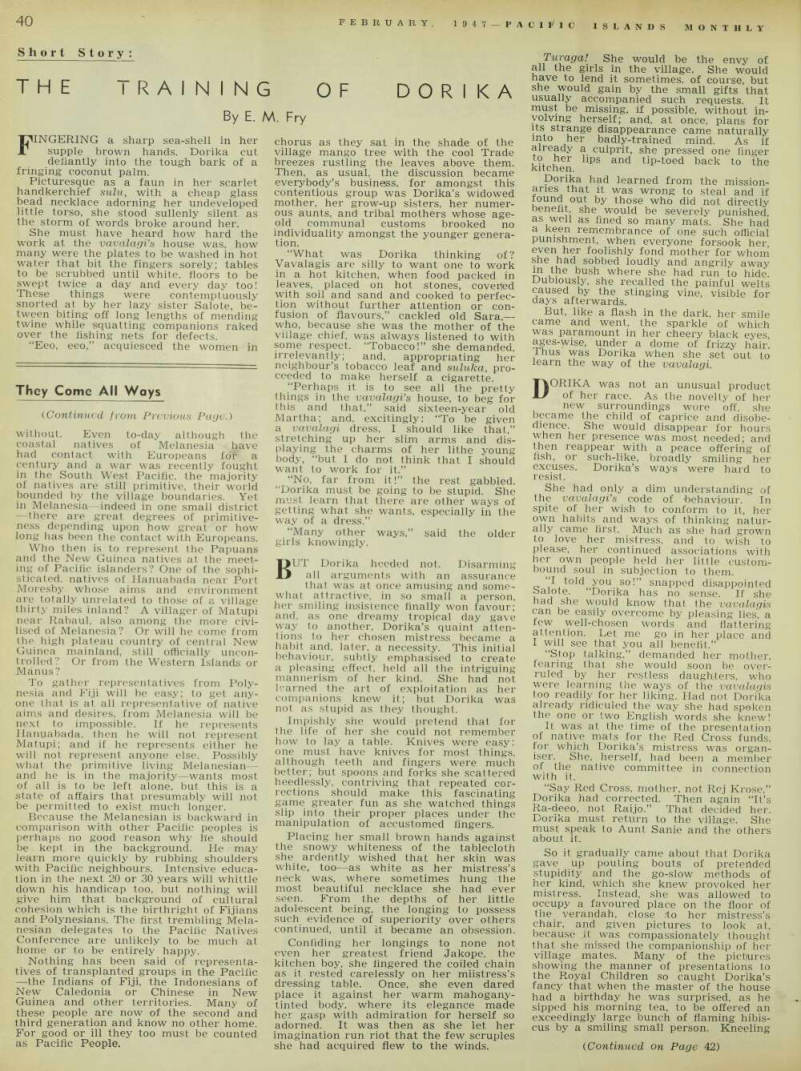
Representing one of the “foreign” groups in the Pacific. Javanese children whose home is in Noumea, New Caledonia.
Photo by F. E. Dunn.
A High Chief of American Samoa.
Tahitienne —a study of a Polynesian girl of Papeete, Tahiti, by Frederick Simpson.
without. Even to-day although the coastal natives of Melanesia have had contact with Europeans for a century and a war was recently fought in the South West Pacific, the majority of natives are still primitive, their world bounded by the village boundaries. Yet in Melanesia —indeed in one small district —there are great degrees of primitive ness depending upon how great or how long has been the contact with Europeans.
Who then is to represent the Papuans and the New Guinea natives at the meet ing of Pacific islanders? One of the sophi sticated, natives of Hanuabada near Port Moresby whose aims and environment are totally unrelated to those of a village thirty miles inland? A villager of Matupi near Rabaul, also among the more civi lised of Melanesia? Or will he come from the high plateau country of central New Guinea mainland, still officially uncon trolled? Or from the Western Islands or Manus?
To gather representatives from Poly nesia and Fiji will be easy; to get any one that is at all representative of native aims and desires, from Melanesia will be next to impossible. If he represents Hanuabada, then he will not represent Matupi; and if he represents either he will not represent anyone else. Possibly what the primitive living Melanesian — and he is in the majority—wants most of all is to be left alone, but this is a state of affairs that presumably will not be permitted to exist much longer.
Because the Melanesian is backward in comparison with other Pacific peoples is perhaps no good reason why he should be kept in the background. He may learn more quickly by rubbing shoulders with Pacific neighbours. Intensive educa tion in the next 20 or 30 years will whittle down his handicap too, but nothing will give him that background of cultural cohesion which is the birthright of Fijians and Polynesians. The first trembling Mela nesian delegates to the Pacific Natives Conference are unlikely to be much at home or to be entirely happy.
Nothing has been said of representa tives of transplanted groups in the Pacific —the Indians of Fiji, the Indonesians of New Caledonia or Chinese in New Guinea and other territories. Many of these people are now of the second and third generation and know no other home.
For good or ill they too must be counted as Pacific People.