Hospitality in the Mangaia Manner
p. 39 · Read in the full issue
A Trader’s Tale:
By "Tukapa Koko"
COMPARING past events with present, I am beginning to wonder why those Scriptural folk made such a fuss about a locust or two.
When I hold back a tear to let a smile appear, I’m painting a crowd with moonshine the crowd of Mauke-ans that were my guests. And it has taught me the evils that result from bringing a primitive race, happy in their innocence, into contact with the white man’s notions of what is a seemly standard of living.
It is my amazing good fortune to have a large number of native in-laws—two hundred and sixty-three, I believe it is; though there are additions each year, as Time takes its inevitable course.
My worries began with the Tere , which is similar, ’Erbert ’Enry tells me, to the inalaga —a sort of glorified picnic-cum- Cook’s-Tour, from one island of our group to another. But it was Johnson that suffered most.
Johnson so named because his native cognomen is impossible to a white man’s organs of speech, unless said white man has swivelling tonsils, safe from rupture-risk once invited a daughter who resided on the neighbouring island to visit the old folks at home (“home” being the decrepit old wooden shack, like a barn, where she first saw the light some thirty years before) and to bring her “foreign” because not Mangaian— hubby with her.
The idea was quite good; but when a tribe of some forty people disembarked from the hither-ward schooner. Johnson’s welcoming smile was a bit mechanical after he had greeted them all.
They were a strange assortment of Polynesians; the leader of the expedition, —who was not Johnson’s daughter, as one might expect was a lady of Chinese extraction, who seemed to be a re-incar nation of Catherine of Russia. She took charge of everything; marshalled the lately-seasick, the woe-begone, the woozy; and having picked up dressing, the crowd marched up the rocky Jacob’s -ladder that leads from the beach, and were soon at Chez Johnson.
Pigs and hens had been killed in haste —there would be leisure enough to re pent a fortnight later, when the Retreat would be sounded and it was not difficult at first to refresh the sea-weary guests. Nor did it take them long to get into Laager—to outspan, so to speak —for they had brought with them beds, lamps, quilts, blankets, and pillows galore; the old home began to look really in habited when all these were arranged —so many beds to a side, three at each corner. There were also the green enamelled indispensables, biblically named “leremia” that seem to be such a feature of native Teres.
The guests were a musical lot, too.
They had brought instruments of theii
own, and they started warnling almost as soon as they got settled down —all except the four children of the Cathay extracted lady. Here, I witnessed a re markable piece of racial canniness, purely Chinese. While the other kids in the party were fooling about, these four made a dash at a small coffee patch by the side of the house, where some beans still lay on the ground. They gathered all these up, and brought them along in triumph. They were half an hour at the job and the bag held five pounds of coffee.
The guests spent the afternoon meeting people and renewing acquaintances, and by b p.m. it seemed as if they had always been there that perhaps accounted for Johnson’s worried look, for tea-time was nigh, but the pig-and-chicken of dinner was certainly not seven baskets-full of remnants and the guests expected tea on European lines! That was when we began to see what civilisation has done to the Polynesian.
Johnson’s police salary being village peace-officer, he was entitled to the princely sum of two pounds per quarter —was hastily mortgaged. I assisted, with such groceries as the schooner had brought me, jam, cake, and a few other things. Johnson negotiated at the Beach for a sack of flour, and returned triumph antly with it.
The mob were fed; morning tea and pancakes; evening pancakes and tea. in between, the pot-luck of pig and chicken seemed to satisfy them.
The nights were filled with music for nearly two weeks; but the joy of enter taining guests seemed to neurotise honest Johnson, for his temper became progres sively shorter as the fortnight passed.
The star musician of the party was Terei, a good-looking girl of twenty.
She played and sang well; at the end of the time, I found it hard to lose her.
Not much of a tale, this; there is no thrill, just a final word of life in Poly nesia, and how the best of friends must part, must part.
They returned to their home island at last, and a weeping Terei took farewell.
Not long after, a rounding schooner put in at our island, and I met one of the Tere-ites, on his way to Rarotonga.
“How’s everyone?” I asked.
“Meitaki” (Good) said the ex-guest.
“And how’s Terei?” I inquired.
“She’s dead!” said the Stranger.
Ships that pass in the night , . . ! !
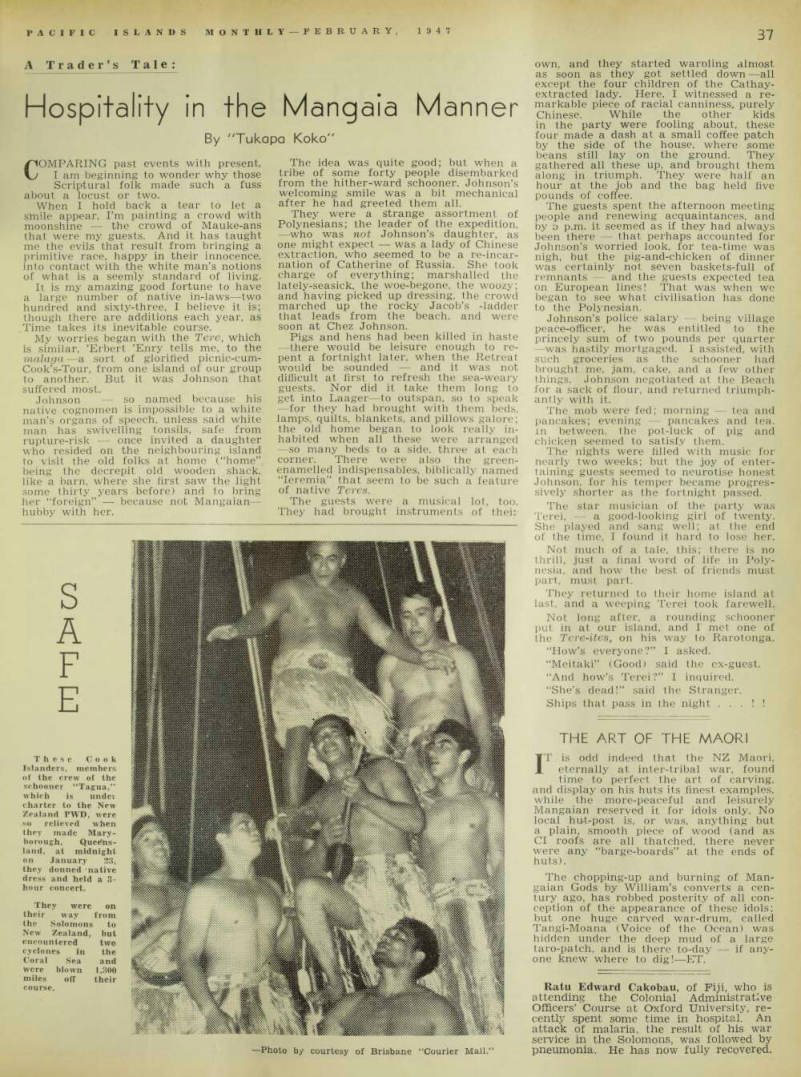
S A F E
These Cook Islanders, members of the crew of the schooner “Tagua,” which is under charter to the New Zealand PWD, were so relieved when they made Mary borough, Queens land, at midnight on January 23, they donned native dress and held a 3hour concert.
They were on their way from the Solomons to New Zealand, but encountered two cyclones in the Coral Sea and were blown 1,300 miles off their course.
—Photo by courtesy of Brisbane “Courier Mail.”