Fifth Conference Of International
pp. 13-14 · Read in the full issue
Aviation Organisation Meets
In Melbourne
Will Consider Special Problems of Pacific Aviation
FLOWERS and flags greeted 200 repre sentatives and observers from 23 nations when they met at the fifth meeting of the Provisional International Civil Aviation Organisation in Wilson Hall, Melbourne University, on February 4. PICAO was formed in Chicago in 1944 and Montreal, Canada, has been chosen as the heaquarters of the organisation; Dr. Edward Warner is the permanent chairman.
PICAO is an international technical body and its meetings, of which 10 are planned, are designed to solve problems of air navigation peculiar to various parts of the world.
Having already held four such meetings in other countries, procedure at the Mel bourne meeting created few troubles al though in considering the South Pacific area it was necessary also to decide what ground organisation provided by the Allies during the war should be retained for civilian use and what modifications to suit the long ocean flights in the South Pacific might be made to stand ards laid down previously by PICAO.
The meeting will also compile a draft South Pacific Regional Manual contain ing all the information a pilot needs to know and discuss such technical matters as uniform practice in setting altimeters, and uniform instrument approach and procedures.
The Australian Minister for Air (Mr.
Drakeford) in his opening address to the Conference said that the problems in the South Pacific were unique in that they involved long ocean hops and low traffic density. He thought it would be a long time before a dozen aircraft were stacked up over Nadi (Fiji) waiting to land. The main difficulty in maintaining air transport across the Pacific was that there is as yet, hardly enough traffic to
justify the cost of maintaining expensive ground facilities, and as ocean traffic, too, is widely spaced, shipping can give only negligible assistance to weather fore casters After the opening session, at which the general public was admitted, five tech nical committees were set up in accor dance with usual PICAO practice to carry out the real work of the meeting.
These committees were: ■ Air Traffic Control (ATC) ■ Aerodromes, Air Routes and Ground Aids (AGA) ■ Communications (COM) b Meteorology (MET) ■ Search and Rescue (SAR) Later another working committee was set up to deal with proposed alterations to South Pacific boundaries. This com mittee eventually decided to leave the boundaries as they had already been de fined by PICAO, but to instruct technical committees to set forth requirements as they relate to trans-Pacific operations without regard to regional boundaries.
It had been suggested by the United Kingdom delegation that the region should be confined to the South Pacific whereas the area suggested by PICAO includes routes that operate entirely with in the North Pacific.
The United States has suggested al ternatively that the region be extended to include the east coast of China and Hong Kong and Netherlands delegates wanted NEI to be included.
These proposals were discarded but the committee’s report will mean that technical committees will be able to make recommendations about facilities neces sary for the completion of any long ocean flights extending outside the defined boundary of the South Pacific.
THE following countries sent delega tions to the meeting; the name of the leader of each delegation ap pesar in parenthesis: United Kingdom (Mr. Dennis Peel); New Zealand (Mr. J. M. Buckeridge); Greece (Mr, Nicolades); Bolivia (Capt.
German Pol); Australia (Air Marshall R.
Williams); Czechoslovakia (Mr. Tokoly);
China (Col C. Y. Liu); Portugal (Col.
H. Delgado); Netherlands (Mr. B. F. H. van Lent); Canada (Mr. A. D. McClean); France (Col Migeon); Switzerland (Mr.
J. A. Pietzcher); Philippines (Col. J. A.
Villamor); El Salvador (Mr. N. Kara gheusian); United States of America (Mr.
Glen Gilbert). Representatives of PICAO’s Interim Council at the meeting were: Dr. Edward Warner (Leader), Messrs. G. D. Cartwright, Nelson Ho, V.
H. Davey, Wertman, Fowler. E. A. West lake, J. Lerew and Ivor McClure.
Representatives of International Air line Transport (Operators’) Association were: Capt. Garden (New Zealand). Mr.
McGrane (New Zealand). Mr. H. A.
Ferris (Canada), Mr. P. Oolgaard (Hol land), Capt. Gerrand (New Zealand), Cdr.
H. C. Walker (New Zealand). S/Ldr. Pirie (New Zealand), and Capt. Ritchie.
Formalities are Killing Air
Transport
IT is hoped by the air-travelling public that somewhere within the frame work of PICAO, consideration will be given to making air travel easier and less entangled in the miles of red-tape and form-filling that must be negotiated be fore a traveller can fly from one country to another at present.
With regard to this Whites Aviation says: Airline operators and air travellers are hopefully looking to PICAO.
Already that organisation has drafted a set of recommended standards for the simplification of border crossing regu lations. The recommendations suggest a
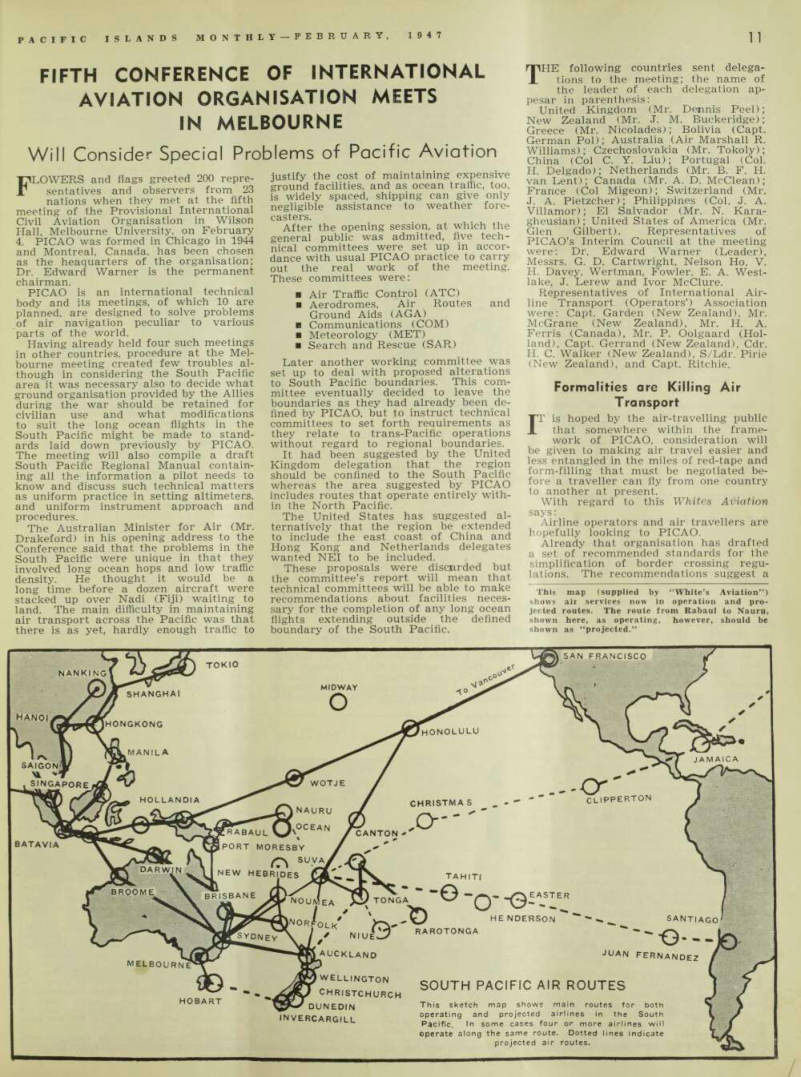
This map (supplied by “White’s Aviation”) shows ail services now in operation and pro jected routes. The route from Rabaul to Nauru, shown here, as operating, however, should be shown as “projected.”
standard passport valid for one year through the territories of the 46 member States.
If recommendations made by PICAO are adopted, an air traveller off on a business trip or a vacation would find border crossing much simpler than it is at present. The issue of a “non-immi grant passport” card is recommended. It is also proposed that instead of informa tion sheets, otherwise known as forms, the passenger could merely fill in a “pas senger card” on board the aircraft. On arrival at various ports of call, immigra tion authorities would be able to enter on the card the time the visitor was allowed to remain in the country.
PICAO suggests that member States should establish customs-free airports which international aircraft could pass through without being subjected to all manner of hindrances. PICAO recog nises the importance of public health, but recommends the acceptance of an international certificate of innoculation.
Passengers could carry that certificate with them. Also recommended is the elimination of passports and visas for airline crews.
Not only passengers, but also airlines are troubled by the hundred and one formalities that are slowing down travel.
Literally thousands of forms have to be completed before an aircraft can proceed from New Zealand to the United States with 40 passengers, seven or eight crew, 200-odd parcels of freight and a few bags of mail. Those forms add up to quite an appreciable number of pounds.
TO give point to their complaints, Whites Aviation quotes a United States official who recently made a world trip by air. The official said: “In the old days it took my grandfather nine days to get ready and 90 days to get to America from the Old Country.
Now it takes 90 days to get ready and 9 hours to get here.”