Six Nations Meet To Plan Advancement
pp. 10-70 · Read in the full issue
of South Pacific Peoples South Seas Agreement Drawn Up and Signed
Delegates At South Seas
Conference
United Kingdom
Mr. Ivor Thomas, MP.—Parliamentary Under secretary o£ State for the Colonies.
The Rt. Hon. E. J. Williams. —United Kingdom High Commissioner, Canberra.
Sir Alexander Grantham, KCMG.—Governor of Fiji and High Commissioner for the Western Pacific.
Mr. J. B. Sidebotham, CMG.—Assistant Secretary in Charge Pacific Department Colonial Office.
Mr. A. R. W. Robertson. —Financial Secretary, Fiji.
Mr. G. Kimber. —Office of the United Kingdom High Commissioner, Canberra.
France
Monsieur Pierre Auge.—French Minister in Canberra.
Monsieur R. F. Lassalle-Sere.—lnspector-General of Colonies.
Monsieur A. Gazel. —French Minister in New Zealand.
Monsieur J. Tallec.—Retiring Governor of New Caledonia.
Monsieur, J. C. Haumant. —Governor of French Establishments in Oceania.
Monsieur E. M. de Curton.—French Ministry of Foreign Affairs.
Netherlands
Baron F. C. van Aerssen Beyeren van Voshol, MWO, NL. —Netherlands Minister in Aus tralia.
Colonel Abdoelkadir Widjodjoadmodjo.—General Adviser to the Lieut.-Governor-General of the NEI.
Dr. H. de Rook. —Secretary, Department of Health, NEI Administration.
Dr. Liem Hian-Boo.—Adviser to the NEI Adminis tration.
Mr. M. A. Pellaupessy.—Commercial Adviser to the NEI Administration, Amboina.
Mr. A. J. Beversluis.—Deputy Director of Forestry Service, NEI Administration.
Jonkheer Dr. J. A. de Ranitz. —Royal Nether lands Legation, Canberra.
Lieut, van der Star, RNN (ADC to Lieut.- Governor-General). —Secretary of Delegation.
Mr. J. K. Kroon.—Adviser.
United States
The Honourable Robert Butler.—United States Ambassador in Canberra.
Captain Harold A. Houser, USN.—Governor of American Samoa, Navy Department Adviser.
Mr. James F. Green. —Associate Chief of Division, Dependent Area Affairs, Department of State.
Mr. Roy E. James.—Division of Territory and Island Possessions, Department of the Interior.
Mr. Abbot Low Moffat.—Chief of Division, S-E Asia Affairs, Department of State.
Mr. Arthur L. Richards.—Assistant Chief of Division, British Commonwealth Affairs, Department of State.
Mr. Emil J. Sady.—Division of Dependent Area Affairs, Department of State.
Australia
The Rt. Hon. H. V. Evatt, KC, MP.—Deputy Prime Minister and Minis t|.* for External Affairs.
The Hon. E. J. W’ard, MP.—Minister for Ex ternal Territories.
Sir Frederic Eggleston.—Formerly Minister to the United States.
Col. J. K. Murray.—Administrator of New Guinea.
Prof. K. H. Bailey.—Commonwealth Solicitor- General.
Mr. J. R. Halligan.—Secretary, Department of External Territories.
New Zealand
The Rt. Hon. Walter Nash, MP.—Deputy Prime Minister and Minister of Finance.
Mr. A. G. Osborne, MP.—Parliamentary Under secretary to the Prime Minister.
Mr. J. G. Barclay.—New Zealand High Com missioner, Canberra.
Col. F. W. Voelcker, DSO, MC.—Administrator of Western Samoa.
Mr. W. Tailby.—Resident Commissioner, Cook Islands.
Mr. C. G. R. McKay.—Secretary, New Zealand Island Territories Department.
Mr. G. R. Laking.—New Zealand External Affairs Department.
Mr. C. A. Sharp.—New Zealand High Commis sioner’s Office, Canberra.
Mr. C. Craw.—New Zealand External Affairs Department,
ALTHOUGH the South Seas Conference, held in Canberra, Australia, between January 26 and February 6, had a somewhat disorganised slart, due to the last-minute withdrawal, by Party politicians, of Federal Parliament House as a meeting place; and because some delegates in their opening speeches were inclined to confine their remarks to a reiteration of the old “No Exploitation” catch-cry, a permanent Commission was finally set up and the foundation laid for future co-operation by the nations administering non self-governing Territories in the South Pacific.
An Agreement was drawn up and signed on February 6, by the following: Australia (Dr. H. V. Evatt and the Hon. E. J. Ward); France (M. Pierre Auge); Netherlands (Baron F. C. van Aerssen and Abdoelkadir Widjodjoadmodjo); New Zealand (The Hon. Walter Nash and Mr. A. G. Osborne); United Kingdom (Mr. Ivor Thomas, MP, and Rt. Hon. E. J. Williams), United States of America (The Hon. Robert Butler).
Machinery thereby designed should, if wisely and widely used:— • Co-ordinate and analyse practical ideas and through the headquarters of the Commission (which is temporarily located in Sydney, NSW), distri bute them to the areas where they will do most good. • Make available facilities for research into health, agriculture, trans port and education problems which apply to all the Territories concerned. • Attack the problem of labour and try to apply some practical system or systems; improve production.
Worth noting during the Conference was the advice of Mr. Ivor Thomas, of the United Kingdom delegation, who said that it was necessary to make haste slowly—that self-government could not be handed to a primitive people on a plate and that administrative capacity was a rare thing even among so called advanced people. This advice applies particularly to Melanesia.
The approach of delegates to the Conference varied: Representatives of the United States, Australia and New Zealand were full of enthusiasm; the French and Netherlands delegates were cautious and those from the United Kingdom somewhat phlegmatic.
{From our Special Representative at the Conference )
DELEGATES from Australia, France Netherlands, New Zealand, United Kingdom and the United States of America attended conference in Canberra from January 28 to Febiuary 6 to discuss methcds for “international co-operation in promoting advancement of peoples of non-self-governing territories in the South Pacific.” The Conference was the outcome of talks between Australia and New Zealand in 1944, when the two countries discussed matters of mutual interest in the South Pacific and drew up the Anzac Agreement.
Result of two plenary sessions and seven days of intensive committee work of the Canberra Conference was the signing of an agreement to establish the South Pacific Commission.
The Conference was formally opened on January 28, when Mr. Chifley, Prime Minister of Australia, welcomed the delegates. He said that the matter of native welfare had been discussed at the last Prime Ministers’ conference held in London and the work of the present Conference would play an important part in world peace. Australia, he said, had always been anxious to enter any discussions that would advance the welfare of native people in the South Seas.
Dr. Evatt was elected president of the Conference on the nomination of U.S.
Ambassador Butler.
Dr Evatt said that for three years it had been the Australian Government’s
wish to convene such a conference and he felt confident that an agreement for the establishment of a Regional Advisory Commission for the area in the South Seas would be hammered out. Prelimin ary discussions with all the governments concerned made it apparent that all six powers were in favour of creating such a body and were convinced of the advant ages to be gained from co-operative in ternational investigation and treatment of problems concerning the advancement of the welfare of the native peoples of the South Pacific.
The Rt. Hon. Walter Nash, leader of the New Zealand delegation, and Deputy Prime Minister of NZ, was elected vice president of the Conference, and Mr.
E. W. P. Chinnery, previously Advisor on Native Affairs in New Guinea, was ap pointed secretary of the Conference.
During the first session, leaders of the delegations addressed the Conference.
Ambassador Butler, of the United States, was keenly enthusiastic. He did not mention “exploitation of the natives” but showed a realistic approach to Pacific problems by stating that the United States hoped for the early establishment of a regional advisory commission for the South Pacific, because they believed that such a committee would mean the development of transport facilities, stim ulation of production and trade and the promotion of tourist travel. All these, he said, would tend to hasten the economic
and social advancement of the people of the region.
Baron van Aerssen, leader of the Neth erlands delegation, expressed the willing ness of his delegation to exchange views on all matters concerned, in a frank and cordial atmosphere, guided and inspired by democratic ideals as well as by the respect for existing constitutional auth ority, A welfare policy, he said, was by no means a new or unexplored field of human endeavour to his country.
Monsieur Pierre Auge, French Minister in Canberra and leader of the French delegation approved of the aims of the Commission which did not include mat ters dealing with politics and defence.
The Rt. Hon. E. J. Williams, U.K. High Commissioner in Australia, outlined some of the problems to be faced in the South Seas, but said that he did not want it thought that the U.K. had done nothing in the past and was doing nothing at the moment, because that was far from being the case.
But while the goal must be high, they must not try to reach it in one leap. For if this is done it will overload the mach ine (i.e., Local Government) and it will break down.
Both the Netherlands and French dele gates were particularly emphatic in their desire to exclude any political discussions at the Conference, nor to clothe the Commission with any power which might have political significance.
The wisdom of this atitude was demon strated during the sittings of the com mittees, when an observer for the In donesian Committee of Independnce, pre sumably for a publicity stunt, attempted to formally protest against the detention of political prisoners in Dutch New Guinea.
The Netherlands delegation was the only one which included a non-Eurpoean member —a man notable for his erudition and quiet dignity.
The Committees at Work
COMMITTEES were formed at the end of the first day’s session and commit tee meetings which were held on sub sequent days were closed to the Press.
The Vice-President (Mr. Walter Nash) impressed upon delegates that they must maintain a strict, silence as to the delib erations and discussions of their commit tees. Because of these secret sessions public interest waned concerning the activities of the Conference, and some of the daily papers—eager for any news— were inclined to exaggerate the discus sions of the various committees into “clashes” and “hitches” in the general progress of business. This was hardly a fair description of the situation where friendly differences were aired and ulti mate agreements reached after candid discussion.
Six committees on which each country was represented by delegates and advisors were formed as follows: Committee I—Area and structure.
Committee ll—The establishment and organisation of auxiliary bodies of the Commission.
Committee lll—Functions and powers of the Commission.
Committee IV —Finance, Committee V —lmmediate projects.
Committee VI —Drafting and co-ordin ation.
Advisers from Papua-New Guinea in cluded Dr. John Gunther (Health), Mr.
W. C. Groves (Education), Mr. Cottrell- Dormer (Agriculture) and one-time Dis trict Officer N. Penglase, who is now at tached to the External Territories De partment, Canberra.
Committee meetings were held from January 29 to February 6 (exclusive of February 1 and 2 when delegates were given the opportunity of motor tours in the country) and the closing plenary ses sion which was again open to the Press commenced on February 6.
The Final Session
THE chairman of the Conference (Dr.
H. V. Evatt) in opening the final plenary session, said that the Con ference had reached a successful con clusion. Delegates had not met in a spirit of aggrandisement, neither had they drafted any agreement directed against anyone, or carved up anyone’s territory. The sole aim of the Confer ence had been to improve the way of life of the island peoples who were not yet able to do it for themselves.
The Minister for External Territories (Mr. E. J. Ward) said the agreement would be a practical instrument for the betterment of the natives, and would not become forgotten or unfulfilled. It re flected the views of the participating governments that the dependent peoples should obtain the right of self govern ment.
Immediate Projects
M. AUGE, in moving a resolution dealing with Immediate Projects (Committee V) said that all agreed that only practical questions would be dealt with.
The immediate projects, put forward by Committee V, and which the Confer ence considered to be of great import ance to the economic and social welfare of the local inhabitants, included: • Agricultural research and investiga tions of plant pests, biological survey and a study of relationship between plants and their environment, including soils and climate. • Economic survey to include native industries, native fisheries, native trading
systems and native co-operative move ments and organisations. A study of mechanisation of production and suitable schemes for organisation of uniform
grading, packing, pooling and marketing of primary products such as copra. The development of schemes for introduction and distribution of potentially useful species, varieties and strains of plants and animals. To take all possible steps to ensure adequate shipping services.
(Continued on Page 67)
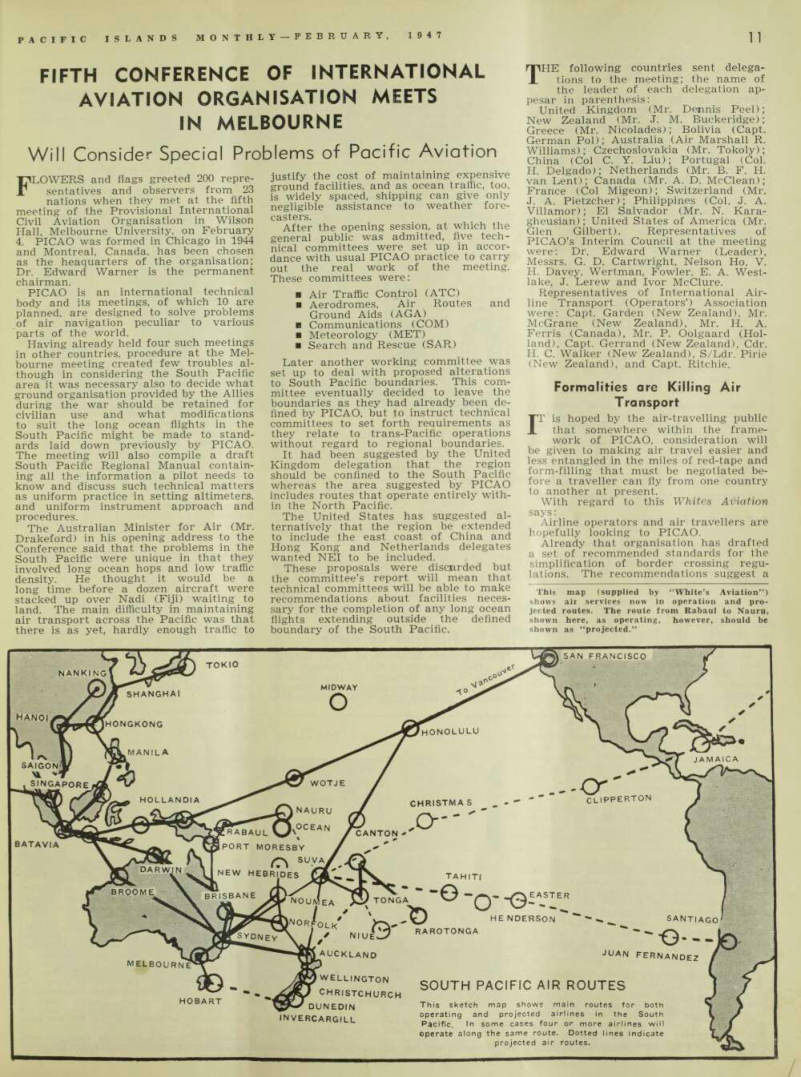
Some of the delegates at the Conference. They are seated round the table in the following order, left to right (excluding “Hansard” re porter on extreme left): Ambassador Robert Butler (USA), Capt. Harold A. Houser (USA), Rt. Hon. E. J. Williams (UK), Sir Alexander Grantham (Fiji), Mr. A. R, W. Robertson, (Fiji), Col. F. W, Voelcker (Western Samoa), Mr. J. G. Barclay (NZ), Baron F. C. van Aersson Beyeren van Voshol (Netherlands), Col. Abdoelkadir Widjodjoadmodjo (NEI), Monsieur R. F. Lassalle-Sere (France), Monsier Pierre Auge (France), Professor K. H. Bailey (Aust.), Col. J. K. Murray (Papua-NG), Sir Frederic Eggleston (Aust.), Mr. J. R. Halligan (Aust.).
• Education and social development projects, including a study of the most efficient methods of teaching illiterate people to read and write in their own languages; a review of research work already carried out in social anthropology and consideration of future lines of re search. A study of special education for handicapped persons (the blind, mentally backwards, lepers and sufferers from other diseases). To ascertain most efficient methods to train local inhabitants for health, education and technical services, visual aids in education; study of the education and social development of women and girls, with a view to widen ing cultural life and improving the dom estic conditions of women. o Fisheries research. ® Forestry surveys. • Health and medical surveys for im proved methods of nutrition; improved village hygiene, including housing. Gen eral surveys of disease and disease-car riers, particular research into TB, leprosy, malaria prevention and dysentery, yaws, filariasis, hookworm and skin diseases, Study of infant mortality and maternal welfare. • Study of labour conditions with view to improvement in accordance with re commendations of the International Labour Organisation.
OTHER matters dealt with at the final session included a resolution (adopt ed) expressing the hope that the co operation of the Kingdom of Tonga may be enlisted in appropriate activities of the proposed South Pacific Commission; A resolution, moved by the U.S. Min ister, expressing a desire that the gov ernments would designate as one of their commissioners, a person whose services would be made available for work with the Commission throughout the year; A further resolution moved by Baron van Aerssen urging the governments to permit officers in their own services to be made available to the staff of the Com mission on secondment or loan.
The Agreement
BY signing the Agreement the six gov ernments agreed that: • A South Pacific Commission be established. • Territorial scope to comprise all non self-governing territories in the Pacific, administered by them and lying south of the Equator and east of, and including, Netherlands New Guinea. Scope may be altered by agreement. • Commission to consist of not more than twelve Commissioners: each gov ernment may appoint two, one of whom shall be senior. Alternate Commissioners and advisers may be appointed. Commis sion to be a consultative and advisory body to the governments in matters affecting economic and social develop ment of non-self-governing territories and for the welfare and advancement of their peoples. To this end Commission to have following powers: Study, formulate and recommend measures for development of economic and social rights and welfare of inhabi tants of territories, particularly regard ing agriculture, communications, trans port, fisheries, forestry, industry, labour, marketing, production, trade and finance, public works, education, health, housing and social welfare; Provide for and facilitate research in technical, scientific, economic and social fields, and ensure maximum co-operation
and co-ordination of activities of re- Se Mnkp b ?prommendations for co-ordination of local projects in any of these fields; Provide technical assistance, advice and information for the governments: Promote co-operation with non-participating governments and non-governmental organisations with common interests; Make enquiries and recommendations with regard to establishment and activities of auxiliary and subsidiary bodies. • Commission discharge such other
functions as may be agreed upon by the governments. • Commission to make such adminis trative arrangements necessary for its powers and functions. • Commission to give early considera tion to resolution passed at Conference relating to “immediate projects.” ° Commission secure legislative and administrative provision as required to ensure Commission will be recognised as possessing legal capacity and entitled to
privileges and immunities as necessary for its powers and functions. • With regard procedure, the Commis sion may meet at such times and in such places as it determines; two regular ses sions to be held each year, and further sessions if desired; two-thirds of senior commissioners to form quorum. It may appoint committees; an annual report to be published. • Special importance to be given to re search work. A Research Council will be established and serve as a standing ad visory body, auxiliary to the Commis sion. Its members will be appointed by the Commission, amongst whom shall be persons highly qualified in health, economic and social development, and shall devote their whole time to the work. • The Research Council shall maintain a continuous survey of research needs, arrange to carry out studies, co-ordinate activities of other bodies, appoint techni
cal standing committees and research committees on special subjects. • A South Pacific Conference shall be established to associate with the Com mission’s work, and local inhabitants of official and non-official institutions will be represented with advisory powers.
Such conference to be convoked within two years after the Agreement comes into force, and afterwards at intervals not exceeding three years. Delegates to the Conference will be appointed for each territory, the maximum number to be de termined by the Commission and selected to ensure greatest possible representation of the local inhabitants of the territory.
Alternate delegates may be appointed, and as many advisers as considered necessary. • A Secretariat shall be established by the Commission. The Secretary-General and Deputy-Chairman to hold office for five years; the former being the chief administrative officer. Staff of the Sec retariat to be appointed from local in habitants of the territories, with view to obtaining equitable national and local representations. • The Secretariat not to seek or re ceive instructions from any government or from any authority external to the Commission: and refrain from any action which might reflect on their position as international officials. Each government undertakes to respect the exclusively in ternational character of the Secretariat, not seeking to influence them in their duties. • The expenses of the Commission shall be apportioned among the govern ments in the following proportions: Aus tralia, 30 per cent.; France, 12£ per cent.; Netherlands, 15 per cent.; New Zealand, 15 per cent.; United Kingdom, 15 per cent.; United States of America, 12 h per cent. Apportionment of expenses is sub ject to adjustment. Pending the adoption of the first budget, administrative ex penses shall be met from an initial work ing fund of £40,000 sterling to which the governments undertake to contribute. • The Commission will co-operate as fully as possible with the United Nations. • The permanent headquarters of the Commission shall be located at such place “within the territorial scope of the Com mission’’ as it may select. Branch offices may be established. Headquarters site to be selected within six months after Agreement comes into force. Pending the selection, temporary headquarters will be in or near Sydney. • The provisions of the Agreement may be amended by consent of the gov ernments. • After five years a participating gov ernment may withdraw from the Agree ment on giving one year’s notice. • If any government ceases to admin ister non-self-governing territories within the scope of the Commission, it shall be deemed to have withdrawn as from the close of the then current calendar year. • Preliminary arrangements for the establishment of the Commission shall be undertaken jointly by Australia and New Zealand. • The Agreement to be registered with the Secretariat of the United Nations Organisations.
A cable was sent to the Governor of French Oceania on January 4, from the Mayor of the city of Gace in France say ing that the name “Boulevard Tahiti” had been given to the finest street in the city. Gace, whose citizens suffered con siderably in the war period, was “adopted” some time ago by the people of French Oceania.