South Seas Conference In An Unhappy Atmosphere
pp. 7-8 · Read in the full issue
THE plan of the South Pacific Re gional Conference was good; and the delegates’ will to accomplish something worthwhile was sincere and praiseworthy. But the Confer ence opened amid nasty political dis cord, and closed under the shadow of vast industrial turmoil. The atmo sphere definitely was not favourable to the accomplishment of anything very noteworthy.
These are not conditions peculiar to Australia: they are common to most of the British Empire, including Bri tain herself, and to France and Hol land. How can intelligent men give their minds completely to the prob lems of native welfare, while prob lems urgently affecting the future of their own people are already defeat ing their leaders in their home coun tries?
Among the delegates who assembled in Canberra there were three classes of men. First, there were the poli ticians—professional babblers, who see all questions with the eye of sec tional prejudice, and whose glib tongues are nearly always informed by knowledge that is purely super ficial. These generally are most dan gerous men—they have great power, they have hypnotised themselves into a belief in their own correctness of view and purity of mind, and they punish all who disagree with them.
These are the “small-time” men who have brought so large a section of the English-speaking world into its pre sent deplorable situation.
The second class are the so-called experts, who have been appointed to highly-paid posts in the Islands’ ad ministrations by the politicians, and who gratefully acknowledge the lat ter as their masters. The Socialist Governments of Britain, Australia and New Zealand have continued and sharply expanded the vicious old system of political appointments—of putting into number one administra tive jobs men who have not been trained for those jobs—and it stands to reason that the appointees, no matter how able and sincere they may be, will allow their judgment to be coloured by their sense of obliga tion.
The third class comprises the
trained men—officials who have spent their lives in particular services, who have no political associations or obli gations, and whose experience and consciences have developed a magis terial mind. These are the men to whom we naturally should look for advice and guidance in all matters affecting the administration of Paci fic Territories; but, under the present fantastic post-war conditions, such men are usually overshadowed and swamped by classes one and two.
THE prelude to the Canberra Con ference was startling, but it pro vides a fitting introduction—a first class fight between the convening Minister, Dr. Evatt (a moderate), and the Speaker of Parliament (Mr. “Sol”
Rosevear, a noisy extremist) con cerning the use of Parliament House for the Conference. Dr. Evatt and his Conference were chased out to a suburban schoolhouse. A piquant bit of background lay in the fact that associated with the defeated and furious Dr. Evatt in the launching of the Conference, was Mr. “Eddie”
Ward (Minister in charge of Aus tralia’s Pacific Territories) a friend and well-wisher of Mr. Rosevear and the Leftists. Thus the overseas dele gates were left in no doubt about political conditions in Australia.
The usual platitudinous and insin cere rubbish was talked at the open ing ceremonies—that is inevitable, wherever politicians are gathered to gether—but it is to be regretted that these Labour Ministers could not keep their sectionalised political views out of their utterances on an occasion like this. The New Zealand Minister.
Mr. Nash, for example, let himself go on the subject of “native exploita tion.” According to Mr. Nash, Euro pean administration of the South Pacific Islands in the past has been merely a cover for “exploitation” of the innocent, long-suffering Island ers; but, by the grace of God, Soci alist Governments have come into power throughout the world to rescue the natives from ruthless traders and industrialists, and establish them in charge of their own countries.
Thereby, doubtless, Mr. Nash ex pressed the sentiments of the Aus
tralians, and some of the British, It is, of course, merely eyewash, designed for things like the Inter national Labour Office and Socialist world-planners; but it is accepted as truth by the unthinking and ignor ant industrial masses.
THERE has been no large-scale or systematic exploitation of Pacific Islands natives for at least 50 years.
Since “blackbirding” was exposed, long ago, the Islands Administrations have been extremely sensitive on the subject of the employment of natives, and all relationships between Euro peans and natives have been strictly and sternly policed. The indentured labour system, which operated in all Melanesian countries until the inva sion, did a very great deal to raise the standard of native life generally.
But, because the cash wage paid to a kept labourer was less than £2O per annum—wealth for a primitive Mel anesian—the system was attacked by the ignorant trade union folk of Aus tralia, and abolished by a class-con scious Minister. The effect of this hasty, ill-judged action is seen to day in the economic chaos of Papua- New Guinea; and, probably, worse is to come. Yet that indentured labour system could have been used most effectively, by Ward and Company, to (a) lift the natives’ standard of life and give them useful technical train ing; (b) quickly restore the Terri tories’ industries.
All the better-class Europeans in the Territories, from the largest trading firm to the smallest planter, acknowledged an obligation to the natives; and, so far from “exploit ing” them, have been ready always to co-operate with the Governments in raising the standards of native life and encouraging re-population.
All those Europeans approved the design and purpose behind Dr.
Evatt’s South Pacific Conference.
The need for some agency to under take the study and co-ordination of South Pacific administration, in the interests of the natives, has been seen, and acknowledged, these many long years. The idea was presented to the non-Labour Governments of Australia and New Zealand, some 15 or 20 years ago, but was either ridi culed or ignored. It is a tribute to the
wisdom and vision of Dr. Evatt that he could make and launch such a plan.
THE plan has been approved, and the South Pacific Regional Com mission soon should be an accom plished fact. Its purpose and its hopes are described elsewhere. It is a tragedy that it should have been launched under unhappy auspices.
Unless all signs and portents are wrong, the Governments of Britain, France, Holland, Australia and New Zealand soon will have upon their hands so many problems involving the future and wellbeing of their own white people that they will have neither time nor energy to spare for the native Islanders. The elaborate economic machinery created by the Socialists for the regeneration of the war-weary world is creaking and cracking, and in imminent danger of collapse. If the three British Em pire Governments do not soon aban don Socialism, and return their nations to a substantial measure of Individualism, disaster cannot be avoided.
It will be time enough for these well-meaning Governments to devote themselves to a study of the native Islanders’ living standards when all is well with their people at home.
Sooner or later their troubles will pass.
Then we shall be very glad that the Conference was held in Canberra in January, 1947—it will have provided us with long-needed machinery for more enlightened and efficient Islands administration. By then, we hope, the politicians and the political appointees will have largely disap peared from the Pacific scene, and the study and the planning will be carried on by men who really know something about colonial administra tion and Pacific Islands problems.
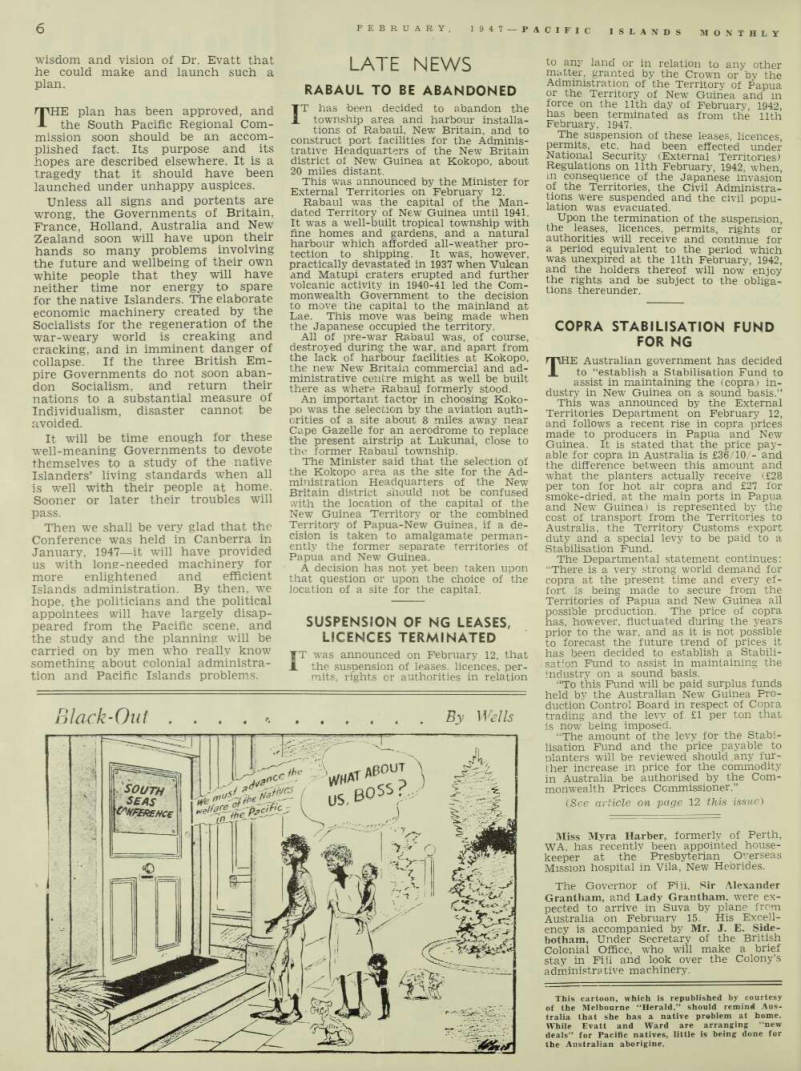
Black-Out By Wells
This cartoon, which is republished by courtesy of the Melbourne “Herald,” should remind Aus tralia that she has a native problem at home.
While Evatt and Ward are arranging “new deals” for Pacific natives, little is being done for the Australian aborigine.