Official Apathy Results in Natives Being Charged
p. 66 · Read in the full issue
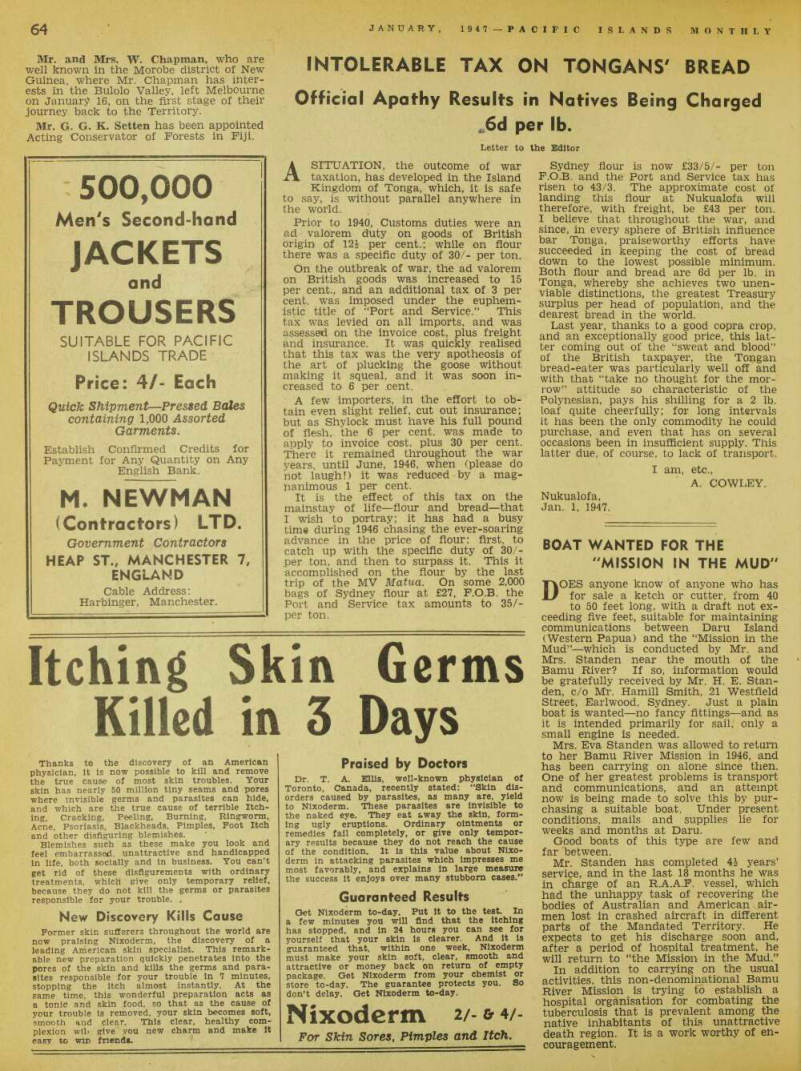
Intolerable Tax On Tongans' Bread
Official Apathy Results in Natives Being Charged 6d per lb.
Letter to the Editor
A SITUATION, the outcome of war taxation, has developed in the Island Kingdom of Tonga, which, it is safe to say, is without parallel anywhere in the world.
Prior to 1940, Customs duties were an ad valorem duty on goods of British origin of 121 per cent.; while on flour there was a specific duty of 30/- per ton.
On the outbreak of war, the ad valorem on British goods was increased to 15 per cent., and an additional tax of 3 per cent, was imposed under the euphem istic title of “Port and Service.” This tax was levied on all imports, and was assessed on the invoice cost, plus freight and insurance. It was quickly realised that this tax was the very apotheosis of the art of plucking the goose without making it squeal, and it was soon in creased to 6 per cent.
A few importers, in the effort to ob tain even slight relief, cut out insurance; but as Shylock must have his full pound of flesh, the 6 per cent, was made to apply to invoice cost, plus 30 per cent.
There it remained throughout the war years, until June, 1946, when (please do not laugh!) it was reduced by a mag nanimous 1 per cent.
It is the effect of this tax on the mainstay of life—flour and bread—that I wish to portray; it has had a busy time during 1946 chasing the ever-soaring advance in the price of flour: first, to catch up with the specific duty of 30/per ton, and then to surpass it. This it accomplished on the flour by the last trip of the MV Matua. On some 2,000 bags of Sydney flour at £27, F. 0.8. the Port and Service tax amounts to 35/per ton.
Sydney flour is now £33/5/- per ton F. 0.8. and the Port and Service tax has risen to 43/3. The approximate cost of landing this flour at Nukualofa will therefore, with freight, be £43 per ton.
I believe that throughout the war, and since, in every sphere of British influence bar Tonga, praiseworthy efforts have succeeded in keeping the cost of bread down to the lowest possible minimum.
Both flour and bread are 6d per lb. in Tonga, whereby she achieves two unen viable distinctions, the greatest Treasury surplus per head of population, and the dearest bread in the world.
Last year, thanks to a good copra crop, and an exceptionally good price, this lat ter coming out of the “sweat and blood’’ of the British taxpayer, the Tongan bread-eater was particularly well off and with that “take no thought for the mor row” attitude so characteristic of the Polynesian, pays his shilling for a 2 lb. loaf quite cheerfully; for long intervals it has been the only commodity he could purchase, and even that has on several occasions been in insufficient supply. This latter due, of course, to lack of transport.
I am, etc.,
A. Cowley.
Nukualofa, Jan. 1, 1947.