widely S type fnd coiSng often
pp. 27-29 · Read in the full issue
Dr. D. W. Hoodless
Widespread Effect of His Work at Suva Medical School
DR. D. W. HOODLESS, the man mainly responsible for the latter-day sue cesses of the Central Medical School, Suva—the institution which trains and equips Native Medical Practitioners for nearly all the Territories of the South Pacific—will retire from the post of
Principal at an early date. As reported elsewhere, he attended his last graduation ceremony at the School in December.
Dr. Hoodless came to Fiji first in 1912, as assistant master, at the Queen Victoria school, in 1915 he was appointed headmaster of Lau Provincial School, and in 1927 he became Assistant Director of Education and Inspector of Schools.
When the Central Medical School was established in 1930, in succession to the more modest Fiji Medical School—which had been in existence since 1886—Dr.
Hoodless was appointed Tutor. At the
beginning of 1936 the title of the post was changed to Principal.
Thp sprrpt of nr ttooHlpco’o
the management?f ’this uniqul institution
nrobablv lips in his C stuLntl. 1 T? They never we?e merely a class—thev wprp a pniwt imTnf
somewhat frightenld natfve lads varvin^
widely S type fnd coiSng often
from primitive communities He studied each boy individually, seeking his good and bad points and trying (and in 90 per cent, of cases with success) to instil into each devotion to his profession confidence
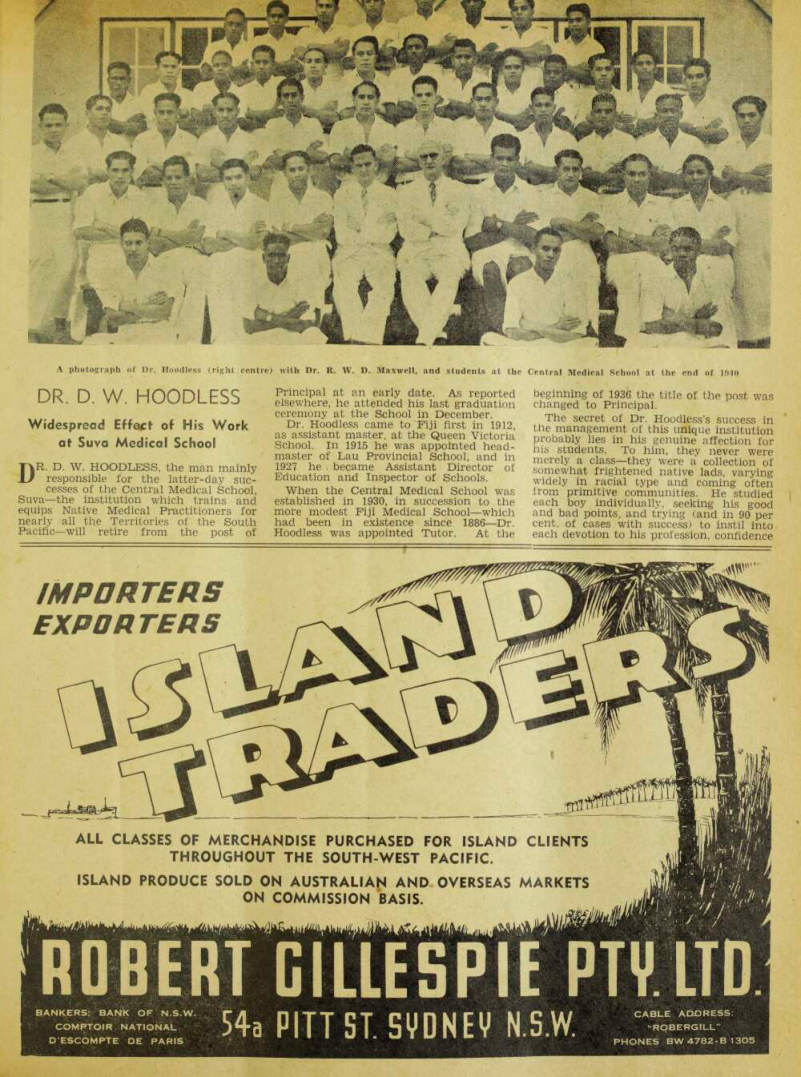
A photograph of Dr. Hoodless (right centre) with Dr. R. W. D. Maxwell, and students at the Central Medical School at the end of 1940
in himself, pride in the peoples of the Pacific Islands, respect for the British flag, and love for the School.
The students came in as isolated strangers, very conscious of their lone liness. They departed with their chins up, intensely proud of their newly-won diplomas, and morally supported in their future activities by the friendships made in four years in the Suva Medical School.
Each man went out to his district, not only as an NMP, but also as an advocate of education, progress and pride of race.
The Influence of Dr. Hoodless and his Medical School, throughout the South Pacific, during 15 years, is beyond calcu lation. He will not be easily replaced.
Dr. Hoodless has a unique knowledge of the operation of the native medical practitioner system in Pacific Territories.
He has written a brief history of the Fiji Medical School and the Central Medical School, and an outline of the work of their graduates, and this will be pub lished shortly.
Dr. Hoodless intends to spend the early part of his retirement in Fiji. His suc cessor, Dr. A. S. Frater, is on his way to Fiji from the United Kingdom.