Why You Do Not Get
pp. 13-14 · Read in the full issue
The Goods You Order
ISLANDS residents have been writing to the “PIM” complaining that they suffer great delay in obtaining goods and services they order in response to advertisements in the journal. They say they receive advice of the despatch of the goods—but the infrequent ships often arrive without them.
A kind of madness has settled upon Australia's post-war working masses. The country is literally torn with strikes, affecting the production and transport of goods, and business of all kinds is carried on with increasing difficulty. That affects the despatch of goods to the Islands.
Goods in transit are subject to many t roubles. They may be pillaged in the dockside stores, where waterside workers are becoming bolder in thieving. They may be held there by dockers’ strikes.
The ships may be themselves held up by strikes. Shipowners, fighting desper ately to keep their fleets moving, often rush their vessels out of port between strikes, leaving cargo behind.
The only good side to a deplorable situ ation is that it cannot get worse. It must either improve or the country will go into some kind of revolution.
The first missionary of the newly founded South India United Church Missionary Society, Rev. Y. Satya Joseph, is en route to Papua, where he will serve under the London Missionary Society. He is accompanied by his wife.
One of the last of the old independent nickel prospectors who were crushed out of existence by the big companies recently died at Pouembout, New Caledonia. He is Pierre Grimigni, a man, like many French colonials, of Corsican origin.
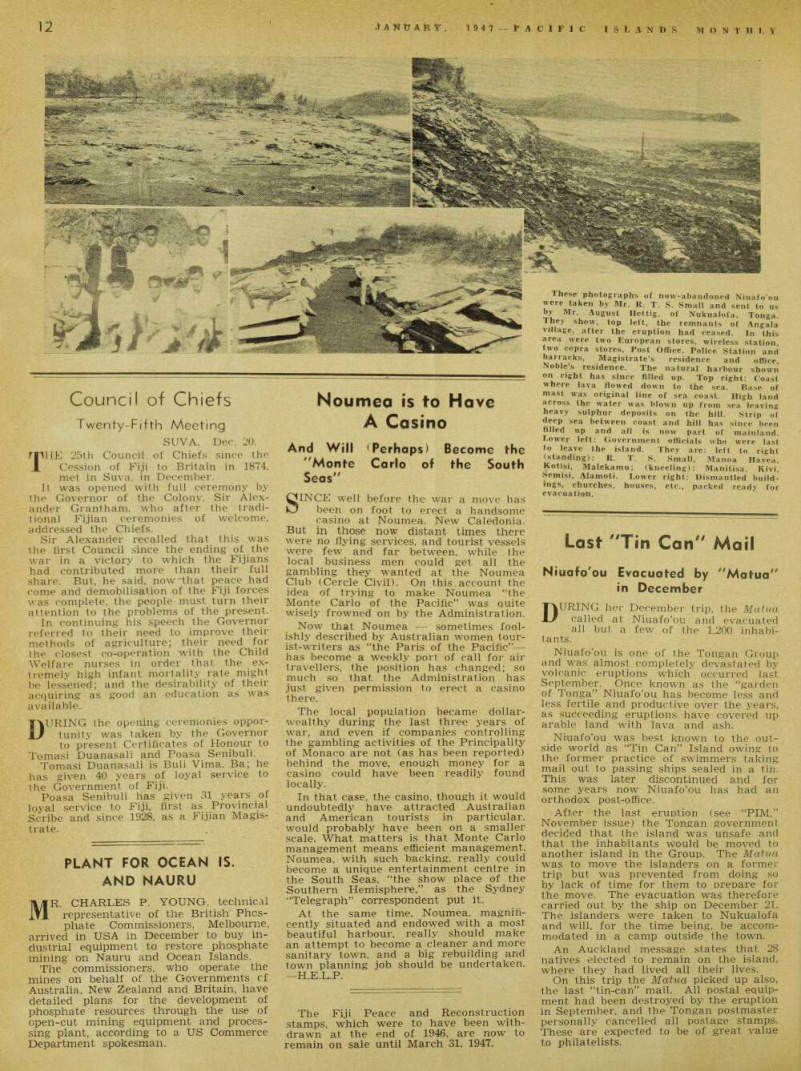
These photographs of now-abandoned Niuafo’ou were taken by Mr. R. T. S. Small and sent to us by Mr. August Hettig, of Nukualofa, Tonga.
They show, top left, the remnants of Angala village, after the eruption had ceased. In this area were two European stores, wireless station, two copra stores. Post Office, Police Station and barracks, Magistrate’s residence and office, Noble’s residence. The natural harbour shown on right has since filled up. Top right: Coast where lava flowed down to the sea. Base of mast was original line of sea coast. High land across the water was blown up from sea leaving heavy sulphur deposits on the hill. Strip of deep sea between coast and hill has since been filled up and all is now part of mainland.
Lower left: Government officials who were last to leave the island. They are: left to right (standing); R. T. S. Small, Manna Havea, Kotisi, Malekamu; (kneeling): Manitisa, Kivi, Semisi, Alamoti. Lower right: Dismantled build ings, churches, houses, etc., packed ready for evacuation.