Madang is Battered But Still Beautiful
pp. 80-81 · Read in the full issue
WHEN you approach Madang from the sea, the small township looks much the same as it did before the war, except where an island has been shorn of its coconuts to give a bet ter approach to the aerodrome. Ashore you will find war damage enough, and the sort of left-over Army atmosphere that is the prevailing one in old Man dated Territory townships to-day.
There are few of the old houses re maining and fewer of the business pre mises. But the magnificent rain-trees that border the cricket oval remain, and so do sufficient of the coconuts to give
the illusion that it is the old Madang.
There are now more and better roads —one connecting Madang and Alexis hafen (it was constructed first by the Germans before World War I, allowed to fall into disuse during our pre-World War II reign, and then reconstructed by the Army after Madang had been taken from the Japs) gives plantations along the coast a land connection with Madang and its port.
Bomb-blast has removed the heads from many coconuts —sufficient, in some cases, to make the plantations unwork able. Their gaunt headless stems, vines climbing thickly up from the base, stand as mute witnesses to the fact that war has been that way. The private plan tation of Mr. James Burns (head of B.P.’s) adjacent to the township area, has been decimated in this fashion, and
is to be “wiped-off” as a plantation pro position.
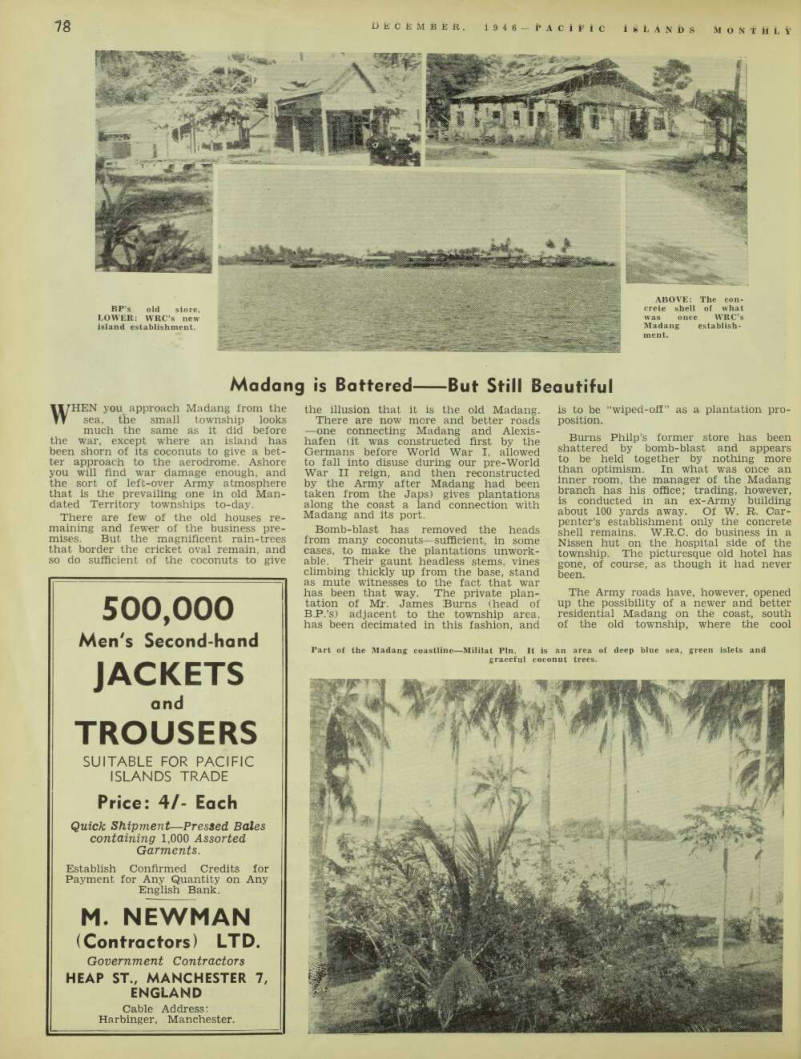
Burns Philp’s former store has been shattered by bomb-blast and appears to be held together by nothing more than optimism. In what was once an inner room, the manager of the Madang branch has his office; trading, however, is conducted in an ex-Army building about 100 yards away. Of W. R. Car penter’s establishment only the concrete shell remains. W.R.C. do business in a Nissen hut on the hospital side of the township. The picturesque old hotel has gone, of course, as though it had never been.
The Army roads have, however, opened up the possibility of a newer and better residential Madang on the coast, south of the old township, where the cool
ABOVE: The con crete shell of what was once WRC’s Madang establish ment.
BP’s old store.
LOWER: WRC’s new island establishment.
Part of the Madang coastline—Mililat Pin. It is an area of deep blue sea, green islets and graceful coconut trees.
breezes blow and the scenery cannot be bettered in any part of the South Seas world. The town-planners are yet to visit Madang. It is to be hoped that they do not neglect this area when they do go that way.
Madang, of course, has little future other than in the coconut. At present the local planters are fighting the usual battles against rehabilitation and labour troubles, and W. R. Carpenter & Com pany are going ahead with the erection of their factory on an island opposite the wharf area—during the war, a Navy establishment.
On Madang waterfront you can learn unofficially all about W.R.C.’s plans.
When their factory gets going (sometime in 1947, it is thought) it is said that they will manufacture vegetable oil, soap, vegetable lard, desiccated coconut and other coconut products from whole coconut kernels (thus reducing the amount of labour needed in copra cut ting) brought from their own planta tions on islands off the Madang coast.
But if you persuade someone to take you across to the island you will prob ably be entertained at tea, and see large pieces of machinery lying about, but you will get no official information as to W.R.C. nlans from the staff. For some season these plans are still hush-hush.
Madang has a weekly air connection
with Lae, and, through Lae, with Aus tralia; but the town must rely on the “Montoro” for most of its stores and supplies. Fresh food is available only when the ship is in or when one grows it oneself. As the “Montoro” calls about once every two months, beer droughts and disguised bully-beef are the order of most of Madang’s days.
Unlike the pre-war era, when Madang was a calling place for scores of small Islands schooners and pinnaces, a small boat —unless it be a mission boat —is rarely seen on Madang harbour now.
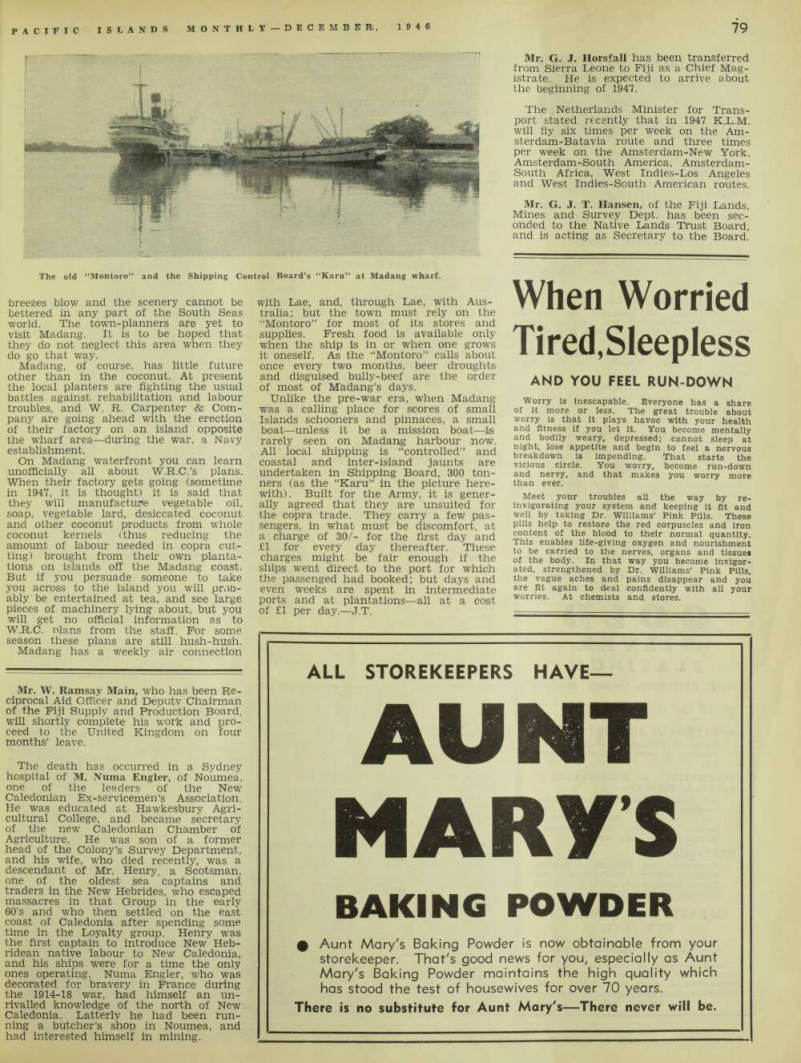
All local shipping is “controlled” and coastal and inter-island jaunts are undertaken in Shipping Board, 300 ten ners (as the “Karu” in the picture here with). Built for the Army, it is gener ally agreed that they are unsuited for the copra trade. They carry a few pas sengers, in what must be discomfort, at a charge of 30/- for the first day and £1 for every day thereafter. These charges might be fair enough if the ships went direct to the port for which the passenged had booked; but days and even weeks are spent in intermediate ports and at plantations—all at a cost of £1 per day—J.T.
Mr. G. J. Horsfall has been transferred from Sierra Leone to Fiji as a Chief Mag istrate. He is expected to arrive about the beginning of 1947.
The , Netherlands Minister for Trans port stated recently that in 1947 K.L.M. will fly six times per week on the Am sterdam-Batavia route and three times per week on the Amsterdam-New York, Amsterdam-South America, Amsterdam- South Africa, West Indies-Los Angeles and West Indies-South American routes.
Mr. G. J. T. Hansen, of the Fiji Lands, Mines and Survey Dept, has been sec onded to the Native Lands Trust Board, and is acting as Secretary to the Board.
Mr. W. Ramsay Main, who has been Re ciprocal Aid Officer and Deputv Chairman of the Fiji Supply and Production Board, will shortly complete his work and pro ceed to the United Kingdom on four months’ leave.
The death has occurred in a Sydney hospital of M. Numa Engler, of Noumea, one of the leaders of the New Caledonian Ex-servicemen’s Association.
He was educated at Hawkesbury Agri cultural College, and became secretary of the new Caledonian Chamber of Agriculture. He was son of a former head of the Colony’s Survey Department, and his wife, who died recently, was a descendant of Mr. Henry, a Scotsman, one of the oldest sea captains and traders in the New Hebrides, who escaped massacres in that Group in the early 60’s and who then settled on the east coast of Caledonia after spending some time in the Loyalty group. Henry was the first captain to introduce New Heb ridean native labour to New Caledonia, and his ships were for a time the only ones operating. Numa Engler, who was decorated for bravery in France during the 1914-18 war, had himself an un rivalled knowledge of the north of New Caledonia. Latterly he had been run ning a butcher’s shop in Noumea, and had interested himself in mining.
The old “Montoro” and the Shipping Control Board’s “Karu” at Madang wharf.