Wau Road
pp. 40-49 · Read in the full issue
There and back by wea pon-carrier, converted ambulance and jeep.
By Judy Tudor
THE somnolent, gray clouds of morning had given place to one of Lae’s rare fine days. Hazy blue sea; mountains standing out clear —beautiful, but for bidding; and golden sunshine.
We spent the best part of it at Milford Haven, the weather unnoticed, our eyes turned rigidly southward, across about two miles of turbulent, yellow water pro vided by the Markham River, which elects to enter the sea in that vicinity.
Milford Haven is no tourist resort; it is the “port” of Lae, invented and left behind by the Armies of the United States and Australia when they finished the war in that quarter.
The Haven is a small cove on the left of the Markham mouth; it affords slightly more protection to shipping than did the old open-roadstead north of the drome, but only slightly more. The Armies, from necessity, built a wharf there and long lines of pontoons made of iron tanks, and workshops and sheds; and the RAAF (presumably), had added a control-tower. Then they joined it by road to old Lae and the new military Lae beyond the drome and the Butibum River.
IN Army days, Milford Haven was prob ably the nerve centre of all local activity. To-day, except on the rare occasions when a ship is in, it is a picture of decay. The pontoons, rusted and twisted, rise and fall awkwardly on the tide; the buildings and control-tower are bleaching in alternate sun and rain, and falling into disrepair; huge pot-holes, of pond proportions, near the wharf entrance, are kept brimming by Lae’s over-abundant rainfall. A derelict ship or two lies nearby and the beach is covered with the usual litter of tropical, slack-water beaches—dry coconuts and old palm-fronds, bits of drift-wood and dead leaves.
My companions—Mr. and Mrs. L. E.
Ashton, from Wau —and I arrived at Mil ford Haven about 8 a.m. Alternately we: sat in the weapon-carrier, looked across the Markham mouth; wandered around the beach kicking coconuts; looked across the Markham mouth; sat on a log; looked across the Markham mouth; got back in the carrier . . .
About midday we retired to the doubt
ful shade of the control-tower, with a large packet of sandwiches and a luke warm bottle of beer. Then at regular intervals this sort of thing went on: Me (rising, and peering across the yellow water): “I can see two black blobs on the far side. Would . . .?”
L. E. Ashton (also rising and peering); “No. Fishing canoes.
We would all subside. Then Mrs. Ash ton, after a decent interval, would get up and her eyes, as though drawn by a powerful magnet, would also turn south wards. “Not a thing in sight,” she would say. “Isn’t it awful!”
The fact was we were looking for a barge. And this is why.
THE road from Wau to the coast was still a novelty. It had taken war and the Army and bond-buyers’ money to give it to New Guinea—9o-odd miles of it, only 20 of which (from Wau to Sunshine, below Bulolo) had already been built when war began. I must see it, particularly as the pessimists were already giving it a limited life. But due to a whole series of the exasperating cir cumstances such as only New Guinea, 1946, can produce, time was now a prob lem and I had only three days left in which to make the trip before I was to leave for South by plane. At last, in desperation I appealed to the Ashtons, then perfect strangers to me, and begged and was promised a lift in their weapon carrier.
Now, in the years before the war, when the Wau road was often discussed, several alternative routes were proposed; but when the Army, as a matter of military expedience, decided to connect Wau to the sea coast by road, they chose Lae as the coastal terminal and took their route up the south bank of the Markham, from Labu. Labu is to the south bank what Milford Haven is to the north bank of the river. In between, as I have already indicated, there churns about two miles of muddy Markham water. It is impossible to bridge it —at least, at that point—so the gap is filled by barges, which act as vehicular ferries.
That is why the Ashtons and I gazed forlornly across that lonely water that fine day in October. Waiting for the barges that never come in. Or almost never.
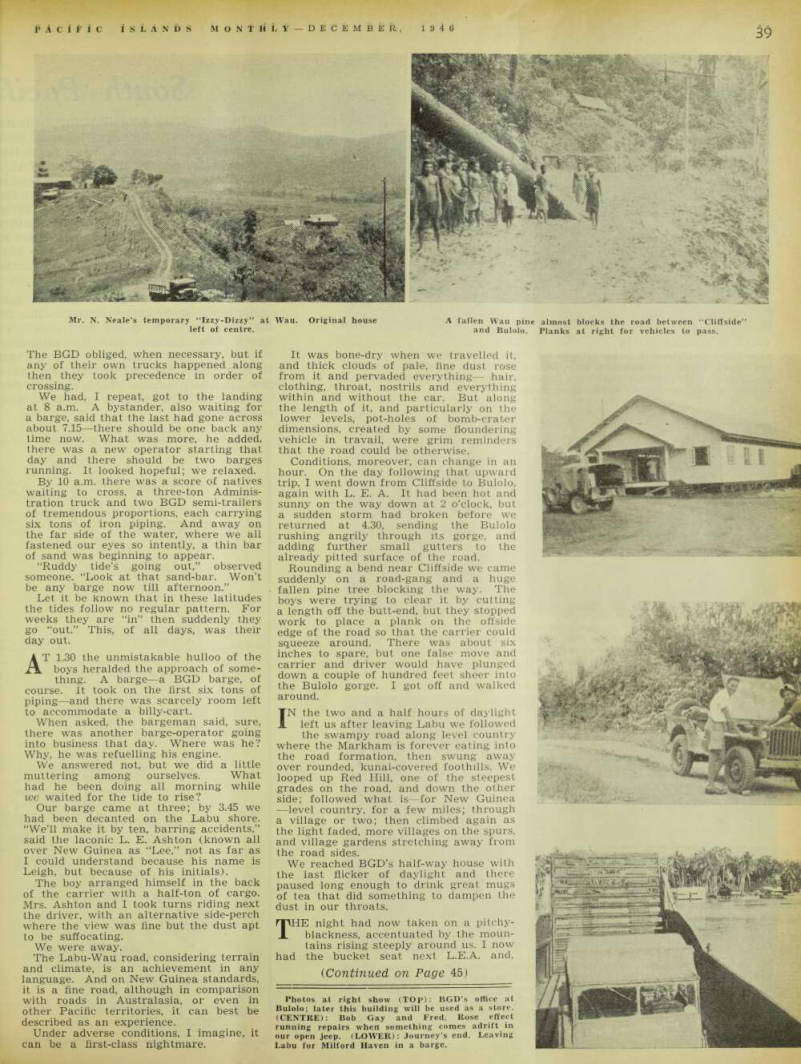
THE barges, the Ashtons had said, as we drew up at the landing, were an unknown quantity. They did not run on a regular schedule and, as the one public contractor had recently gone out of business, the only ferry was being run by the Bulolo Gold Dredging Company.
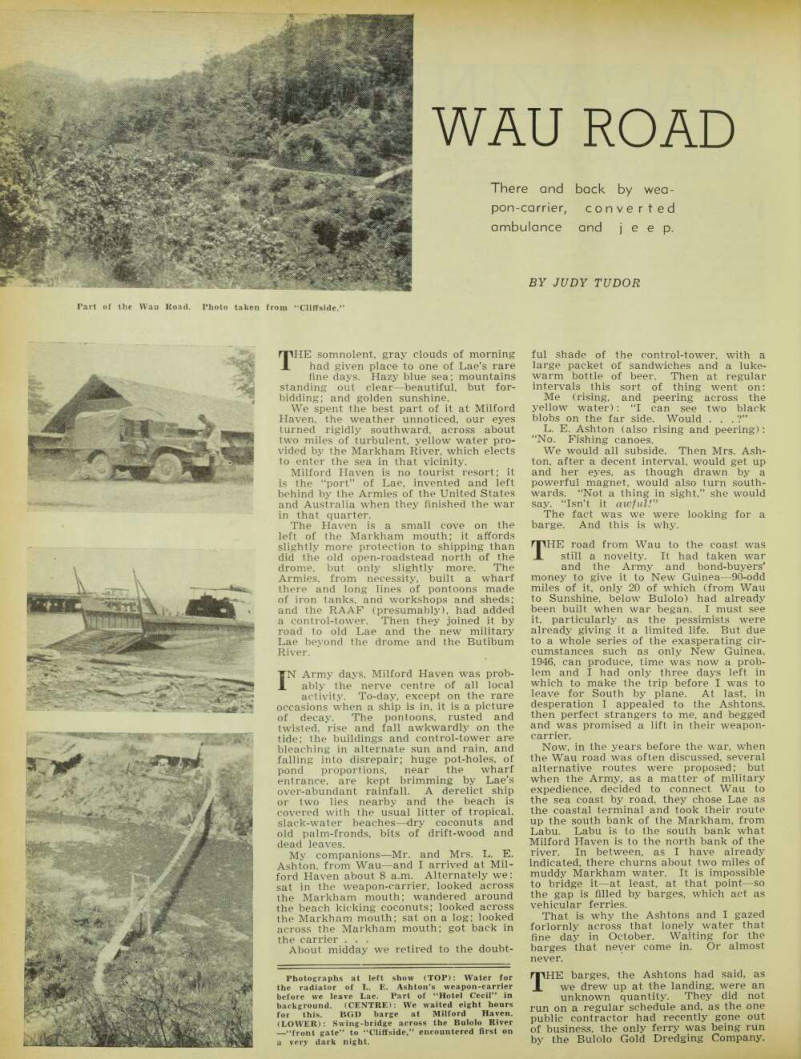
Part of the Wau Road, Photo taken from “Cliffside.”
Photographs at left show (TOP): Water for the radiator of L. E. Ashton’s weapon-carrier before we leave Lae. Part of “Hotel Cecil” in background. (CENTRE): We waited eight hours for this. BCD barge at Milford Haven. (LOWER): Swing-bridge across the Bulolo River “front gate” to “Cliffside,” encountered first on a very dark night.
The BGD obliged, when necessary, but if any of their own trucks happened along then they took precedence in order of crossing.
We had, I repeat, got to the landing at 8 a.m. A bystander, also waiting for a barge, said that the last had gone across about 7.15 —there should be one back any time now. What was more, he added, there was a new operator starting that day and there should be two barges running. It looked hopeful; we relaxed.
By 10 a.m. there was a score of natives waiting to cross, a three-ton Adminis tration truck and two BGD semi-trailers of tremendous proportions, each carrying six tons of iron piping. And away on the far side of the water, where we all fastened our eyes so intently, a thin bar of sand was beginning to appear.
“Ruddy tide’s going out,” observed someone. “Look at that sand-bar. Won’t be any barge now till afternoon.”
Let it be known that in these latitudes the tides follow no regular pattern. For weeks they are “in” then suddenly they go “out.” This, of all days, was their day out.
AT 1.30 the unmistakable hulloo of the boys heralded the approach of some thing. A barge—a BGD barge, of course. It took on the first six tons of piping—and there was scarcely room left to accommodate a billy-cart.
When asked, the bargeman said, sure, there was another barge-operator going into business that day. Where was he?
Why, he was refuelling his engine.
We answered not, but we did a little muttering among ourselves. What had he been doing all morning while we waited for the tide to rise?
Our barge came at three; by 3.45 we had been decanted on the Labu shore.
“We’ll make it by ten, barring accidents,” said the laconic L. E. Ashton (known all over New Guinea as “Lee,” not as far as I could understand because his name is Leigh, but because of his initials).
The boy arranged himself in the back of the carrier with a half-ton of cargo.
Mrs. Ashton and I took turns riding next the driver, with an alternative side-perch where the view was fine but the dust apt to be suffocating.
We were away.
The Labu-Wau road, considering terrain and climate, is an achievement in any language. And on New Guinea standards, it is a fine road, although in comparison with roads in Australasia, or even in other Pacific territories, it can best be described as an experience.
Under adverse conditions, I imagine, it can be a first-class nightmare.
It was bone-dry when we travelled it, and thick clouds of pale, fine dust rose from it and pervaded everything— hair, clothing, throat, nostrils and everything within and without the car. But along the length of it, and particularly on the lower levels, pot-holes of bomb-crater dimensions, created by some floundering vehicle in travail, were grim reminders that the road could be otherwise.
Conditions, moreover, can change in an hour. On the day following that upward trip, I went down from Cliffside to Bulolo, again with L. E. A. It had been hot and sunny on the way down at 2 o’clock, but a sudden storm had broken before we returned at 4.30, sending the Bulolo rushing angrily through its gorge, and adding further small gutters to the already pitted surface of the road.
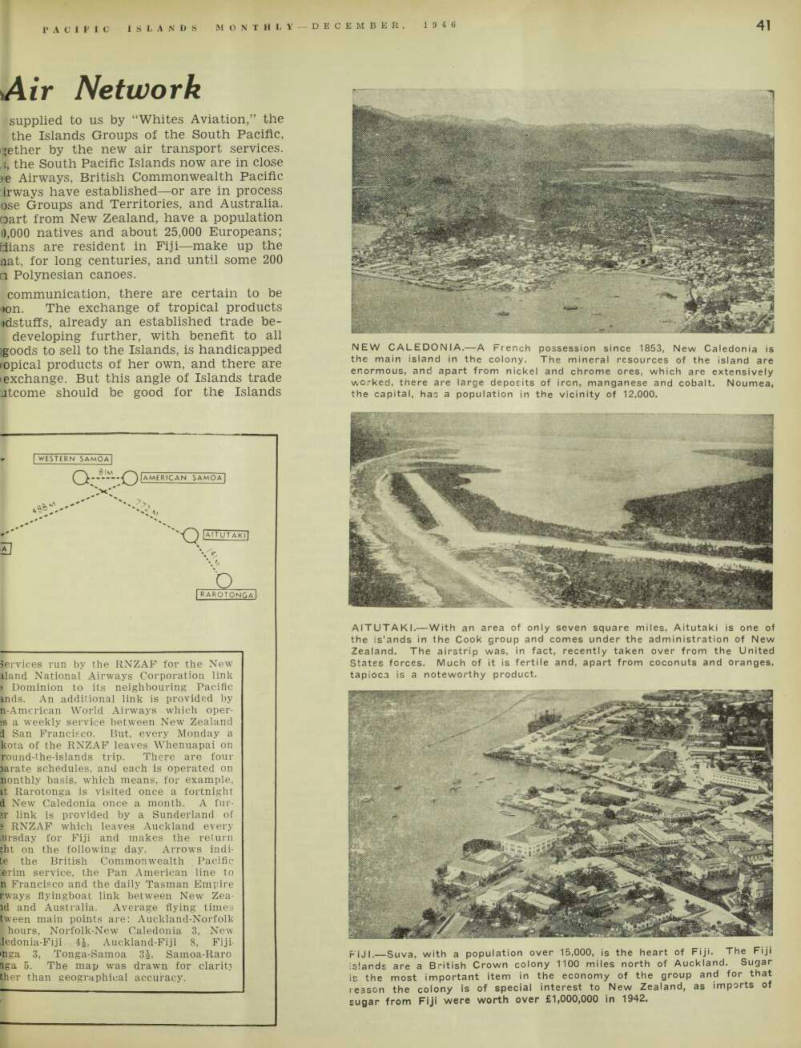
Rounding a bend near Cliffside we came suddenly on a road-gang and a huge fallen pine tree blocking the way. The boys were trying to clear it by cutting a length off the butt-end, but they stopped work to place a plank on the offside edge of the road so that the carrier could squeeze around. There was about six inches to spare, but one false move and carrier and driver would have plunged down a couple of hundred feet sheer into the Bulolo gorge. I got off and walked around.
IN the two and a half hours of daylight left us after leaving Labu we followed the swampy road along level country where the Markham is forever eating into the road formation, then swung away over rounded, kunai-covered foothills. We looped up Red Hill, one of the steepest grades on the road, and down the other side; followed what is—for New Guinea —level country, for a few miles; through a village or two; then climbed again as the light faded, more villages on the spurs, and village gardens stretching away from the road sides.
We reached BCD’s half-way house with the last flicker of daylight and there paused long enough to drink great mugs of tea that did something to dampen the dust in our throats.
THE night had now taken on a pitchy blackness, accentuated by the moun tains rising steeply around us. I now had the bucket seat next L.E.A. and,
(Continued on Page 45)
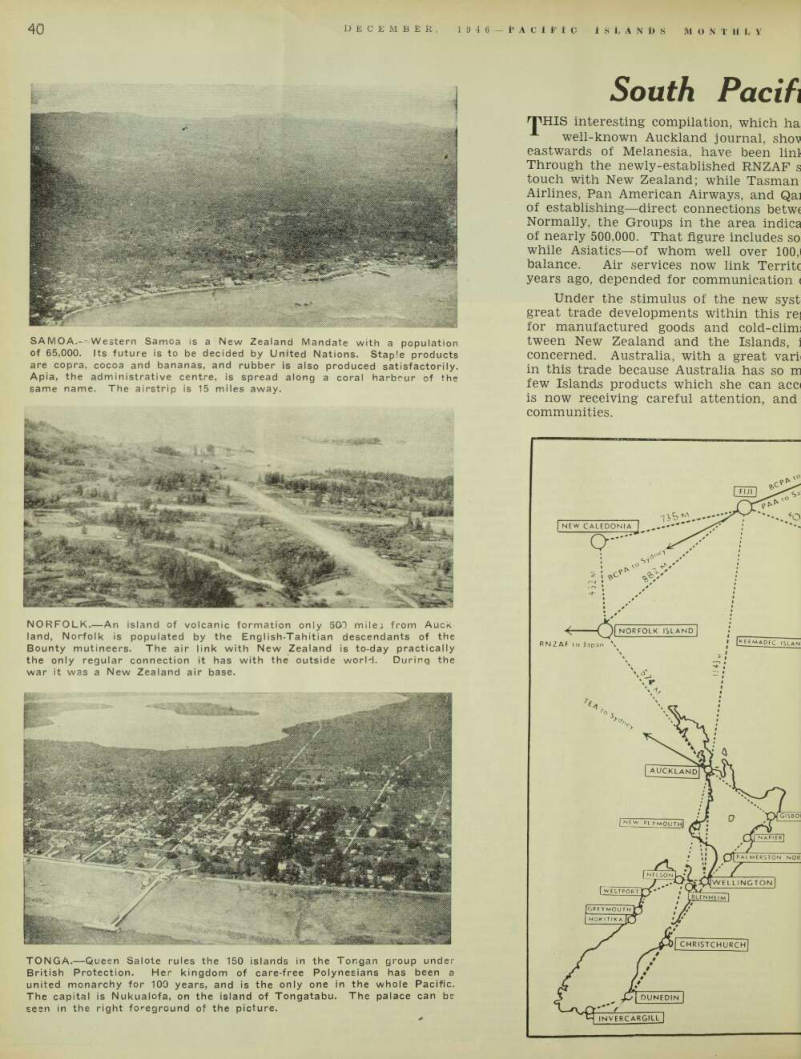
Mr. N. Neale’s temporary “Izzy-Dizzy” at Wau. Original house left of centre.
Photos at right show (TOp): BCD’s office at Bulolo; later this building will be used as a store. (CENTRE); Bob Gay and Fred. Bose effect running repairs when something comes adrift in our open jeep. (LOWER): Journey’s end. Leaving Labu for Milford Haven in a barge.
A fallen Wau pine almost blocks the road between “Cliffside” and Bulolo. Planks at right for vehicles to pass.
in spite of the continual curves, the ascents and descents, the pot-holes and the loose stones, I kept falling asleep, to be jerked back to consciousness again as we charged next into a stream, or one of the Ashtons said “That is the Wampit, down there” or “This is Zenzag” or “The Watut” or “That’s the Bulolo, now.”
The rivers seemed to me to flow along inky chasms that might have been any thing from two to two hundred feet deep, nothing was real except the bouncing carrier and that portion of the road before us, illuminated by the headlights.
Then we came to Bulolo township—a blaze of electricity as bright as a Luna Park in a desert of darkness. But no one was around and we went through without stopping.
I now roused myself sufficiently to think about my hostess. I had met neither Mrs. Doris Booth, of “Cliffside” with whom I was to stop, nor her brother Norman Wilde, nor his wife. But I had had a letter from Mrs. Booth, which con culded by saying: “Don’t bother to write —just arrive.”
I hadn’t written; but I certainly was arriving. I hardly thought that Mrs.
Booth had been thinking of this hour when she wrote that note.
We rounded a bend in the gorge and there ahead and above us was a light.
“Cliffside,” I was told. We had arrived.
While the carrier was garaged on the road side of the river I was instructed to go ahead. “You’ll hit the bridge over there, and some steps.”
I went ahead, and hit the bridge. Then the bridge hit me. It was a swing-bridge, and it bounced back with every step I took, while the dark Bulolo, laughed like a mad thing down below.
On the other side there were steps— many steps. I followed them up into the blackness, beckoned by the brilliant light from above, I tottered across a lawn and came to a house, and the bright light, and behind it an even brighter voice.
“We were expecting you,” I was told.
I guess I looked like something that had recently emerged from the good earth. From my shorts downwards I was powdered with dust; my hair was gray with it and my face caked.
But there was whisky and tea and sand wiches, and the sort of house they had forgotten in Lae, and a bath —and a bed, a blessed bed into which I sank promptly and slept. Occasionally I would half wake, feel the weapon-carrier still climb ing mountains; then I’d hitch the blankets further up (it’s a two-blanket climate up there) and sleep some more.
TO Wau we went next morning in Mr.
Wilde’s sawn-down ex-Army ambu lance. Like Lae and Salamaua and other New Guinea townships there*is little of the old Wau left. The drome is the same, and “Izzy-Dizzy,” the old home of Mr. Norman Neale, perched on a hilltop, is recognisable. But it is only the shell of a house, and uninhabitable; the Neales live temporarily in a small house on a spur behind their original establishment.
In the township area, nothing remains but the shrubbery—crotons, bougainvillea and hisbiscus and other tropical flowers grown into a jungle.
Destruction in Wau, however, was not due to fighting but to an enthusiastic scorched-earth policy which effectively reduced Wau to a shambles. Such fight ing as there was, when Australian troops were hurriedly flown in to deal with infiltrating Japs in February, 1943, took place near Wilde’s coffee plantation —and the plantation still flourishes.
Wilde (pronounced Vild-e, and not to be
confused with my hostess’s brother) is a German. He was interned during the war, and his plantation is now under option to Messrs Colin Tomkins and P.
Jensen. They grow the best coffee I have ever tasted, and have exported over 14 tons of it to Australia in the few months they have been in operation. la common with the rest of the Ter itory their problem is labour. They are at present employing 40 Kukukukus to pick berries —a new experiment in native labour. The Kukukukus are extremely primitive and semi-nomadic. They were never used previously as workers.
Many residents have now returned to the goldfields area; but, except for those employed by the larger mining companies, most are biding their time, hoping that
the labour position will ease and that mining machinery will become more easily procurable. In the meantime, they plant sweet-potatoes and vegetables and live, apparently, on War Damage Insurance payments or other resources, tn contrast to Wau is Bulolo. Bulolo wa s su bj ec t e d to the same ruthless scorched-earthing as was Wau, but BGD are going ahead with rehabilitation in a way that reflects sharply upon the long-range scientifically-planned schemes of the Administration, for most aspects of future New Guinea life. Discussion of Bulolo’s progress is dismissed all over the Territory with the assertion that it is “an American company—and Americans know how to get these things done!”
Whether there are Americans or Aus
tralians or men from Mar* behind Bulolo’s rehabilitation plans, it is idle to suppose that their progress has been made effortlessly; the problems and obstacles that they have faced and beaten
are known only to the executive heads of Bulolo, but one can imagine that they were considerable. The point is that BGD are working to an organised plan and getting things done; the rest of New Guinea rehabilitation is still at the talk ing stage.
BGD first rebuilt their power station at Biune and brought power and fight to the township; next, they got their saw mill going and, from the beautiful local pine, are sawing timber for the new buildings.
In a joinery department next the mill, pre-fabricated houses are being cut and many of these are already being erected in a horse-shoe above the executive centre of the town. When the town is complete it will cater for all the requirements of native and European employees in a model community which even the critical Administration cannot fault.
Many of the buildings have already been finished, and Mr. J. D. Simpson, the manager, showed me around with justi fiable pride. In the almost complete hospital we met a large, round, jolly looking man in shorts and little else, who was equipped with a tin of paint and a brush. I somehow missed hearing his name.
When we were outside again I asked: “Do you have a full-time doctor here then?”
“Why yes, that was the doctor you just met. Dr. Carl Gunther,” I was told.
“Great Heaven,” I said, incautiously, “I thought he was the painter.”
Mr. Simpson yelled back through a window: “She thought you were the painter, Carl!”
The doctor had his head down painting a hospital bed with white enamel. He waved a brush at us. “So I am,” he said, “for the moment.”
BCD’s answer to the labour shortage is to make their community as fully mechanised as possible. Where before the war they employed 1,400 natives, now they expect to employ not more than 600. Every electrical and time-saving gadget is to be installed in the messes and kitchens, and hot-water services and mechanised laundries will do away with a legion of personal servants.
IT was due to BCD kindness that I was able to make my return journey to the coast on schedule. When asked about transport Mr. Simpson thought for a moment and then said that there would be a jeep going down the next day.
“Bob Gay has to catch your plane to Moresby—and he wants to go down by road. You can go with him and Freddie Rose.”
In the course of conversation next day I gathered that Mr. Gay had a marked preference for going to Lae by plane; I wondered if he had been diverted from his purpose in the name of BGD hospi tality.
L.E.A. again rose to the occasion and delivered me early at Bulolo. From there I and my new travel companions ’set off in a jeep—an open jeep which its fond driver described as “fresher, somehow.”
I’m still wondering what he meant exactly.
I lashed my hat on with a piece of cord and put on a pair of sun goggles but I can thoroughly recommend the speed and efficiency of the one-day suntan treatment I got on that occasion. Not even a capricious Southern spring has been able to remove it entirely.
BUT my jeeping companions were good companions and the driver, like most New Guinea drivers, a wizard. He could carry on an animated conversation covering most things on earth, the while he urged that jeep up mountainous in clines, through creeks, and everlastingly around corners and pot-holes.
Now the road was revealed to me in its full glory and I could see the bumps I had merely felt on the night journey. It wound for the most part through uninhabited, dry-brown kunai hills with only an occasional swing-bridge built at an angle of 90 deg. from the road and with a pot-bellied sag of its decking, to break the monotony.
We climbed to Zenag, over 4,000 feet above- sea-level, and the highest point in the road. Here there was a cool breeze, in marked contrast to the stifling heat in the tight, kunai valleys. The air is invigorating, and the scenery majestic, and Mr. Mick Leahy (who runs the
Morobe Transport Company and does most of the cargo freighting along the road these days) has thought of building a hotel at Zenag.
An argument as to whether it would or would not be a good thing for trans port drivers to have a place of refresh ment so close to a dangerous road, kept us occupied until we reached BCD’s half way house.
The men had brought a half-yard of steak with them from Bulolo’s freezer, and the cook-boy grilled it with tomatoes for our lunch.
Then back again to the dusty, snaking road we went—a road which I began now to recognise from the forward journey.
More climbs, more bridges, more twists everlasting. Past transports toiling up wards, past vehicles abandoned months before, where they had broken down and never been removed, past villagers and village gardens and a few boys working on the road, back to the Markham and a mile of track constructed of sawn timber and wire mesh, to keep it out of the swamp, AND so we came to the end of the famous road. Dusty and rough and, in parts, neglected it may be; but, withal, it could be the lifeline of what some day must be the resuscitated gold fields area, and the Lae hinterland.
Mechanised maintenance equipment is needed urgently, but on the whole the road is less fearsome than it might be.
The Army did the job well.
Labu showed up for afternoon tea — and a barge was waiting. No delay this time. The tide, they said, had been in all day.