N.G. Natives's Adjustment
pp. 29-30 · Read in the full issue
To Post-War Conditions
DEAN John Bodger, of the Anglican Mission at Dogura, near Milne Bay (New Guinea), who recently visited Brisbane for the Anglican Provincial Synod, said that New Guinea natives were successfully and quickly readjusting them selves to post-war conditions and that much training of natives had been done since the war ended.
Dean Bodger has been in New Guinea and Papua for more than 16 years. He remained during the war years and in 1944 at the request of General MacArthur, toured the United States to talk on Pacific topics, later he travelled through Canada and Great Britain where he again lec tured on the Pacific war.
According to the Dean, experiments in rice-growing in Papua and the introduc tion of other new crops had been success ful. Food, he said, has been scarce in New Guinea and Papua during the past year, following a bad drought. He also referred to the shortage of rice and maize seed, and material of all kinds. Taro, one of the main native crops, has become diseased throughout the Northern Solomons and gardens there will have to be replanted. The Government is send ing new stocks of fowls and pigs, to re place those lost by the natives during the war.
Dean Bodger’s mission territory is 500 square miles in area but he still walks to nine out-stations, some of them 4,000 ft. up in the mountains. —JHM.
Lady Scott, of Suva, Fiji, left the Col ony for New Zealand on November 20.
The marriage took place recently at Mr. and Mrs. O. L. Davidson’s home, Ellington Estate, Raki Raki, Fiji, of Miss Ellie Hodge to Mr. John Rennie Stevenson, of the Fijian Affairs Office, Suva. The couple plan to visit New Zealand in the new year, and later will go on to Bris bane where the bride’s parents live.
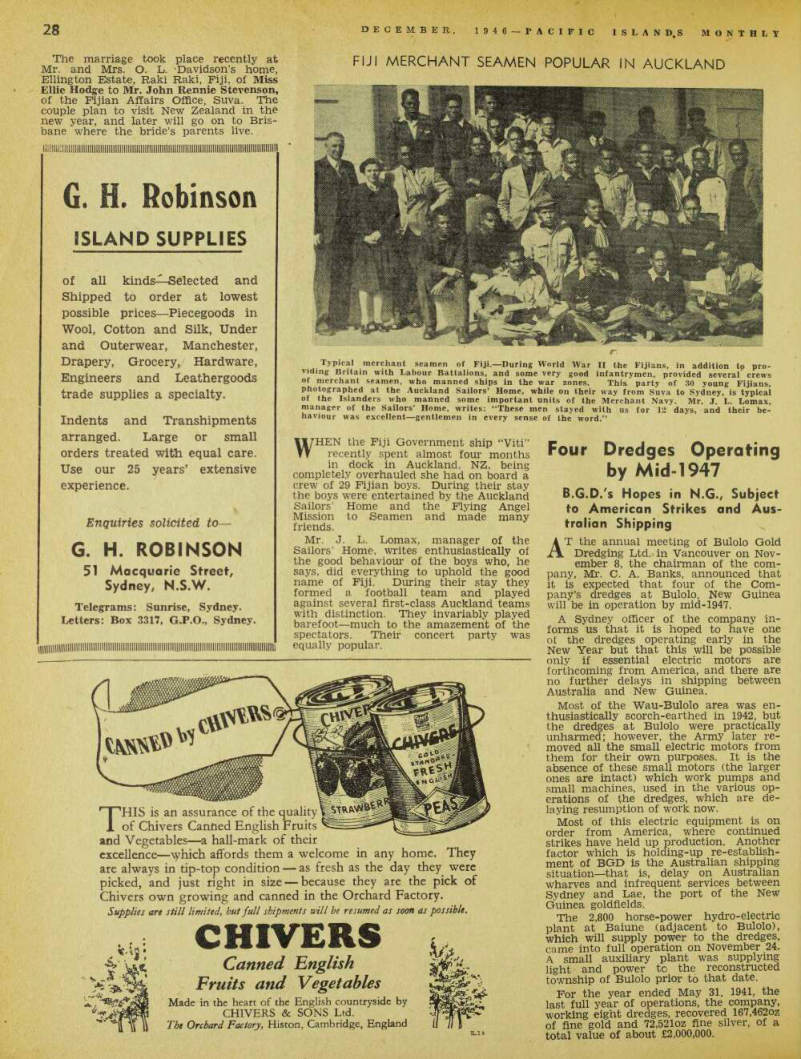
WHEN the Fiji Government ship “Viti” recently spent almost four months in dock in Auckland, NZ. being completely overhauled she had on board a crew of 29 Fijian boys. During their stay the boys were entertained by the Auckland Sailors’ Home and the Flying Angel Mission to Seamen and made many friends.
Mr. J. L. Lomax, manager of the Sailors' Home, writes enthusiastically of the good behaviour of the boys who, he says, did everything to uphold the good name of Fiji. During their stay they formed a football team and played against several first-class Auckland teams with distinction. They invariably played barefoot—much to the amazement of the spectators. Their concert party was equally popular.