A Modern Sinbad Comes To Grief In Fiji
pp. 15-16 · Read in the full issue
Wreck of the "Pagan" in the Lau Islands
Suva, Nov. 24.
BORN with itchy feet, John Caldwell, American, is at present here in Suva waiting for a ship to take him to Sydney and his wife who lives in that city. He has just survived a shipwreck on one of the Lau Islands when he was attempting to sail his 30 ft. cutter from Panama to Sydney.
Caldwell was trained as a school teacher; but, in 1940, he went to sea in the American Merchant Navy. In 1944, he had reached Sydney after calling at most ports in the old and new worlds and here he decided to join the RAAF.
He trained in Brisbane,- Dubbo, Canberra and Sydney i(in the course of which training he met his wife) but the war with Japan ended before he got to a battle area, and he was immediately sent back to sea by the United States War Shipping Administration. He visited in this way the Pacific Islands, Japan.
Manila, China and England and then found himself back in America again, “demobbed” and faced with the problem of getting himself back to Sydney, where his wife was still living.
As a step in the right direction, he went to Panama, and there was able to pur chase, from four Poles, the 30 ft. “Pagan,”
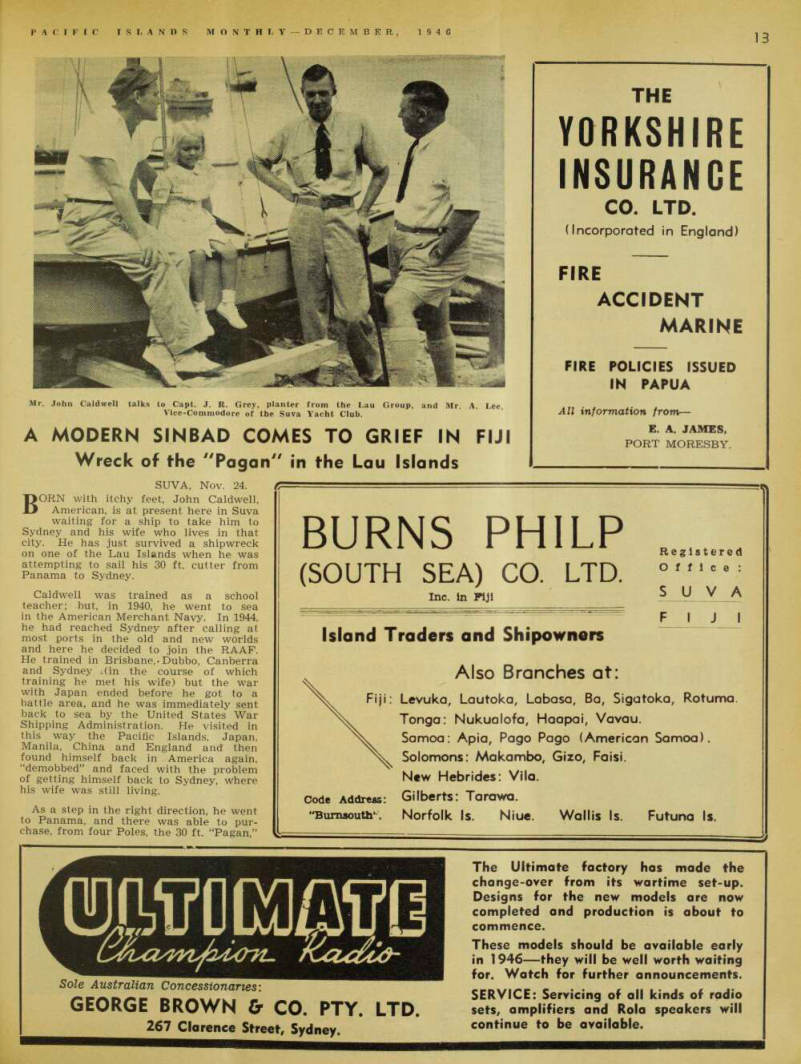
Mr. John Caldwell talks to Capt. J. R. Grey, planter from the Lau Group, and Mr. A. Lee, Vice-Commodore of the Suva Yacht Club.
which they had just sailed across the Atlantic.
In this ship Caldwell set off and hoped to make a non-stop run to Australia.
Weeks ran into months as he battled southwards through the Galpagos and Marquesas Groups, but he experienced little trouble until off the Northern Cooks, where the little ship met a hurricane.
The masts were ripped out of the bottom, the sextant was broken, the chronometer damaged and salt water ruined most of his drinking water and most of his food. After the blow had passed, Caldwell found that his boat was leaking badly and thenceforth most of his time was spent in ceaseless pumping.
Day by day, he grew weaker on his small ration of food and water. One
morning at the end of 21 days, he sighted the island of Tuvutha, in the centre of the Lau Group, eastward of Viti Levu.
Caldwell sailed around it, trying to find a passage through the reef; but he could not, and, fearful of losing the island altogether, he deliberately put his ship up on the reef and floated ashore on a life raft, to a little cove surrounded by high cliffs.
He was too weak to help himself further and he lay there for three days and nights, semi-conscious, and without food and water.
On the afternoon of the third day a party of Fijian children found him; but, evidently terrified by the bearded, gaunt man lying so helpless, they ran off. But that night four strong men appeared in a canoe, with palm-frond torches, and they carried him back to their village, about a mile distant.
Here, for almost three weeks, they cared for Caldwell and, after he began to recover they entertained him royally.
Then a small cutter called unexpectedly at the island, seeking shelter from bad
weather, and it took Caldwell across to Lomaloma, where he transhipped to Suva.
Caldwell’s only problem at present is how to get to Australia in time for Christmas.