"Pacific Trusteeships"
pp. 7-8 · Read in the full issue
What Is Happening in Relation to "Pacific Trusteeships"
rERE has been much in the news papers during the month about the new Trusteeship Agreements, presented to the United Nations, which are to take the place of the Mandates (mostly C-Class) granted by the League of Nations in respect of former German colonies.
So far as the Pacific area is con cerned, there is no vital difference between Trusteeship Agreement and Mandate, except that the administer ing nations will now have the right to maintain armed bases and armed forces within their trusteeship areas.
The League of Nations Mandated Areas were New Guinea, the Bismarck Archipelago and Bougainville (in the care of Australia); Western Samoa (New Zealand); Caroline, Marshall and Mariana Islands (Japan); and the phosphate island of Nauru, for which Britain, New Zealand and Australia held a joint mandate. All were C-Class Mandates—meaning that the natives were held to be in capable of self-government.
There is little doubt that Australia will be granted the Trusteeship over New Guinea, as heretofore. But there is some doubt about what is to hap pen to Western Samoa (see report elsewhere), to the late Jap Mandate, and to Nauru.* THE Samoans have rejected the Agreement proposed by New Zea land, and ask for (a) union between
Western and Eastern Samoa; and (b) a larger measure of self-government.
Both are perfectly reasonable re quests. It is ridiculous to put the Samoans in the same category as the primitive peoples of the New Guinea mandated islands.
Samoan native opinion, if left to crystallise itself without outside interference, almost certainly would ask that Samoa be united, and that the protecting and administering power should be either Britain or the United States. However, under very strong persuasion, the Samoans ex pressed themselves in favour of con tinued association with New Zealand —probably on the ground that New Zealand is only Britain in a watered down form, after all.
It really does not matter much whether the Samoans are protected in future by either Britain or the United States. What is of importance is that the Samoans should seize this opportunity of demanding national unity. It is a reflection upon the wisdom and justice of the Anglo- Saxon Powers that this fine race, now numbering some 70,000 people, should be completely divided between Eastern and Western Samoa. If that partition of the country is maintained, despite Samoan pleas, it will be a mockery of all the high-sounding principles heard nowadays at UNO.
The history of it all goes back one hundred years. British, German and American traders were first into the Samoan Archipelago, and they com peted bitterly for the favours of the warring Samoan kings and chiefs. In
the last half of the last century, the United States flag was established in Pago-Pago (centre of Eastern Samoa); Germany obtained Western Samoa; and Britain withdrew altogether, on condition that Germany abandoned her claims in relation to Tonga and the Solomons.
American and German (followed by New Zealand) rule was exceedingly beneficial to the Samoans. Their in born readiness to fight among them selves was discouraged and sup pressed; the several factors which had led to a tragic decrease in their num bers were removed, and the popu lation began steadily to increase; and they were effectively instructed in the arts of industry and good local government.
To-day, the Samoans are quite cap able of governing themselves, with only light supervision from some administering authority. But, if thev are to attain the nationhood to which they are entitled by their qualities, they must be united. The set-up created by the Three-Powers Treaty of 1899, which divided Samoa be tween two separate nations (Germany and United States) should be wiped out. To allow that to be done, either the United States or Britain (through New Zealand), or both, must sur render sovereignty.
THE Americans appear to be ready to enter into a Trusteeship Agree ment with UNO in respect of the Carolines, Marshalls and Marianas; but they are determined to make their own terms. It is right and proper that they should.
Because they were attacked by an Asiatic Power, they were forced, in order to protect themselves, and get to grips with Japan, to conquer the
*As we go to press, acceptance of the New Guinea and Samoan Agreements by UNO is announced
Japanese Mandated islands. And a bloody business it was, in which the United States lost many thousands of her best men. Those islands now be long to America by right of conquest.
They must be held by America, as protection against further aggression from Asia. They cannot be returned to Japan; and no other nation has any claim to them.
America is quite willing that they should be under Trusteeship, so that they may be open to a periodical check-up by UNO emissaries; but America will listen to no challenge concerning her rights there.
There has been no challenge, except from Russia. That Power, as part of her deliberate policy of sowing sus picion and unease among the demo cratic nations—and so preparing the ground for the overthrow of Western civilisation by the Soviet’s Red hordes —has been offering opposition and offensive criticism, at all points of the Trusteeship debates. Russia cannot cripple the Trusteeship plan, under which the old League Mandates will be liquidated and the administrations rearranged; but she will do her best —or worst.
EXCEPT for some pointless snarling by Russia—which insisted -that the British were late with their pro posed Agreement, and therefore were trying to hide something—little has been heard at UNO about Nauru.
There may be a good reason for that. This may be regarded as an opportunity to bring the two phos phate islands of Nauru and Ocean (the latter now part of the Gilbert and Ellice Colony) under the one administration. There are several arguments in favour of a change— the chief being that the paramount interest and activity in both islands is the industry directed and con trolled by the British Phosphate Com mission. The BPC must find the present administrative set-up (Nauru under a Joint Mandate, and Ocean through the High Commission for the Western Pacific and the G. and E.
Government, under the British Colonial Office) both awkward and embarrassing.
In any event, UNO need not worry about the natives of Nauru. The British authority has seen to it most scrupulously that the Nauruans, and the Banabans of Ocean Island, as the native owners of the land carrying the phosphatic rock, receive a royalty on every ton that was carried away.
There are no richer Islanders in the Pacific.
There may be some interesting changes in the boundaries of Pacific Territories before UNO gets its Pacific Trusteeship Agreements all com pleted. But little change is expected in relation to the biggest of them— what is now called the Mandated Territory of New Guinea.
If it were not that Australian con trol of the “defensive perimeter” of South-west Pacific Islands is vital to the future existence of Australia, no good purpose would be served by a continuance of the present arrange
ment, either as Mandate or Trustee ship. Apart from the defence con sideration, Australian administration of New Guinea is of no use to either Australia or New Guinea. But Aus tralian administration must remain, because those chains of islands are a screen for under-populated Australia against the countless millions of over-populated Asia.
THE most significant development in Trusteeship discussions at UNO was the demand of the Indian dele gates that the “White Australian Policy” should not be carried on into the New Guinea Agreement—in other words, that New Guinea, under the new set-up, should be open to Asiatic immigration.
An Indian motion, to that effect, was defeated by only 16 to 11; and 11 delegates abstained from voting.
Those figures are disconcerting.
India, having been granted self government, is going to make a great effort to break down the barriers, set by Europeans for their own survival, against Asiatic immigration; and New Guinea has felt one of the first on slaughts. UNO, of course, could doi no other than keep the Asiatic flood out of New Guinea. It would be absurd to allow the Territories, held by Australia as a barrier against Asia, to be penetrated by masses of Indians—especially in the light of what has happened in South Africa and Fiji.
This is only the opening of the campaign. We are going to hear much of the Asiatics’ demand for “the open door” in the Pacific. It will not be easy to keep the door closed. The really white nations represented at UNO are few. Our anti-Asiatic policy can depend upon support from only two members of The Big Five— Britain and America. Russia and China almost certainly will be for the open door. Communist-ridden France now is uncertain and unpredictable.
The opening of the door to Asiatics would mean the end, not only of the white communities in the Pacific Islands, but of Australia and New Zealand as European nations.
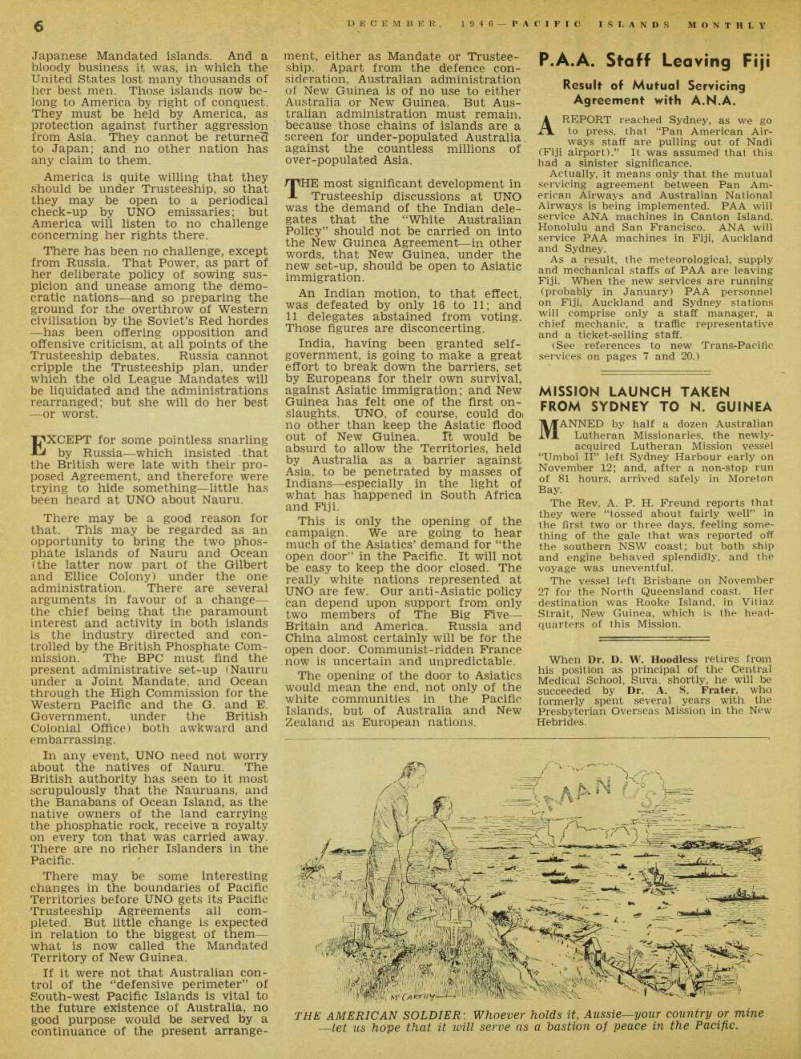
THE AMERICAN SOLDIER: Whoever holds it, Aussie—your country or mine let us hope that it will serve as a bastion of peace in the Pacific.