Lae and Salamaua are Shadows of Their Former Selves
pp. 65-68 · Read in the full issue
NOTHING now remains of pre-war Salamaua, that port of hope, and blasted hopes, that saw the Morobe goldfields through their golden era. It is as isolated and abandoned now as when old Shark-eye Park found the first gold at Koranga Creek in the early 20’s.
The coconuts that provided shade along tVip rond bavp Q’one New ones have been planted but, as yet, they are but a few feet high. Only two of the original houses are recognisable Mr.
“Bill” Marshall’s house and the isolation building of the former hospital These too are rickety and show signs of having at some stage been knocked flat by bombblast Nothing remains of the once popular pub A group of thatched huts occupies the site They were used as a rest camp for AW AS who were stationed in Lae during the latter part of the war.
But Salamaua’s hedges of hibiscus and crotons, and the trailing bougainvillea and fragrant frangipanni bloom on apparently they have sprung from old
roots which survived the bomb-blast.
A small hut was erected some months ago out of tarred paper and iron and became temporarily the District Office.
But Salamaua. as a sub-station, has been abandoned by the Administration now and, in October, Mr. "Yorkie” Booth, as the township’s lone resident, was occupy ing it.
Further out, towards Kila, Mr. R Tebb has established a trade-store, with a young ex-soldier in charge.
The old aerodrome, and Kila, have gone back to the jungle. Two directional finding radio towers, erected in 1938. when W. R. Carpenter & Co. inaugurated the air-service between New Guinea and Australia, are all that remain, but they lean at a drunken angle, useless.
There has been much erosion at the f he isthmus, and many of the callyfillium trees, which, were a feature of the place, have gone.
There is no regular communication between Lae and Salamaua these days.
The only way of reaching what has now
become a ghost-town is to hire a launch and chug 18 weary miles across the Huon Gulf, Mornhp No one T AE is the port of M Ld knows why even in its decline, Salamaua has some beauty and attractiom Except Lae has nothing, not even a good harbour, The only recognisable building of former days, in Lae, is Guinea Airways old workshops all else is obliterated, although in the vast triangular area formed between Milford Haven, the hotel, and Malahang native hospital, there are hundreds of buildings left behind by the Australian and US Armies and connected by what were once good roads, now falling into disrepair. Some of these abandoned buildings have been converted to civilian use or domestic purposes; the rest are rapidly being overtaken by the jungle.
All are made ol Sisalkraft (a kind of tarred paper) native materials, and black iron.
The District Office, an ex-US Army est
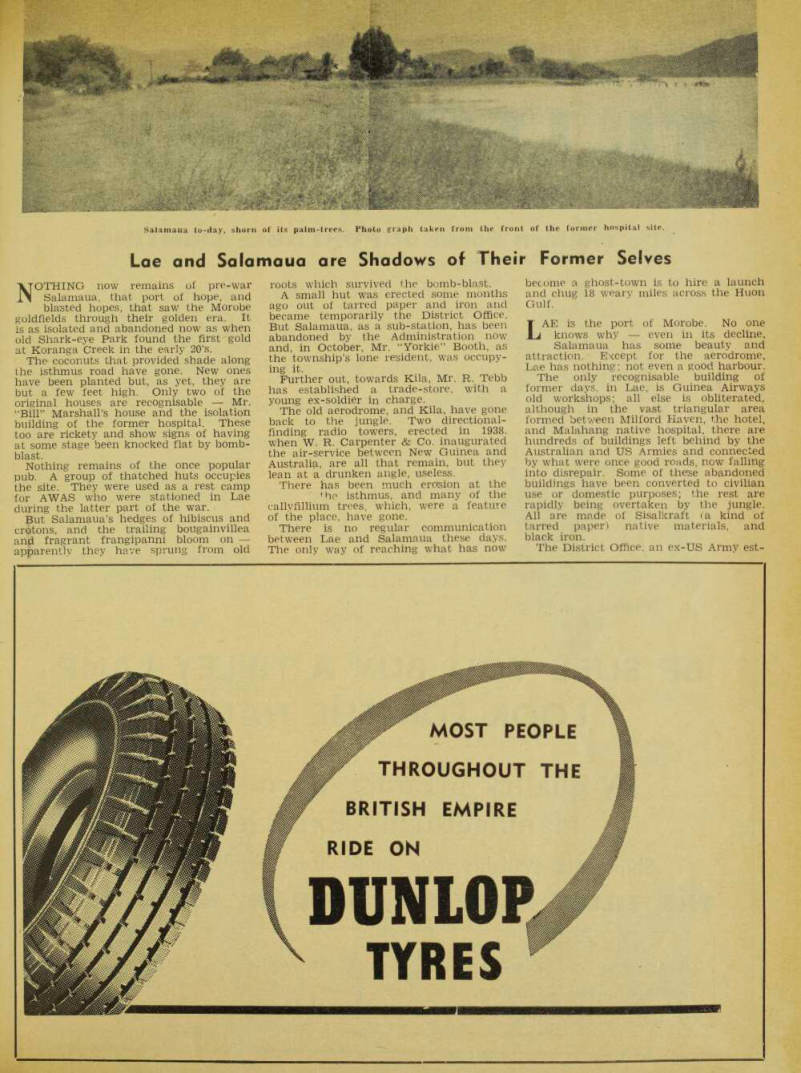
Salamaua to-day, shorn of its palm-trees. Photo graph taken from the front of the former hospital site.
ablishment, sprawls across the top of the plateau which will eventually become the residential area of the new, planned town.
It is half way between nowhere and no where else.
Even if building materials were avail able, no one is permitted to build-perman ent structures at present—except the Chinese community whose Chinatown Las apparently been alloted. For the re'st, the Town Planners have not yet done Lae over, or settled finally just where and how people shall build.
Lae to-day is fit only for people with a gift for making silk purses out of sows’ ears. It is also a place where white-men work. The old myth that manual labour in New Guinea was an excursion-ticket to the cemetery, has been exploded. White men do work —and hard. And the death rate has not gone up.
Local natives have, on the other hand, apparently lost the power of their legs.
Their one delight i's to ride in jeeps and lorries: their one ambition is to learn to drive either.
Labour is scarce, from local sources, and mostly dumb. House-boys, however, are fairly easy to obtain, but hard to keep for more than a few months, when they tire
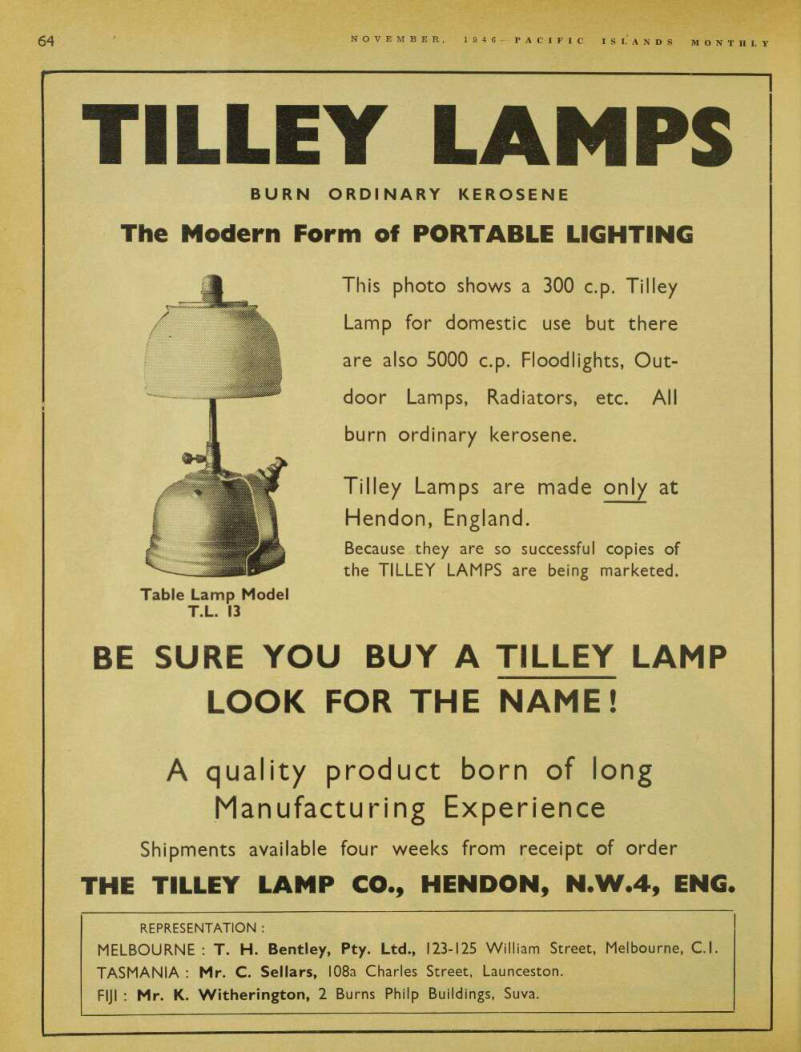
Some of Lae’s buildings. Top shows the kunai house of the manager of Burns, Philp & Co.
Centre is W. R. Carpenter & Co.’s store. Lower is Burns, Philp store.
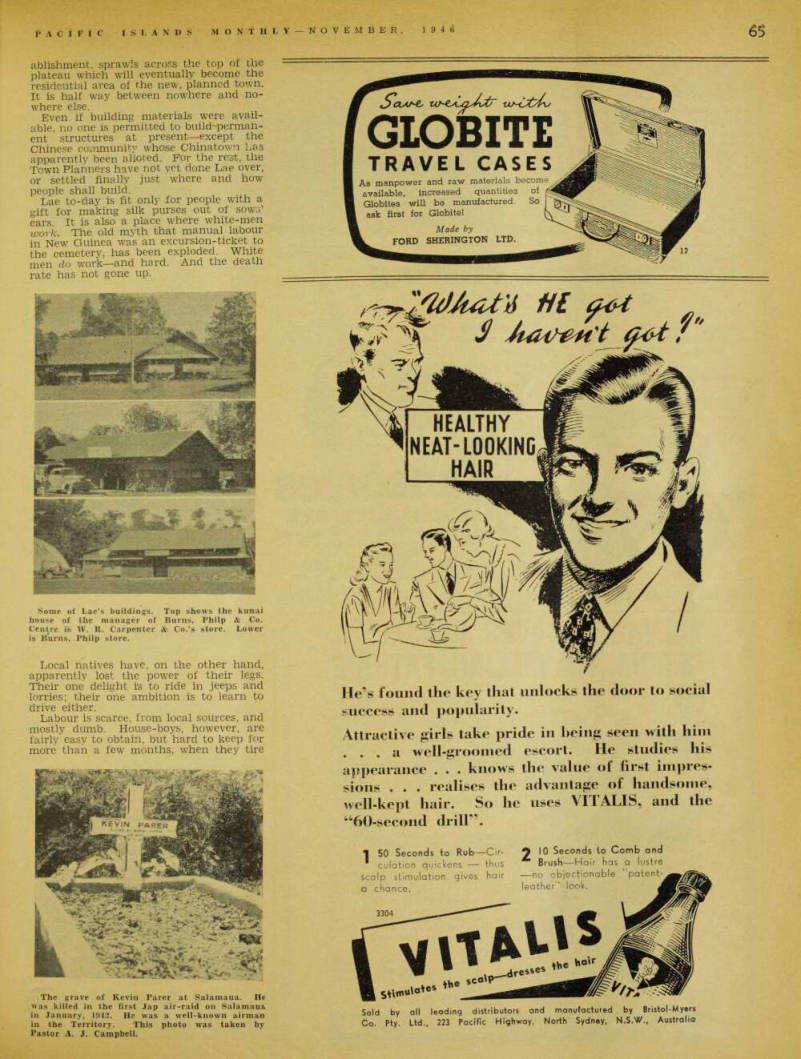
The grave of Kevin Parer at Salamaua. He was killed in the first Jap air-raid on Salamau[?] in January, 1942. He was a well-known airman in the Territory. This photo was taken by Pastor A. J. Campbell.
of labour and wish to return to their place, for any of the various reasons natives have for their home-goings. Even having a boy “on paper” apparently does not pre-
vent his going home when he wishes, these days.
Incidentally, it is no longer infra dig for Madame Territorian to do her own house hold chores. She will if 'she can, of course, still rely on native servants although they are more unreliable and undisciplined than previously; but if these are not forthcoming, she will turn-to herself.
There is now a. town electricity supply (it is shut off between midnight and 6 a.m.) and a water supply which fails completely at regular intervals.
A very few people own jeeps, but for the majority who are not supplied with means of transport by Government de partments, the problem of getting around the attenuated settlement that is now Lae, is a very real headache.
But in spite of these difficulties, the scarcity of food for long weeks at a time, the indifferent housing, and the filthy climate, Lae’s residents are cheerful, de termined to hope for the best, and to see
it through.
J.T.
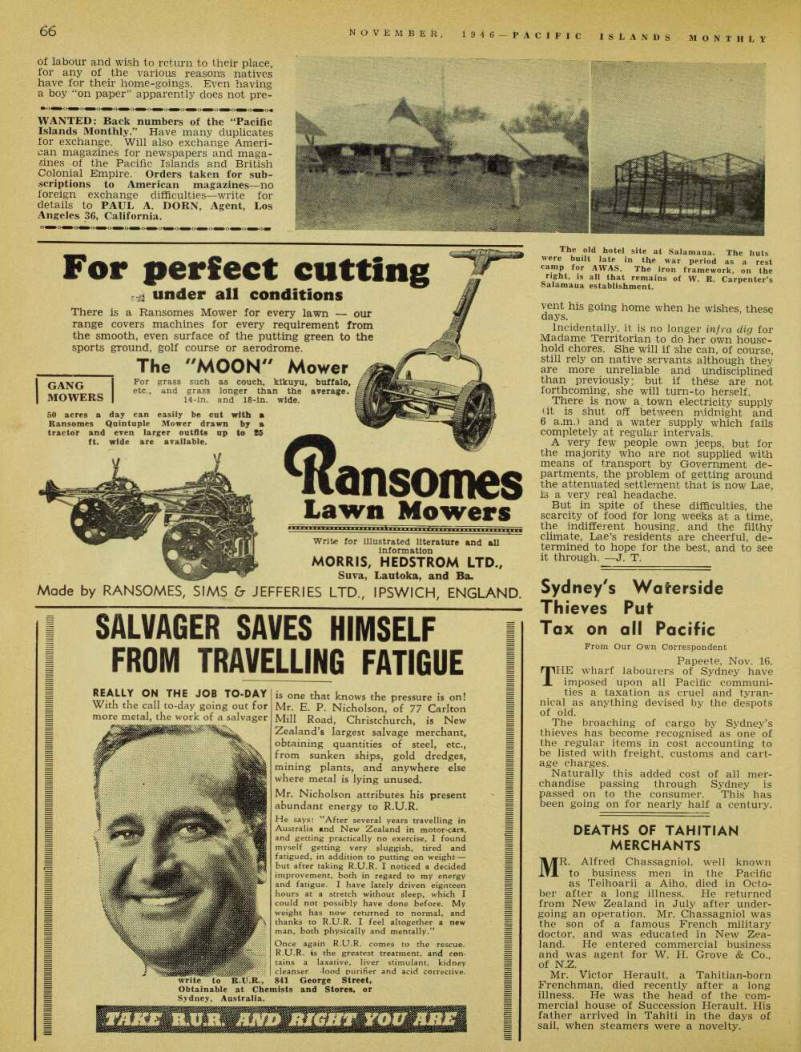
The old hotel site at Salamaua. The huts were built late in the war period as a rest camp for AWAS. The iron framework, on the right, is all that remains of W. R. Carpenter’s Salamaua establishment.