How Late R. F. Brechin Pioneered The Cinchona
pp. 44-45 · Read in the full issue
Plantations
Photos and story by Pastor A. J. Campbell, of SDA Mission, Central New Guinea
ABOUT 1936, about a year after my family and I arrived in Central New Guinea to take up our mission work on that great tableland, after being transferred from the Solomon Islands, a fine young man named R. F. Brechin was sent in by the Administration to investigate the possibilities of growing quinine.
Mr. Brechin brought with him much enthusiasm and some precious cinchona seed for planting in the first experi mental plots, which were located near the Government station, to the west of the Kainantu landing-field.
The few who saw those first few thou sands of seeds sprout and grow were in tensely interested in all developments associated with the introduction of cin chona to the central highlands of New Guinea. With the commencing of any new enterprise there is usually both dis couragement and encouragement; but Mr. Brechin remained undeterred as, with deep interest, he watched over what was naturally a slowly developing enterprise.
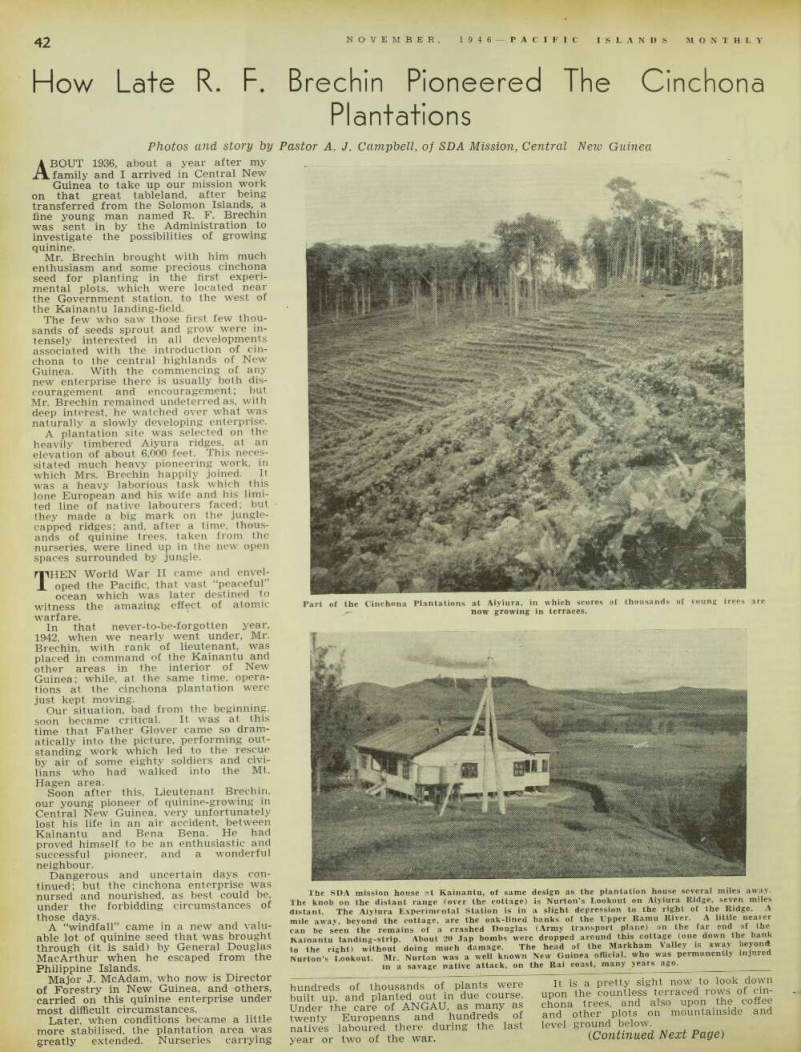
A plantation site was selected on the heavily timbered Aiyura ridges, at an elevation of about 6,000 feet. This neces sitated much heavy pioneering work, in which Mrs. Brechin happily joined. It was a heavy laborious task which this lone European and his wife and his limi ted line of native labourers faced; but they made a big mark on the jungle capped ridges; and, after a time, thous ands of quinine trees, taken from the nurseries, were lined up in the new open spaces surrounded by jungle.
THEN World War II came and envel oped the Pacific, that vast “peaceful” ocean which was later destined to witness the amazing effect of atomic warfare.
In that never-to-be-forgotten year, 1942, when we nearly went under, Mr.
Brechin, with rank of lieutenant, was placed in command of the Kainantu and other areas in the interior of New Guinea: while, at the same time, opera tions at the cinchona plantation were just kept moving.
Our situation, bad from the beginning, soon became critical. It was at this time that Father Glover came so dram atically into the picture, performing out standing work which led to the rescue by air of some eighty soldiers and civi lians who had walked into the Mt.
Hagen area.
Soon after this, Lieutenant Brechin, our young pioneer of quinine-growing in Central New Guinea, very unfortunately lost his life in an air accident, between Kainantu and Bena Bena, He had proved himself to be an enthusiastic and successful pioneer, and a wonderful neighbour.
Dangerous and uncertain days con tinued; but the cinchona enterprise was nursed and nourished, as best could be, under the forbidding circumstances of those days.
A “windfall” came in a new and valu able lot of quinine seed that was brought through (it is said) by General Douglas MacArthur when he escaped from the
Philippine Islands.
Major J. McAdam, who now is Director of Forestry in New Guinea, and others, carried on this quinine enterprise under most difficult circumstances.
Later, when conditions became a little more stabilised, the plantation area was greatly extended. Nurseries carrying
hundreds of thousands of plants were built up. and planted out in due course.
Under the care of ANGAU, as many as twenty Europeans and hundreds of natives laboured there during the last year or two of the war.
It is a pretty sight now to look down upon the countless terraced rows of cin chona trees, and also upon the coffee and other plots on mountainside and level ground below.
{Continued Next Page )
Part of the Cinchona Plantations at Aiyiura, in which scores of thousands of young trees are now growing in terraces.
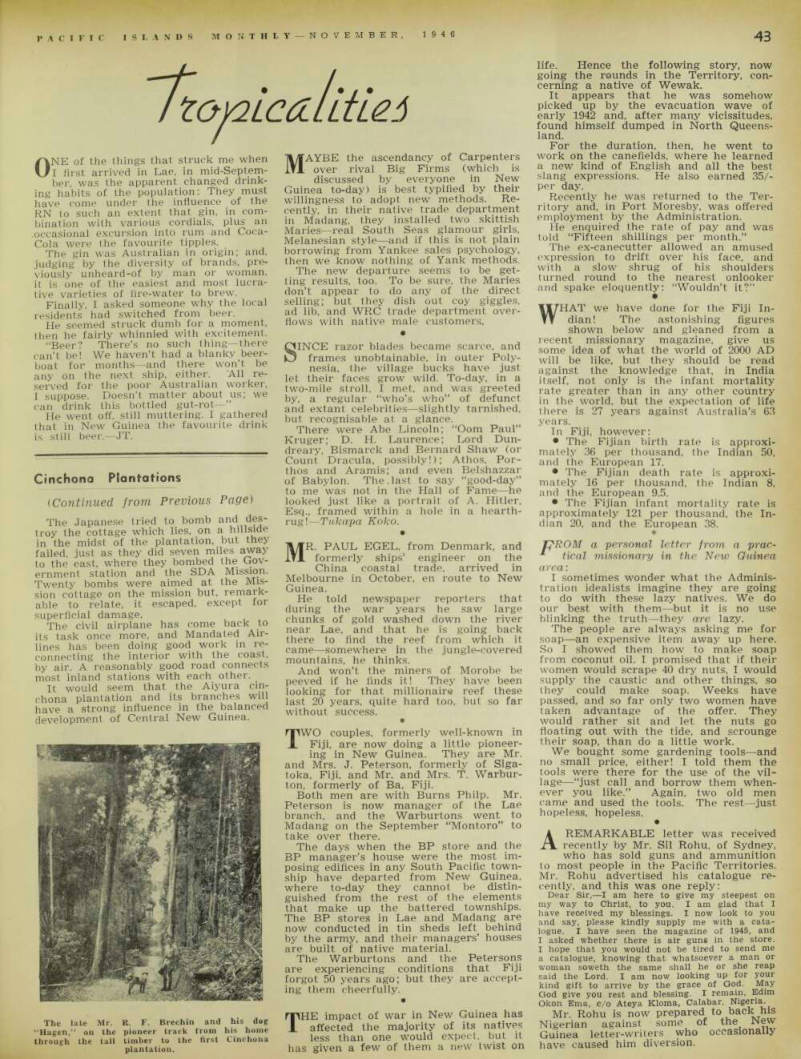
The SDA mission house at Kainantu, of same design as the plantation house several miles away.
The knob on the distant range (over the cottage) is Nurton’s Lookout on Aiyiura Ridge, seven miles distant. The Aiyiura Experimental Station is in a slight depression to the right of the Ridge. A mile away, beyond the cottage, are the oak-lined banks of the Upper Ramu River. A little nearer can be seen the remains of a crashed Douglas (Army transport plane) on the far end of the Kainantu landing-strip. About 20 Jap bombs were dropped around this cottage (one down the bank to the right) without doing much damage. The head of the Markham Valley is away beyond Nurton’s Lookout. Mr. Nurton was a well known New Guinea official, who was permanently injured in a savage native attack, on the Rai coast, many years ago.
The Japanese tried to_ bomb and des troy the cottage which lies, on a hillside in the midst of the plantation, but they failed, just as they did seven miles away to the east, where they bombed the Gov ernment station and the SDA Mission.
Twenty bombs were aimed at the Mis sion cottage on the mission but, remark able to relate, it escaped, except for superficial damage.
The civil airplane has come back to its task once more, and Mandated Air lines has been doing good work in re connecting the interior with the coast, by air. A reasonably good road connects most inland stations with each other.
It would seem that the Aiyura cin chona plantation and its branches will have a strong influence in the balanced development of Central New Guinea.
The late Mr. R. F. Brechin and his dog “Hagen,” on the pioneer track from his home through the tall timber to the first Cinchona plantation.