On the Roof
pp. 42-43 · Read in the full issue
Of New Guinea
RECENTLY. through the good graces of the Administrator of New Guinea, Colonel J. K. Murray, a “PIM” representative was permitted to pay a brief visit to the Government station at Mt. Hagen, Central New Guinea.
The trip was made both ways in an RAAF Courier which, once weekly, flies supplies and mail for RAAF personnel, from Australia to Rabaul, with a stop off in Lae to take supplies to the Gov ernment stations on the great central tableland.
Although permission to make the trip had been given in Moresby (the area is still nominally “uncontrolled” and getting there usually involves many conditions, the least of which is lodging a £250 bond of good faith) there were still difficulties to overcome.
The Courier is an unpredictable bird.
It arrives unheralded and unsung, albeit more or less regularly. However, occa sional interruptions occur in the service, whereupon the ether, between Lae and Moresby and all points South, runs hot with what are called (as a hang-over of Army days and Army ways) “Signals.”
Before the war these would have been called, simply, radio messages. However, “signals” sounds better and, as the District Officers and ADOs these days in New Guinea seem to spend about four fifths of their time either sending them or receiving them, or waiting to receive them, it is seemly that they be given an important-sounding name.
Most signals are sent off into the blue — and that, apparently, is that. Not many p them ever receive a direct answer — but that perhaps is a subject over which it is kinder to draw a veil.
IT So happened that, after waiting in Lae for over a week for a Signal that would fix, more or less approximately, the date of the “PIM” representative’s iourney onto the roof of New Guinea, the “PIM” representative was down at the Lae drome one day and saw there, unexpectedly, a RAAF plane. It had come in sometime after dawn and in quiries drew forth the information that it would leave for Hagen on the morrow.
This was news to the local District- Officer, too. So much for Signals, All that was necessary, then, was to persuade the ADO, who arranges the loads to go in to Hagen, that the 105 pounds which the “PIM” representative weighs would make no appreciable differ ence to the airworthiness of the aircraft.
Even this was accomplished in due course.
WE had heard for years of the beauty of this plateau, high above the steamy forests and fevers of the New Guinea coast, but this was the first time we had been permitted to see it.
The pictures taken on the trip ,and repro duced here, with those supplied by Pastor Campbell, give but a limited idea of the area. They cannot indicate the atmosphere of the place—tell of the vast green parklands that stretch away be neath the wings of the plane as it travels over Garoka, Chimbu, Benna Benna and on to Hagen station at 5,500 feet.
When you step from the plane at Hagen, the air is cool and invigorating; and at once you are in a new and dif ferent world. Mountains still tower high above, marking the limits of the wide valley. Old Mount Hagen, not very im pressive with his square head hidden in the clouds, seems almost squat—although the summit is a good 7,000 feet above the level of the Hagen station (5,500 feet).
Trees border the streams which are running down cold from the mountains— trees unlike those of the lowlands. There is not a coconut or manifestation of the “glamourous tropics” anywhere. But there is a carpet of green, and a pro fusion of gladioli, dahlias, roses, carna tions and sweet peas, that have been grown around the station under the supervision of Mr. G. Greathead, the officer in charge. Further afield, there are more utilitarian product's such as cabbages and potatoes, rhubarb, beans, peas, lettuce and strawberries which in size and lusciousness, out-do their proto types grown in Southern soil.
Europeans who have been permitted to glimpse this wonderland have fallen for its possibilities. However, it is doubtful if it will ever be developed by Europeans, It is called an “uncontrolled’’ area; but a more correct term would be “protected” area.
THE natives are friendly and, although they bear but slight resemblance to the marvellous New Race that has been discovered from time to time, by hysterical journalists they are of a dif ferent type to the lowland natives.
Whether or not they are a better type, capable of greater development, remains to be seen. Certainly they are no more “uncontrolled” than the rest of the primitive tribes of the interior and are, in fact, much more amenable to law and order than the natives of many other districts to which Europeans have free access.
It is planned that the Central table
land shell be developed for and by the natives and, with this in view; a great tea industry is already blue-printed. The ’success of this, too, is a matter for the future to decide.
There are reasons for and against keeping Europeans out, of course—and as many good reasons against it as for it.
However, there are two ways in which Hagen should be utilised—and immedi ately—for the benefit of Europeans. One is the establishment of a rest-house or houses where people could go to recu perate from the debilitating process of
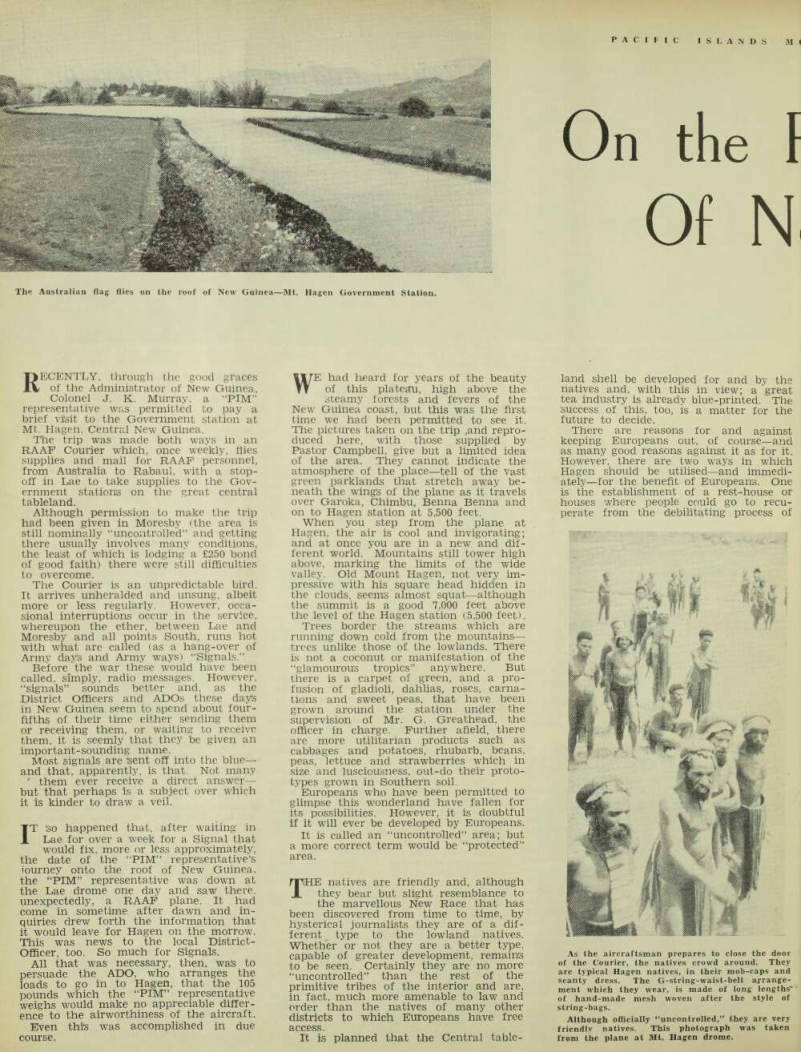
The Australian flag flies on the roof of New Guinea—Mt. Hagen Government Station.
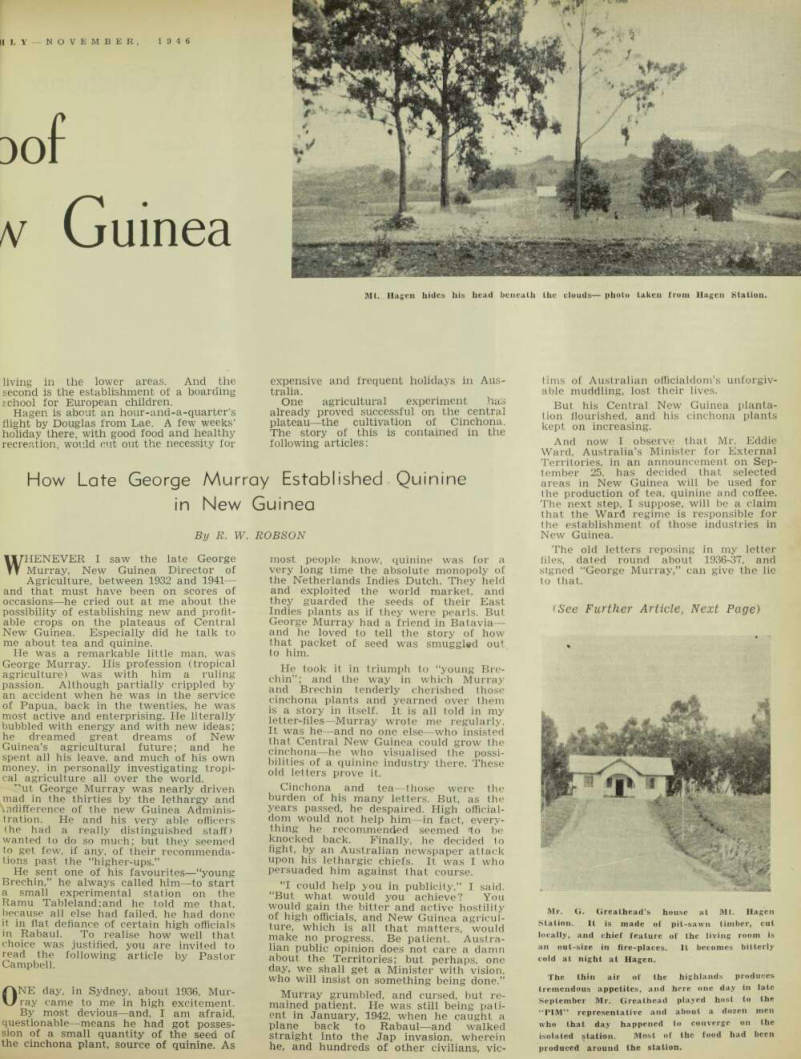
As the aircraftsman prepares to close the door of the Courier, the natives crowd around. They are typical Hagen natives, in their mob-caps and scanty dress. The G-string-waist-belt arrange ment which they wear, is made of long lengths of hand-made mesh woven after the style of string-bags.
Although officially “uncontrolled,” they are very friendly natives. This photograph was taken from the plane at Mt. Hagen drome.
living in the lower areas. And the second is the establishment of a boarding school for European children.
Hagen is about an hour-and-a-quarter’s flight by Douglas from Lae. A few weeks’ holiday there, with good food and healthy recreation, would cut out the necessity for
expensive and frequent holidays in Aus tralia.
One agricultural experiment has already proved successful on the central plateau—the cultivation of Cinchona.
The story of this is contained in the following articles:
Mt. Hagen hides his head beneath the clouds photo taken from Hagen Station.