Jeepers!
pp. 40-41 · Read in the full issue
By Judy Tudor
rnHE sound of the bouncing jeep is now J. the song of the land!
Once upon a long, long time ago the New Guinea variety of Homo sapien (brown or white) padded the hoof. To be sure there were such things as planes and schooners and, in the few townships, a modicum of motor vehicles.
But that still left great areas of mountain and jungle and beach over which the only form of transport was two legs.
Man and woman, they started off on weeklong treks without the bat of an eyelid. Over hill and dale they went, into streams, through kunai, along razorbacked mountains, followed by a long line of straggling carriers.
But that was once upon a long, long time ago. Today, legs are unfashionable and unpopular as a mean of transportation. Even the natives have lost the use of their underpinnings and have, instead, developed hitch-hiker’s thumb. New Guinea has become the province of the more rugged types of internal combustion engine. , In the course of recent travels I have ridden in jeeps, and weapon carriers, srmoured cars, old ambulances and in three-ton trucks; but I’ve seen only half a dozen conventional type cars one of btf'the Administrator *° **“ b ° ot ' b 8 All (an™ the roads upon which they run have been left behind bv the re- Hde of war- all are somewhat vL* all are without mufflers; and most
Therefore* 1 this SSS
S c eTSK?d be Seen ’
MAYBE the man who invented the jeep had in mind such a place as this.
At all events, this tough little vehicle, apparently springless and certainly joltproof, when in good trim, is ideal for the highways and by-ways that be-spatter New Guinea. Provided by two lavish Armies with war funds to spend, these roads are now falling into pot-holes and becoming grass-grown in parts.
The Armies used jeeps with effect; civ- Ilians came later saw and fell for them; and the natives learned the pleasures of jeeping.
There are “hot” jeeps, scrounged from
Army parks in the early days of transition to civil administration; there are jeeps without batteries and jeeps without lights and hoods and spare tyres; jeeps with leaking petrol pumps and no brakes; the elegant cream-painted red-cushioned jeep of the hairdresser in Moresby; the mechanically sound specimens of the gold-mining companies; and, lastly, the jeeps of contention, standing in long disintegrating lines in the Commonwealth Disposals parks, from which vital spare parts have been systematically lifted, Tenders are now belatedly being called for the purchase of these. It is said that it is necessary to buy five of them in order to make one complete vehicle.
Remember sleepy-hollow Moresby in the old days? About three decrepit cars and no noise, save that of boys’ voices and, perhaps, the far-off rumble of ships’ winches or the wind in the coconuts, Today, it is a maelstrom of sound from hundred s of units of unmuffled, scream machinery. Visitors soon learn the art of the lapse in the conversation— stipy silence while a madly-revving jeep or truG k passes, then the threads of con versation taken up where they were droppe d and continued brightly to the next ear-splitting interregnum.
But, although Moresby must now have many hundreds of vehicles, they still carry no licence plates. There was no regulation to cover motor registration f0 p r fl e n^%^ ar - t th^ a ?^ e " t
Sses Uttssss
SfiTSSS!® re^it/motorvehicles.
Neither is there any taxi service in Moresby. The drill is to thumb a ride; and, while the petrol lasts, local residents are willing to divert considerably from their course to oblige visitors and neigh hours. The stranger within Moresby’s gates soon learns to hitch-hike from one pa rt of the attenuated township to the other, , , , . „ A FTER I had been in Port Moresby a few days an old New Guinea friend offered to take me to the Sogeri tableland above Rouna Falls, from which the Kokoda trail leads off over the form
idable Owen Stanleys and where there are several rubber estates and room for more.
I had already sampled this lad’s driving in the wilds of Sydney, and entertained some misgivings, but I guess he had been born for a jeep, which requires a tech nique all its own, but none of the finesse of city driving. Your plan if you are a jeep passenger, is to tie your head up in a scarf, put on a pair of goggles, divest yourself of all impedimenta, sit tight and hang on. If you give all your mind to this, then the chances are that you will stay there; if you become too diverted by the" scenery, you are likely to find your self slung off into it.
Dodging pot-holes and other obstacles is a sissy business. The best method of approach is to belt straight over or through them; always—with the aid of the large handle thoughtfully provided by the manufacturers at the passenger’s side of the vehicle (driver can cling to the wheel when things get tough)—preventing
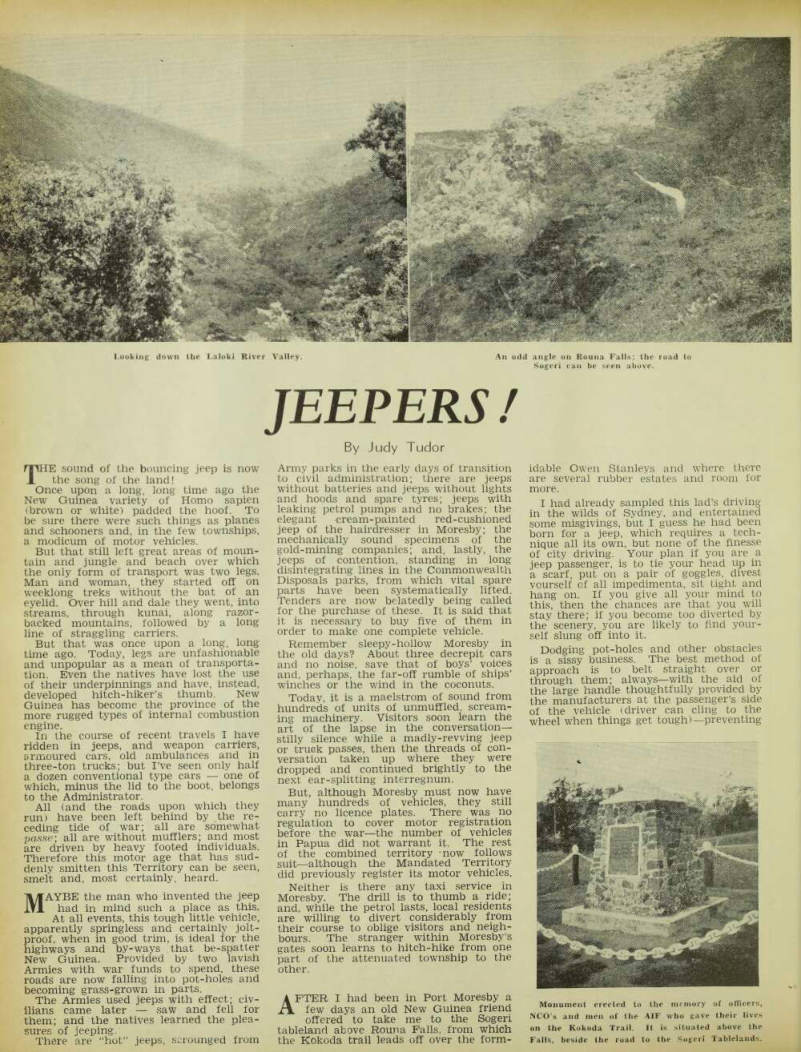
Looking down the Laloki River Valley.
An odd angle on Rouna Falls; the road to Soger! can be seen above.
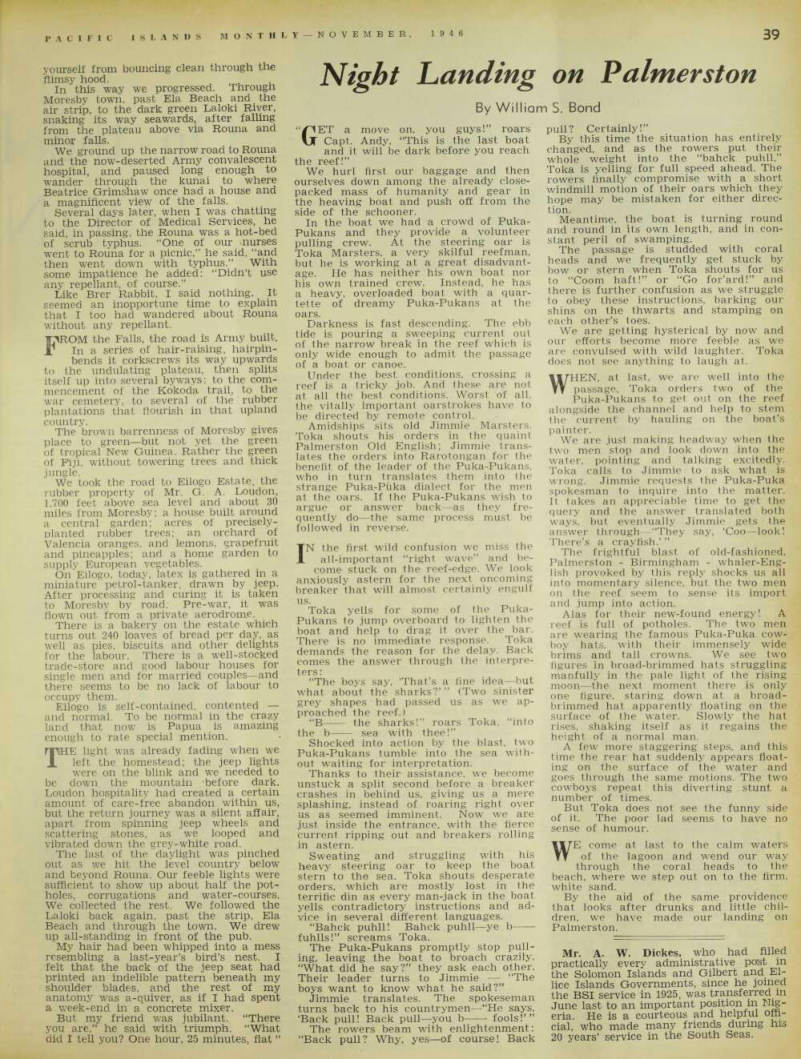
Monument erected to the memory of officers, NCO’s and men of the AIF who gave their lives on the Kokoda Trail. It is situated above the Falls, beside the road to the Sogeri Tablelands.
yourself from bouncing clean through the flimsy hood.
In this way we progressed. Through Moresby town, past Ela Beach and the air strip, to the dark green Laloki River, snaking its way seawards, after falling from the plateau above via Rouna and minor falls.
We ground up the narrow road to Rouna and the now-deserted Army convalescent hospital, and paused long enough to wander through the kunai to where Beatrice Grimshaw once had a house and a magnificent view of the falls.
Several days later, when I was chatting to the Director of Medical Services, he said, in passing, the Rouna was a hot-bed of scrub typhus. “One of our nurses went to Roiina for a picnic,” he said, “and then went down with typhus,” With some impatience he added: “Didn’t use any repellant, of course.”
Like Brer Rabbit, I said nothing. It seemed an inopportune time to explain that I too had wandered about Rouna without any repellant.
FROM the Falls, the road is Army built.
In a series of hair-raising, hairpin bends it corkscrews its way upwards to the undulating plateau, then splits itself up into several byways: to the com mencement of the Kokoda trail, to the war cemetery, to several of the rubber plantations that flourish in that upland country.
The brown barrenness of Moresby gives place to green—but not yet the green of tropical New Guinea. Rather the green of Fiji, without towering trees and thick jungle.
We took the road to Eilogo Estate, the rubber property of Mr. G. A. Loudon, 1.700 feet above sea level and about 30 miles from Moresby; a house built around a central garden; acres of precisely planted rubber trees: an orchard of Valencia oranges, and lemons, grapefruit and pineapples: and a home garden to supply European vegetables.
On Eilogo, today, latex is gathered in a miniature petrol-tanker, drawn by jeep.
After processing and curing it is taken to Moresby by road. Pre-war, it was flown out from a private aerodrome.
There is a bakery on the estate which turns out 240 loaves of bread per day, as well as pies, biscuits and other delights for the labour. There is a well-stocked trade-store and good labour houses for single men and for married couples—and there seems to be no lack of labour to occupy them.
Eilogo is self-contained, contented and normal. To be normal in the crazy land that now is Papua is amazing enough to rate special mention.
THE light was already fading when we left the homestead; the jeep lights were on the blink and we needed to be down the mountain before dark.
Loudon hospitality had created a certain amount of care-free abandon within us, but the return journey was a silent affair, apart from spinning jeep wheels and scattering stones, as we looped and vibrated down the grey-white road.
The last of the daylight was pinched out as we hit the level country below and beyond Rouna. Our feeble lights were sufficient to show up about half the pot holes, corrugations and water-courses.
We collected the rest. We followed the Laloki back again, past the strip, Ela Beach and through the town. We drew up all-standing in front of the pub.
My hair had been whipped into a mess resembling a last-year’s bird’s nest. I felt that the back of the jeep seat had printed an indelible pattern beneath my shoulder blades, and the rest of my anatomy was a-quiver, as if I had spent a week-end in a concrete mixer.
But my friend was jubilant. “There you are,” he said with triumph. “What did I tell you? One hour, 25 minutes, flat ”