Typical Of England At War
p. 22 · Read in the full issue
A WORLD-FAMOUS firm of agricul tural machinery manufacturers, Ran somes. Sims and Jefferies Ltd., of Ipswich, England, has just published a volume, “Ransomes and the Second World War,” that is something more than a trade production. It is not only a history of how this 150-year-old firm literally turned its plough-shares into guns and munitions: it also describes how agricul tural machinery makers generally, by producing the most modern motor-driven implements for the farms, helped mater ially to gain victory on the food front.
The starvation of Britain, by cutting off her supplies of sea-borne food, was an essential part of Hitler’s plan. Britain replied by largely feeding herself. The task was simplified by farm mechanisa tion.
This firm’s great factories at Ipswich were only 10 miles from the coast, and directly opposite enemy-occupied coun tries: and the factory work, between 1939 and 1945 was disrupted by no less than 1.466 air raid warnings and attacks. But it carried on, and did a magnificent job. in manufacturing both munitions and farm implements.
Now, it is back in the markets it knew so well before the war, seeking purchasers for all kinds of agricultural machinery, lawn mowers, trolley buses, trucks, cranes, and so forth.
This snapshot, reproduced below, is of Mr.
Charles Whippy, the well-known boatbuilder, of Walu Bay, Suva, who died recently. His boats are known all over the Central Pacific. Mr.
Whippy’s funeral cortege was one of the largest ever seen in Suva —he was widely known and highly esteemed.
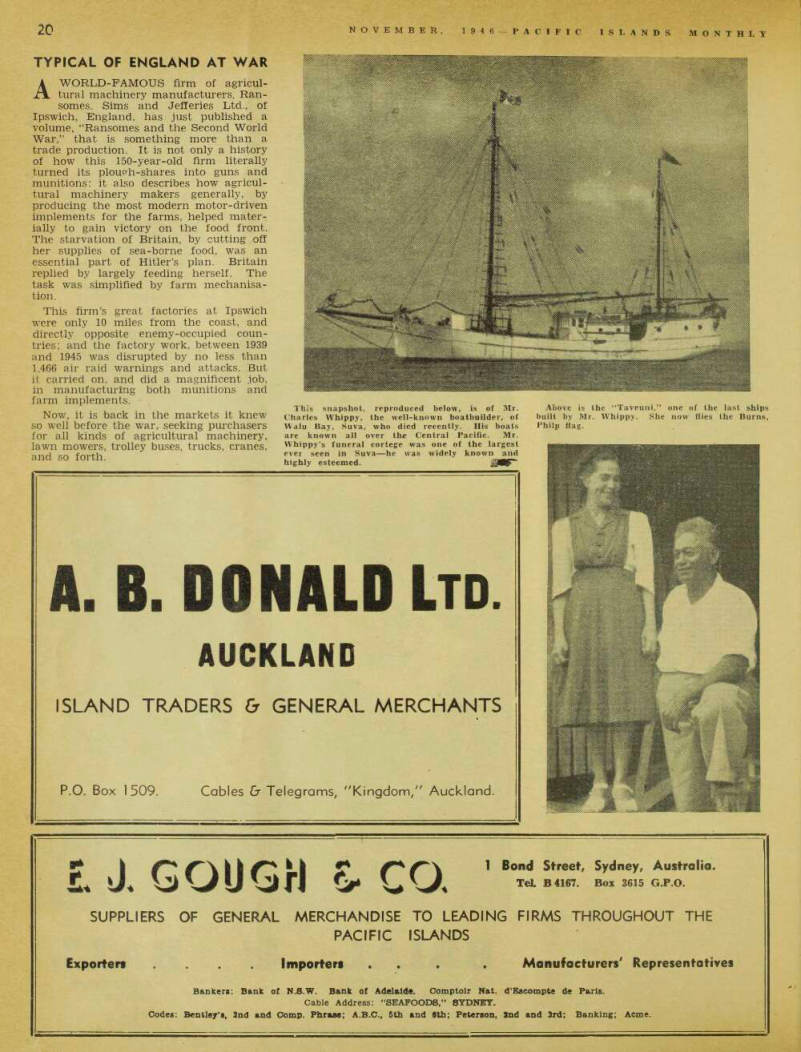
Above is the “Taveuni,” one of the last ships built by Mr. Whippy. She now flies the Burns, Philp flag.