The Australian Taxpayer Pays For This
pp. 14-71 · Read in the full issue
WHEN I was northward bound in Sep tember, I was accorded, in Port Moresby, an interview with Mr. L.
Brumby, of the Commonwealth Disposals Commission.
Mr. Brumby is reported to be a Mel bourne business man, who has devoted several years, gratis, to the Common wealth Government in order to help rid it of war’s white elephants.
It was said in the Territory that he had arrived there to clean up the chaos created by former officers of the Com mission. That, however, may be just one of the current exaggerations that Territorians invent to beguile the tedious weeks and months of rehabilitation.
Mr. Brumby is one of those gentlemen who smile easily with their facial muscles, but not with their eyes. He also has a ready answer to most stock ques tions. The interview lasted 30 minutes; for 29 of them Mr. Brumby spoke and, where he looked like faltering, he was prompted by his confidential secretary, Miss Mitchell. This state of affairs may simply be the outcome of my being nat urally an inarticulate creature.
On the other hand, I came away from that interview feeling that I had been “blinded with science,” and with the notion that I should thenceforth believe that everything the CDC had done, was doing, and would do, was sound, logical, fair and of inestimable benefit to the Australian taxpayer and the returned New Guinea resident alike.
Therefore, my reactions to what I saw and heard of CDC activities further north, were in spite of Mr. Brumby, not because of him. They sprang from the fact that I was an Australian taxpayer and a buyer of Australian war bonds, rather than from sympathy for Terri torians.
TECHNICALLY, Territorians have no more claim to material left behind in New Guinea by the receding tide of war than have Australians. It is, however, simple commonsense that the goods already in the country should be available for rehabilitation purposes. In relation to the colossal of mat erial that originally was available in the New Guinea territories, the wants of the residents could scarcely make any im pression upon it. Every facility and as sistance should therefore have been given to them to purchase what they
wished from these pools —and if not be cause of commonsense, then because of promises made to this effect by Prime Minister Chifley and External Terri tories’ Minister Ward.
CDC says that these facilities were made available. Residents say that they have been frustrated at every turn, have had to locate what they needed in the jungle, while Southern buyers have been taken on conducted tours, and have met nothing but shilly-shally and indecision from local salesmen of the Commission who must always “consult Moresby” be fore a deal is finalised.
RESIDENTS cannot be 100 per cent, right—some of them have in fact rehabilitated themselves quite well from CDC stocks and have, indeed, much more now than they ever had before the Jap invasion. But they are not 100 per cent, wrong, either, and some of the actions of CDC are hard to-understand.
It is, for example, a fact that the Lae car-park was closed for over two months, and then it was announced that it had been sold in its entirety to a Southern buyer—a Mr. O’Connor.
I met Mr. O’Connor, socially, in Lae.
It was some time before I deduced that he was there to buy Disposals goods and not to boost New Guinea as a tourist resort. ■He was loud in his praise of the coun try, its climate and the tour he had just made at fhe Government’s expense in a Catalina. He had a stone axe from Hagen, some Sepik carvings, a couple of words of Pidgin—and was coming back to spend a holiday in New Guinea some and£ Then an officer on the “Montoro” told me that they have been carrying the same sort of cargo both ways for months.
One trip they took motor vehicles down for Southern buyers; on the next north bound voyage they brought other motor vehicles back. On one occasion they took 1000 axes down; on the following trip they brought 500 axes back.
In the big world of to-day such things are, perhaps, unavoidable. But it is hard to convince simple Mr. Ordinary Citizen of the rightness of such complicated methods. , , , The man in Lae or Madang who has to thumb a ride or walk can scarcely
(Continued on page 69)
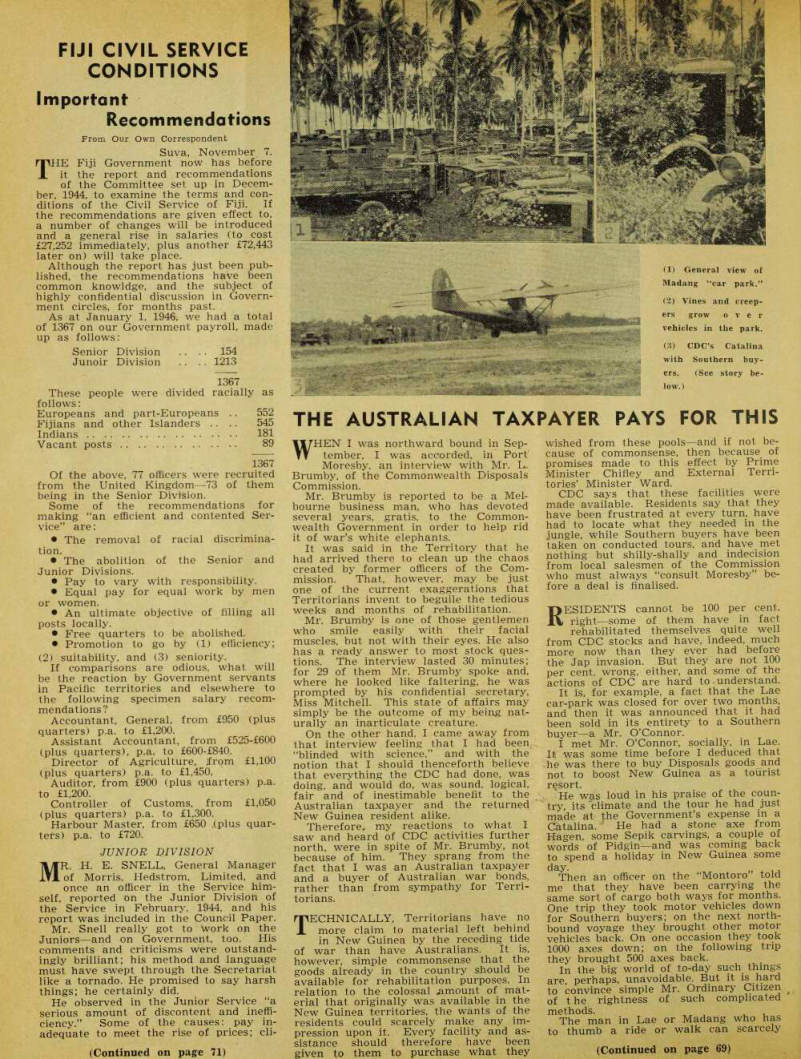
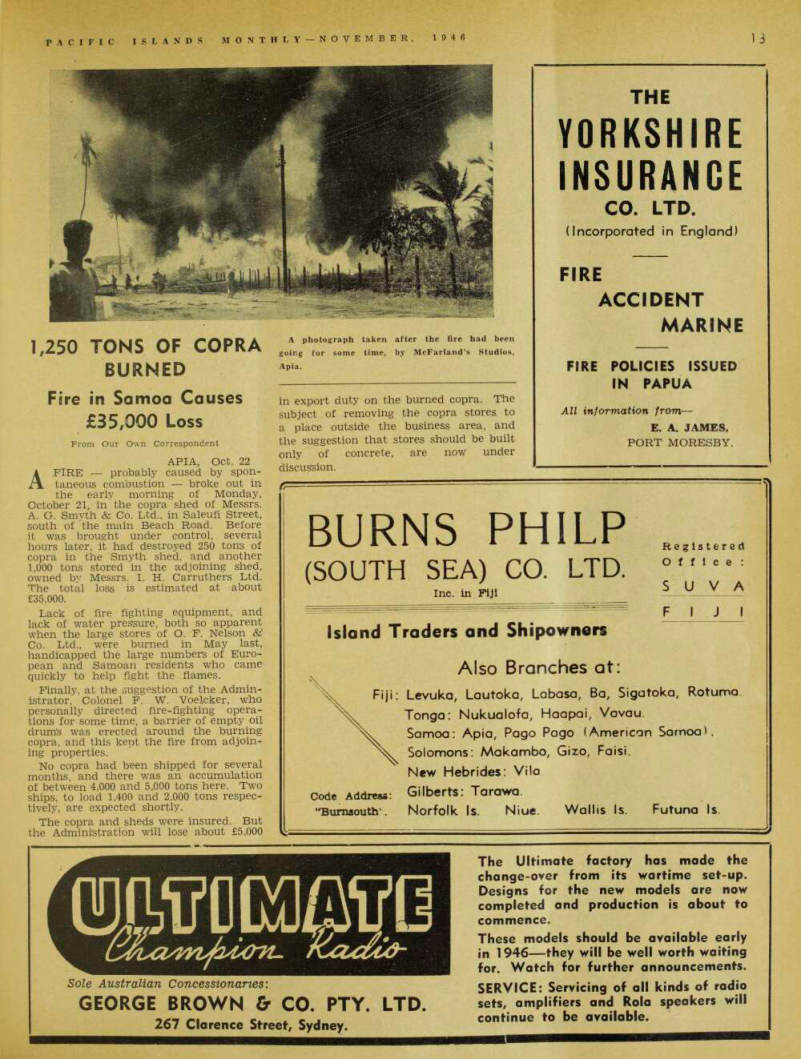
(1) General view of Madang “car park.”
(2) Vines and creep ers grow over vehicles in the park.
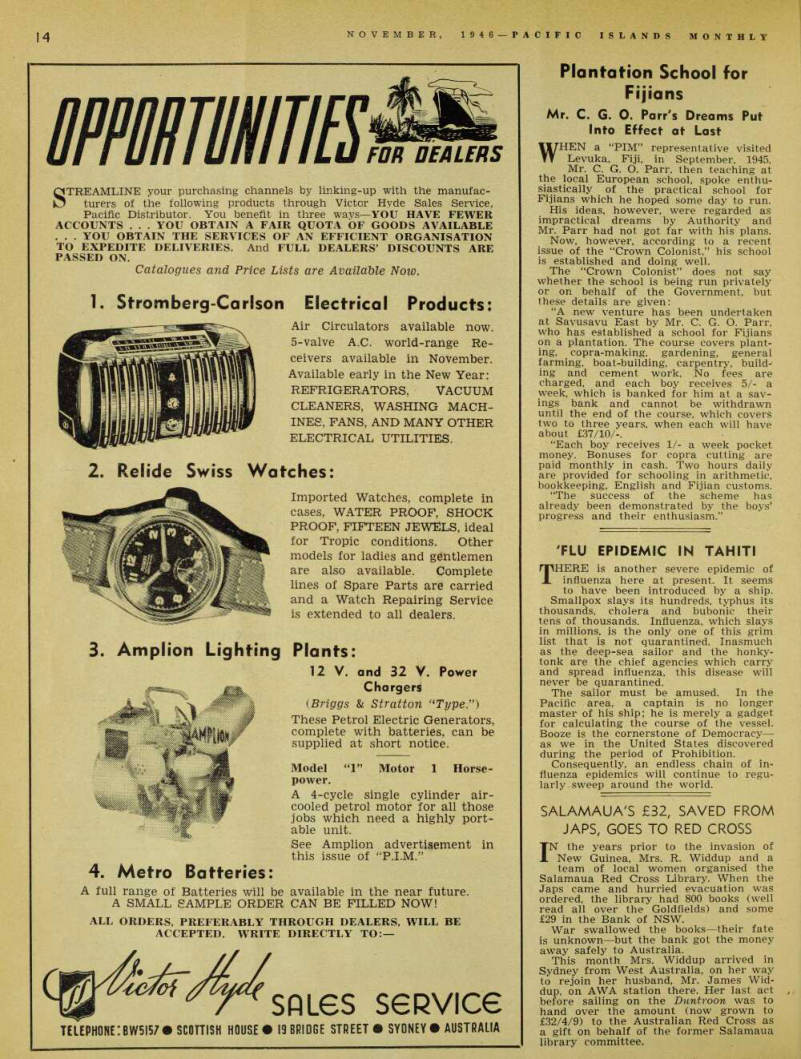
(3) CDC’s Catalina with Southern buy ers. (See story be low.)
be expected to cheer when he sees Sou thern buyers doing tours of the Terri tory in a Catalina which costs (so it is rumoured) about £2OO a day to run. Nor can one expect the would-be purchaser of axes to rejoice in buying axes in Aus tralia when he could have had them at half the price right there in New Guinea.
THE photographs reproduced here were taken in Madang. This car-park under the coconuts had, I was told, been there for over a year. They prob ably were good lorries, once.
I had to wade through creepers up to my neck to take the photographs, and the vehicles too, as can be seen, were covered with vines; the bodies were rot ting and the engines rusting.
About the time that the photographs were taken, the park was sold to a mys terious Southern buyer. It was believed that the trucks would be dismantled for their tyres, engines and other spare parts that would be of use in Australia.
Photograph (3) shows the CDC amphi bious Catalina on Madang drome. Be neath the wings is a large group of buyers who had just then returned from inspecting goods at Wewak.
NOT far from where this last photo graph was taken was a long line of RAAF tractors and vehicles in which no one seemed particularly interested; several aero engines—said to be worth £4OOO each —which had been abandoned because it was “not worth while to shift them,” and a number of crates contain ing milling machines, lathes and other power machinery.
A man who had started a repair busi
ness in Lae was interested in one of the lathes, but the price he was prepared to give was not considered sufficient. Even tually, he and the CDC will probably get together on the deal —but by that time it is likely that either some South ern buyer will have bought it, or it will have rusted away, out there in the kunai near Madang drome.
Such is the great need for motor re pairs around Lae district, it would have been sense if the Administration had pur chased the machine and presented it to the engineer in question. But such simple ways of dealing with any problem are beyond the complicated processes by which departments and governments and
countries are run in 1946.
JT.